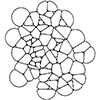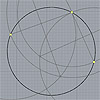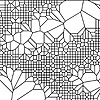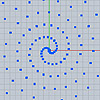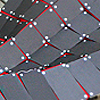
In this fun experiment, points rock and roll! It should be based on a sound input of course but this is only a test to see if I can handle a timer and graph input at the same time. I’ll modify this definition to actuate with sound. The use of the timer component gives a certain degree of randomness to the overall formation. Here is a video of the Headbanging Points […]
Author Archive
Bending is an easy operation in Rhino and Rhinoscript, however, Grasshopper did not include that particular transformation (along with cage editing) yet. I tried to simulate the bending transformation by using native Grasshopper components. First, surface projections and pulls did not work at all, because I wanted to simulate a real bending effect without changing the surface area or edge lengths. Then, the Surface Morph component seemed to handle this […]
Basic Design I exercise called “Cut and Fold: Deviation” explores diversity within relationships and material behavior. It is initially introduced by Salih Küçüktuna as a simple but effective exercise platform. Below are some students’ works on this one-week exercise. The term “deviation” has many uses in a range of fields from medicine to sociology. However, it is frequently used in statistics with an interesting evocation to design computing: In mathematics […]
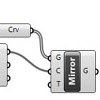
In today’s drawing class, we taught methods of drawing basic transformations by hand. Mirror was one interesting subject of that. However, then I opened Grasshopper and Rhino to test the effects of curved mirror planes. Unfortunately, I realized that there is already a curved mirror component in Grasshopper :( Here is the Grasshopper definition: [GHX: 0.9.0061] This might be one of the simplest ways of introducing generative deformations for design […]
I’ve come across this nice website about the short history of tilings and tessellations. In this post, I am regenerating a tiling of Dürer rhombii. Albrecht Dürer sounds like one of the pioneers of some of the concepts of today’s emerging field of architectural geometry. Here is a phrase from that website about Dürer; “…Like Kepler, regular polygons and polyhedra fascinated Dürer… A large section of the Painter’s Manual is dedicated to […]
While looking at the student works of my 2009 class, I realized that in some cases, the “pipe” component takes a considerable amount of time to execute even on fast computers. Students mostly create pipes to model structural frame systems such as canopies and facade frames. Therefore, the path of the pipe is usually linear (not curved). I decided to calculate the performances of three approaches that could be used […]
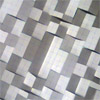
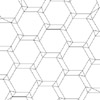
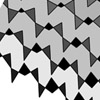
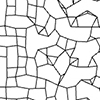
Below is some student works from this year’s Architectural Geometry / Pattern Deformations assignment. Students developed their own pattern deformation sequences mostly on regular tessellations. Based on the classical Parquet Deformation exercise, we tried to implement a rule-based approach in order to explore emergent patterns. The exercise seems to reveal endless improvisation potential. The exercise requires students to design a pattern deformation on a 28cm by 28cm area. It should […]
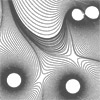
Force fields might be one of the most influential component sets of Grasshopper. Thus it also becomes a de-facto standard design approach like the Voronoi subdivision. There are beautiful examples of this mathematical solution. Here is a good explanation of mathematics underneath, and here are my previous studies. I tried to use the Grasshopper’s force field components and see how it looks like when animated. Thus, multiple spin forces are merged […]
Here is a simple description of Rhinoceros’ Printing dialog. It is the same with version 4.0, nothing changed in layout and printing dialogs in 5.0. Significantly our Architectural Geometry classes should benefit from this explanation. Most of these options should be tested with a plotter (e.g. pencil widths) before final print-outs. Also, you may try creating a PDF file of your homework from this dialog.
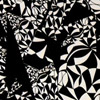
Below are some of the student works from the 4th-week exercise Bits and Pieces of this semester’s Basic Design studio. The gestalt notion of “figure-ground phenomenon” refers to the characteristic organization of perception into a figure that ‘stands out’ against an undifferentiated background. What is figural at any one moment depends on patterns of sensory stimulation. And on the momentary interests of the perceiver. Thus, the figure-ground relationship is an […]
While searching for a way to work with random points and growing populations, this idea appeared accidentally. I wasn’t trying to mimic the behavior of Karyokinesis of biological cells (in fact I’m in serious doubt about biomimicry in general). The trick is to use a timer + data recorder + a knob for the arbitrary user input. It starts to breed when you start the timer, but to change the […]
I learned this method from the open math resources website. I couldn’t help myself repeat it in Rhinoceros. It was quite fun to solve circle tangency problems in 2D, this is one of them: drawing the circle that passes three given points, not using ready-made commands but only geometric tools of the circle (compass) and ruler (line). Here is the sequence of it: First of all, we need to know […]
This was the initial example of image processing in our Parametric Modeling class. I saw this design on Maxthreads Architectural Design’s website (especially here). Hand-drawn and digital diagrams can also be digitized and used in order to describe certain parameters for design formation. Such algorithms would similarly use the Image Sampler Component of Grasshopper. In the algorithm below, image data is used to capture black pixels as attractors of a Voronoi subdivision. […]
Here is a simple explanation of the famous Euclidean Constructions: Why didn’t Euclid just measure things with a ruler and calculate lengths? For example, one of the basic constructions is bisecting a line (dividing it into two equal parts). Why not just measure it with a ruler and divide by two?One theory is the the Greeks could not easily do arithmetic. They had only whole numbers, no zero, and no […]
Grasshopper still surprises me. This definition draws a spiral by using a random component. It is obvious that the seed value of the random component has a relationship with an archimedean or a similar spiral. My intention was to create a definition to put a number of random points inside a circular area, not a rectangular one. While I grow the radius of a circle and get a t parameter […]
I at the Center is a multiple-axes vertex deformation based on a quadrangular hyperframe, designed by David Oleson at the studio of William Huff in 1964. Below, you see the original drawing and my Grasshopper animation based on a single-point attractor, creating the “I” wherever it is. It was a pleasure to read and repeat this deformation, which is a nice exercise in data tree operations and also one of the […]
This simple vb.net component controls the Rhino viewport background without a need to enter its options panel. It is used to change the viewport background color and grid visibility quickly within Grasshopper. Here is the definition file: [GHX: 0.9.0056]. In order to be able to return to default settings, I put a “default” toggle. Just click on it to “false” state, then the Rhino background color can be changed by the […]
Instead of searching for an iterated and rule-based variety, this method captures instances of spatial deformation by transforming the hyperframe. This liberates us from a classical understanding of pattern deformations that are enframed within regular polygons, mostly rectangles or hexagons. Grasshopper has a built-in component to study such variety. The spatial Deform component gets vectors as inputs and transforms any given geometric object according to it. This website has also […]
This is our eCAADe paper with Fulya Akipek, explaining our 2013 Workshop series called “Infections”. Contemporary trend of the computational design education is grounded on an integration of domains such as fabrication technologies, material studies, and generative techniques. This requires not only an intuitive handling on digital tools and methods, but also an experience on material and production constraints simultaneously. Patterning emphasizes a material shift in the generative side of […]
This is a small project of a facade study in Grasshopper, designed by KAF Architecture, and built in 2013 at Altunizade, İstanbul. KAF Architecture designed the facade with varying holes with an image of a forest. The image was supposed to generate the holes. At first, the office tried to do this manually, placing circular holes on the image in AutoCAD. However, after several hours, they thought that they needed […]