
Karyokinesis
While searching for a way to work with random points and growing populations, this idea appeared accidentally. I wasn’t trying to mimic the behavior of Karyokinesis of biological cells (in fact I’m in serious doubt about biomimicry in general). The trick is to use a timer + data recorder + a knob for the arbitrary user input. It starts to breed when you start the timer, but to change the evolution speed, just roll the knob! Of course, the knob is as precise as in other input types, but somehow it looks fuzzier to me. Combined with a time-based change, it becomes even crazier! This looks like an example of real-time animation in Grasshopper, without the need for Kangaroo.
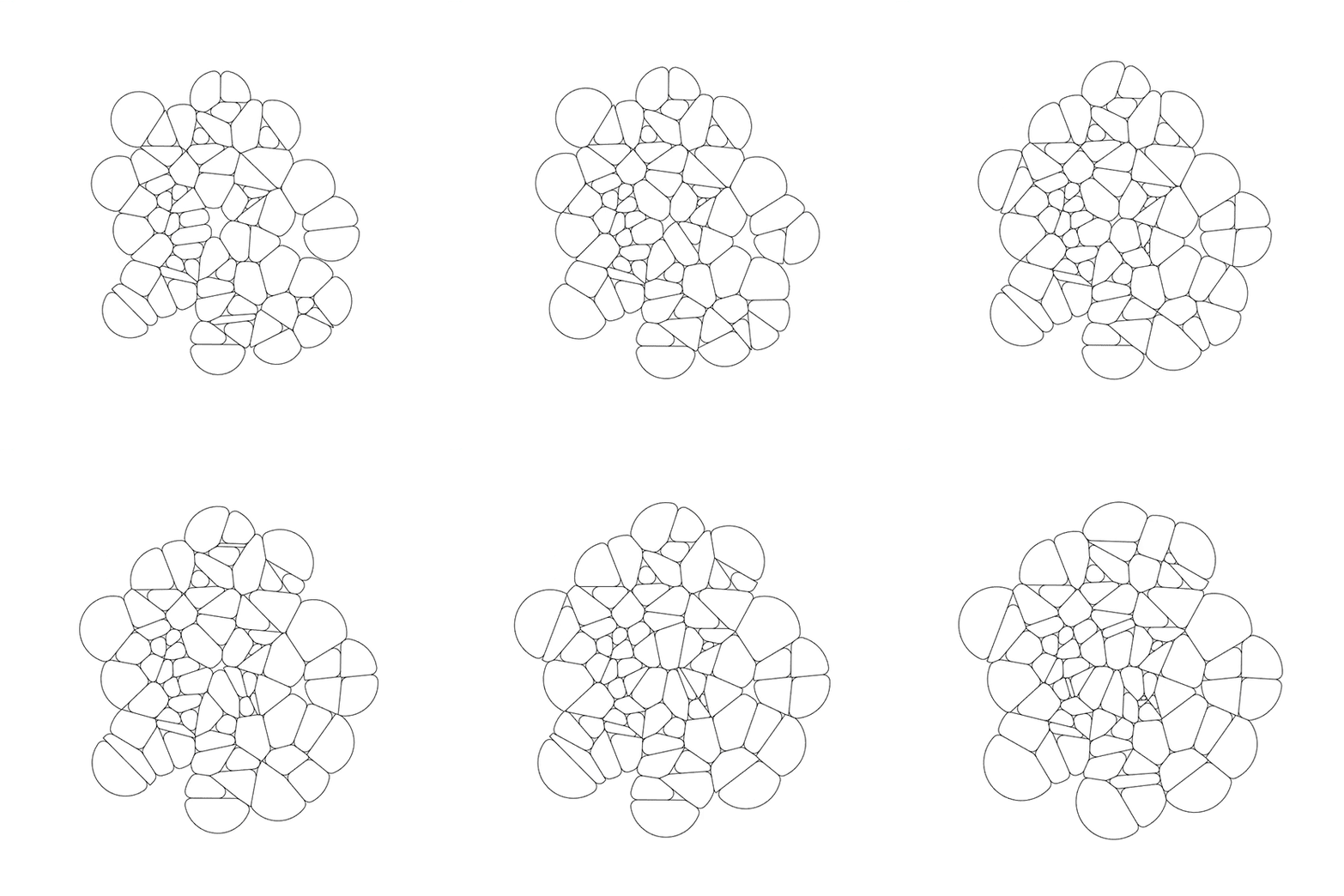
This Grasshopper definition generates an interactive animation visually resembling the cellular division. I created the parametric model in Grasshopper with native components. Thus, no add-ons are necessary for it to work. There is one VB.net script that is responsible for the timer component that re-runs the script every 20 milliseconds. The output of the model is a set of closed curves. Therefore, the outputs are ready for more exploration in Grasshopper. You can use this model further to investigate similar animations.
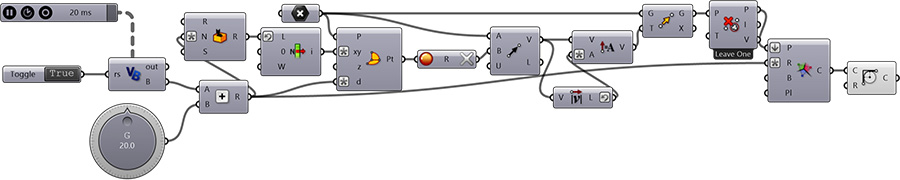
You can rebuild the definition by looking at the diagram above. The VB script includes an if condition for rs input and B=Second(now).
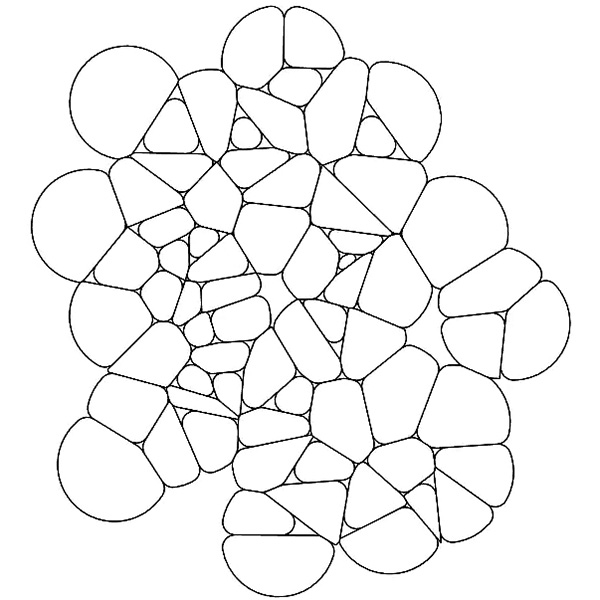
Cite this post
Related Posts
Headbanging Points
December 20, 2013
In this fun experiment, points rock and roll! It should be based on a sound input of course but this is only a test to see if I can handle a timer and graph input at the same time. I’ll modify this definition to actuate with sound. The use of the timer component gives a certain degree of randomness to the overall formation. To run this definition we need a VB script to update a certain value. The code inside of…
Fermat’s Nightmare
October 14, 2026
Revisiting a specific mathematical phenomenon that I previously explored twice, here (in 2017) and here (in 2011), from a different angle in 2026 now. This was the final video (from 2023) that I found in my junk folder during the blog’s resurrection. Today, designers mostly know Fermat through the famous 137.5-degree angle of rotation, which is the mathematical formula used to describe the arrangement of sunflower seeds. However, today I will speculate on a nightmare of Fermat’s. Because Fermat, in…
Regenerating Random Numbers
January 2, 2013
Just a quick tip as I thought might be useful in some cases. Generating random numbers in architectural scripting is not a too catchy thing for designers. It is for sure, we want every parameter to be under our control (as if it were possible!). I was thinking about that in Grasshopper. A dataflow graph such as in Grasshopper regenerates whenever necessary (a change on an input value “fires” every connected component), therefore random number component requires your action (for…
Animate Sketching of a Parametric Truss
July 25, 2012
Previous studies on the timer component were based on understanding its use. This time, I tried to implement it in a geometric design task. Moreover, manipulating the timer component to change the regular animation of parameters. Time does not have to be equally divided into sequences. Rather, new possibilities may emerge with different time flows. A simple triangulation system is developed with a potential manipulation, based on a timer. This definition is exciting and new for me because I’m not…
MusicXML to Grasshopper
July 20, 2012
We can model a musical composition using native Grasshopper components. After the experiments with the timer component (here and here), I managed to build a definition that allows us to produce outputs in various time intervals. I converted a small part of Bach’s Bouree in E-Minor into Grasshopper as a guitar tablature. I used Guitar Pro 5’s MusicXML export function to convert classical guitar tablature into XML data, then organized that file in Excel to suit my data tree design…