designcoding
About Table of Contents Keywords Monthly Archive
Support designcoding!

#curvature

8 posts

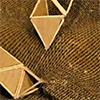
Quad Tiling on Double Curvature

April 3, 2024

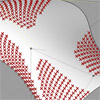
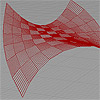
It is not possible to cover a double curvature surface with planar quads. Here is one method that overcomes quad tiling on double curvature by pulling one vertex of the quads to the plane defined by the other three. This method was used in architecture on several occasions such as the exterior facade of The Yas Hotel, designed by Asymptote Architecture in 2009. The same approach is also evident in the roof design covering the central courtyard of the Smithsonian…

Curvature Approximation by Drawing

March 14, 2024

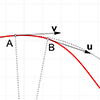
Curvature can be roughly described as how much a curve is “turning” at point a P. We place two “very” close tangents and measure the difference between them. The closer these tangents are, the more precise our approximation would be. An osculating circle is a tangent circle that has the same curvature as the curve at point P. The larger the circle, the more “flat” the curve is. An infinitely large osculating circle means the curve is linear at point…

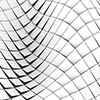
Gaussian Curvature and Surface Paneling

January 24, 2019

As the design of free-form architectural surfaces becomes easier, questioning and foreseeing the feasibility of the construction of these surfaces becomes important. Such an inquiry requires sufficient knowledge of architectural geometry besides the knowledge of materials and structural systems. In this article, we present a preliminary example of a guide. It supports the design and production process of building surfaces with different geometric properties is presented. This guide aims to reveal the relationship between Gaussian curvature and surface paneling. It…

Designing with Grasshopper

May 2, 2012

Today, there are pedagogical and practical challenges on the use of algorithms in architectural design, as computer puts not only a physical but also a cognitive layer between designer and the subject. Formulation of this cognitive layer is becoming important, regarding which model of computing is used to connect designer with the subject. Is it a “designerly” search, or design exploration in a visual programming environment? As most of the researchers admit that visual programming environments are very effective in generating variations,…

Points by Curvature

April 26, 2012

This is the basic form of a surface division, based on curvature. As each point on the surface has a curvature value, this might be used to dispatch those values and see the points at flat and curved parts of the surface. I used my favourite surface equation definition (here) as implemented equation of cos(x)+cos(y) in the animation below.

Monkey Saddle Surface

April 8, 2012

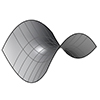
This is another popular “math surface” being rediscovered by designers nowadays, in 2012. Saddle surfaces, seen above as mentioned earlier (here) have a special type named “Monkey Saddle Surface”. This surface was a dramatic example of how Grasshopper can control equations and instantly show graphical results. The mathematical equations start with Z=… this makes it very easy for us to transform any x-y grid centers (a 2d data tree of 3d points) and add z values to them according to…

Surface Components Basics

January 17, 2012

This is a basic formation of component-based design in a dataflow environment. A double-curved surface is subdivided and re-constructed using straight sections. Parametric model of a surface construction by variable components. The main data list of subsurfaces are distributed into four distinct lists, that will be used to construct lines out of double-curved quadrilateral faces. Such definitions could be further advanced by adding a precise fabrication detail.

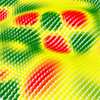
Surface Component based on Gaussian Curvature

December 22, 2011

This experiment is based on a traditional surface-component definition. However, the variation of components is associated with Gaussian curvature. We just control the subdivision and a multiplier value. Results are interesting in as an educational tool to explain NURBS surface curvature and its utilization for Design Geometry. Different surface shapes generate exciting results. Of course, this could be much improved by recognizing positive and negative curvature values, (probably only accepting positive ones maybe).

  • Chapters

    • Algorithms
    • Discourses
    • Fabrications
    • Studios
  • Explore

    • All Keywords
    • Table of Contents
    • Monthly Archive
    • #cuboctahedron
    • #concrete
    • #boolean
    • #le-corbusier
    • #revit
    • #vector
    • #hilbert
    • #designcoding
    • #escher
    • #computational-geometry
    • #dürer
    • #cairo-pentagonal
    • #unrolling
    • #solar-analysis
    • #cycloid
    • #semi-regular
    • #tree
    • #galapagos
    • #grid
    • #dual
  • Search

  • Support designcoding!

  • Enjoying designcoding? Support me on Patreon to keep it growing. Thank you!

  • copyright 2026 designcoding.net | about | privacy policy | end user license agreement