designcoding
About Table of Contents Keywords Monthly Archive
Support designcoding!

#boolean

8 posts

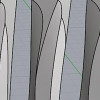
Interlocking Structure with Boolean

August 23, 2026
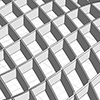
You are seeing the last of the interlocking system trials that I have previously tested in two exercises. If you remember, in our first trial, we were drawing interlocking joinery details on cross-sections using closed curves, without any solid modeling. And here is the most advanced one, I guess. In this exercise, however, we are creating a solid model that incorporates these interlocking details. This time, we will look at how to construct the same system using Boolean operations. Boolean…
Parametric Pendentives

August 1, 2024

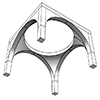
A pendentive is an architectural feature used in domed structures. It is a triangular section of a sphere that allows for the transition from a square or polygonal base to a circular or polygonal dome. Pendentives curve upward from the corners of the base and support the dome above. They help distribute the dome’s weight more evenly and enable the construction of a dome over a non-circular base. I created this Grasshopper model using a technique I had previously presented…

Spooning

July 6, 2024

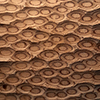
Urban Atölye, led by architect Nilüfer Kozikoğlu initiated the development of this Grasshopper code. The concept was to create a random relief pattern on a surface to be carved out using CNC technology. In Turkish, this technique is referred to as “kaşıklama,” as the resulting shapes resemble those carved out by a spoon. Consequently, I named this Grasshopper definition “spooning.” The definition employs the Populate Geometry component to achieve a random distribution. However, you can further refine it to allow…

Gaudi Column Macro

March 7, 2015

Gaudi-like columns are generated as part of the “boolean” classes of Design Computing. The most inspiring, beautiful, and ugly variations are often done by boolean intersection, as this operation is the surprising one of the three brothers. While the class deals with the concept of emergence once again via solid and void relationships, constructive solid modeling techniques are introduced. Although it is widely used as a spatial analysis approach in architecture, there are some examples of using boolean algebra in…

Void by Subtraction

April 16, 2014

Here is the winning team of this year’s mid-term jury competition in the first-year Basic Design studio at İstanbul Bilgi University. The challenge they undertook was called “Void by Subtraction.” Initially, the students engaged in a series of short-term exercises exploring solid and void relationships. Alongside the studio sessions, they honed their digital modeling skills through Architectural Geometry courses. Their task was to create a contoured structure within a restricted 8m3 volume. Through various iterations using clay and foamboard prototypes,…

Macroforming WFC Shanghai

April 19, 2013

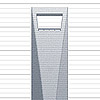
WFC Shangai is a design exercise in our first-year Design Computing class introduced by Onur Yüce Gün. This exercise emphasizes both analytical thinking and associative geometry and aims to utilize boolean operations as solid and void references in creating forms. We asked students to develop variations of this building. In order to discuss this formation in class, I studied a simple algorithm to test variations in real-time. The initial shape, developed by a boolean intersection of a rectangular prism and…

Porous Solids

April 16, 2013

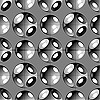
This is a solid-void (or boolean) exercise for first-year students. It is initially introduced by Onur Yüce Gün as an in-class exercise but later became a design problem also. Before getting into the parametric wall and eventually muqarnas exercises, this small but effective assignment helps students understand some of the fundamental concepts such as associativity, solid/void relationships, and component-based design compositions in three dimensions. Here is the initial object we used to introduce in the design computing class: As you…

Interlocking Structure (No Boolean)

January 2, 2012

It has been a tough problem for me, for the last two days. A parametric model of an interlocking structure (sometimes also called egg-crate, waffle, or contouring structure) can be created easily in Grasshopper using a Contour component. In addition, you need a couple of list management operations and a boolean (or region) difference event. However, Rhino and Grasshopper are very slow at calculating boolean differences on both solids and surfaces. Fabrication models of such structures don’t have to be…

  • Chapters

    • Algorithms
    • Discourses
    • Fabrications
    • Studios
  • Explore

    • All Keywords
    • Table of Contents
    • Monthly Archive
    • #space-syntax
    • #revit
    • #paneling
    • #computational-geometry
    • #moebius
    • #quad
    • #enneahedron
    • #dürer
    • #fibonacci
    • #circle
    • #platonic-solid
    • #contouring
    • #ice-ray
    • #graph-mapper
    • #sphere
    • #truchet
    • #phenomenology
    • #gyroid
    • #design-competition
    • #rammed-earth
  • Search

  • Support designcoding!

  • Enjoying designcoding? Support me on Patreon to keep it growing. Thank you!

  • copyright 2026 designcoding.net | about | privacy policy | end user license agreement