
Porous Solids
This is a solid-void (or boolean) exercise for first-year students. It is initially introduced by Onur Yüce Gün as an in-class exercise but later became a design problem also. Before getting into the parametric wall and eventually muqarnas exercises, this small but effective assignment helps students understand some of the fundamental concepts such as associativity, solid/void relationships, and component-based design compositions in three dimensions. Here is the initial object we used to introduce in the design computing class:

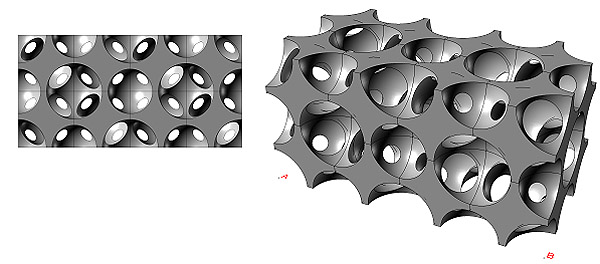
As you see, the component is developed in a fashion that fits well within a composition driven by a simple “mirror” rule. Our in-class assignment was to develop an alternative to the above method. Özgüç introduced interesting variations of these compositions so-called Porous Solids:

Below are some very interesting crystal formations studied by Fiona Meldrum on her website called “Bio-inspired materials chemistry” (here):
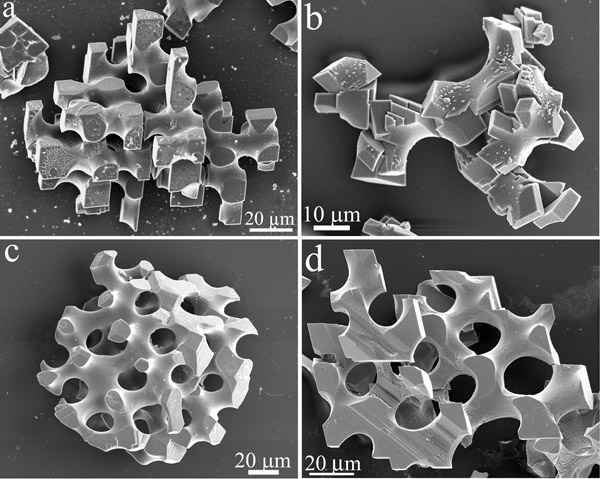
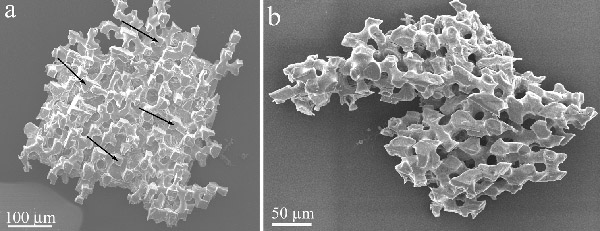
And below is another example, a porous metal foam;
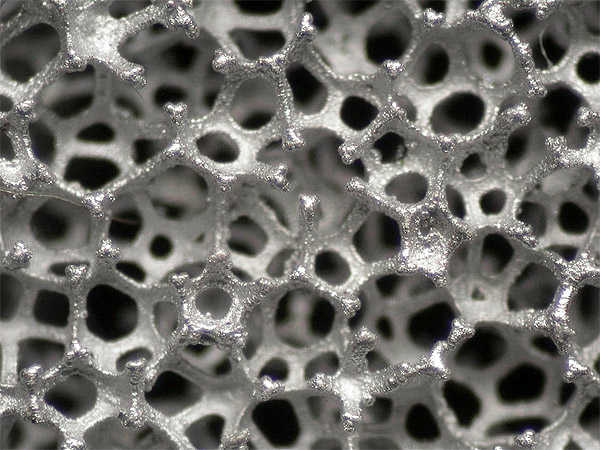
…Celmet is a porous metal made from nickel or nickel chrome alloy. The porous metal manufacturing process comprises electro conductive coating to plastic foam, followed by nickel plating and plastic foam removal by heat treatment. Celmet’s features include high porosity (up to 98%), considerably higher than other porous metals, such as nonwoven metal fabric and foam metal; it also features a three-dimensional mesh-like structure that forms interconnected, open and spherical pores. Moreover, it is easy to process the porous metal into various shapes by cutting and stamping…
Inspiringly beautiful.
Cite this post
Related Posts
Macroforming WFC Shanghai
April 19, 2013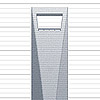
WFC Shangai is a design exercise in our first-year Design Computing class introduced by Onur Yüce Gün. This exercise emphasizes both analytical thinking and associative geometry and aims to utilize boolean operations as solid and void references in creating forms. We asked students to develop variations of this building. In order to discuss this formation in class, I studied a simple algorithm to test variations in real-time. The initial shape, developed by a boolean intersection of a rectangular prism and…
Gaudi Column Macro
March 7, 2015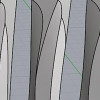
Gaudi-like columns are generated as part of the “boolean” classes of Design Computing. The most inspiring, beautiful, and ugly variations are often done by boolean intersection, as this operation is the surprising one of the three brothers. While the class deals with the concept of emergence once again via solid and void relationships, constructive solid modeling techniques are introduced. Although it is widely used as a spatial analysis approach in architecture, there are some examples of using boolean algebra in…
Escher Patterns in the Classroom
August 22, 2017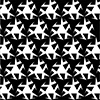
Here is one of the exercises I tested with a few students in Architectural Geometry. The exercise is about creating Escher-like patterns. It is an introductory topic on the designerly utilization of regular tessellations. We use square, hexagonal, or triangular tessellations as underlying structures of complex patterns. Below are some of the student works from this exercise. I think the black-and-white coloring helps in terms of reducing the requirements. Although the patterns designed in this exercise are not Escher patterns,…
Low-Poly Habitat
August 7, 2017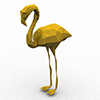
Below is a simple tutorial class we studied in Rhino in 2015 and 2016. The exercise is called “A Low-Poly Habitat”. The aim is to create simple polygon models by analyzing the overall geometric topology of an animal body. First-year design students attended the exercise and they are encouraged to create these models using blueprints from www. They used simple commands such as point, line, and surface from 3 or 4 points and that’s all. Such exercises (hopefully) help them…
Design Geometry Final Works
February 2, 2015
Classical folding methods were subjects to be tested and studied in this semester’s design geometry classes. This has been very useful in introducing first-year students to 3d euclidean constructions and using physical objects as references to a digital model. Groups of students studied different folding methods and made both physical and digital models. Two of these methods were dominant in the class however, one of them was the variations of Miura-Ori, and the other one was Ron Resch’s famous folding pattern. Below…