designcoding
About Table of Contents Keywords Monthly Archive
Support designcoding!

#icosahedron

8 posts

Modeling Stellated Icosahedron

December 14, 2024

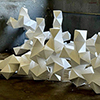
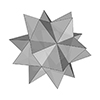
Stellation of polyhedra refers to the process of extending the faces (or edges) of a polyhedron outward to form new, more complex shapes. These new shapes, called stellations, are created by adding extra vertices, edges, and faces that “project” outward from the original polyhedron’s structure. You can create an infinite number of new polyhedral forms, depending on how you extend the faces and edges. In this short tutorial video, I am modeling a stellated icosahedron. I use basic modeling commands…

Modeling Dual of Dodecahedron

December 14, 2024

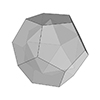
A dual polyhedron is a concept in geometry where two polyhedra are related in such a way that the vertices of one polyhedron correspond to the faces of the other, and the faces of the first polyhedron correspond to the vertices of the second. The process of creating a dual polyhedron is called duality, and it applies to many regular, semi-regular, and some irregular polyhedra. In the case of Platonic solids, the cube and octahedron are duals of each other….

Modeling and Unrolling Icosahedron

December 12, 2024

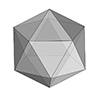
An icosahedron is a three-dimensional polyhedron with twenty triangular faces, twelve vertices, and thirty edges. It is one of the five Platonic solids and is highly symmetrical, with all faces being equilateral triangles. A regular icosahedron has equal edge lengths and angles between its faces, making it one of the most symmetrical shapes in three-dimensional space. In this short tutorial video, I am modeling and unrolling an icosahedron. I studied this beautiful solid here, here, and here before. The Icosahedron…

Icosahedron Study

May 27, 2012

I have come across several high school topics I was afraid of. While I was searching for a geodesic dome definition in Grasshopper, it was quite surprising that I found an easier way of modeling an approximation of icosahedron, the famous platonic solid. Icosahedron was a research topic of this website at various posts before (here, here, and here). In order to generate geodesic spheres, first I had to solve icosahedron. My first experiment was partially successful. I knew icosahedron’s…

Modeling a Geodesic Sphere

May 23, 2012

Not all of them, but when you get the idea, you’ll see there are lots of different alternatives for creating Fuller’s famous Geodesic Domes (Although in fact, he is not the inventor of it). I was playing with Platonic Solids in Rhino and realized that the “Pull” command is very useful in subdividing objects. I modeled this in Rhino 4. First, take a regular Icosahedron and divide it. Because, this is the simplest way for modeling a Geodesic sphere, by…

Icosahedron by Code

April 5, 2012

I tried different approaches to drawing platonic solids using Grasshopper’s native components. However, it seems impossible now. In geometric definition, a platonic solid is a set of points, distributed on a sphere with equal distances. If the set contains 12 points, then it’s an icosahedron. I found lots of information about these objects and mathematicians seem to love analyzing them. They created different approaches to building an icosahedron. One of them is very suitable to implement on Grasshopper’s VB component….

Icosidodecahedron

December 22, 2011

Icosidodecahedron is an Archimedian Solid, a thing in between the Platonic Solids of Icosahedron (d20) and Dodecahedron (d12). It is a rectified version of an Icosahedron, constructed by dividing every edge into two equal segments and joining these segments to create a composition of equilateral pentagons and triangles. Archimedian Solids consist of at least two equilateral polygons, whereas Platonic Solids are constructed by only one. We’ll deduce an Icosidodecahedron from Icosahedron below; First, you should create an Icosahedron, the Platonic…

Modeling an Icosahedron

December 21, 2011

Today’s polyhedra is the beautiful icosahedron. It is one of the five Platonic Solids with twenty equilateral triangular faces. Its dual is the dodecahedron, which has pentagonal faces. Here, I explained the process of modeling an icosahedron. After creating a regular pentagon, you should find the “tip” point of the Icosahedron by intersecting spheres from at least three of the corner points with a radius of the pentagon’s edges. You can exercise Tetrahedron to understand how we find a point…

  • Chapters

    • Algorithms
    • Discourses
    • Fabrications
    • Studios
  • Explore

    • All Keywords
    • Table of Contents
    • Monthly Archive
    • #geodesic
    • #gyroid
    • #regulations
    • #unity
    • #gosper-curve
    • #arduino
    • #music
    • #hyperbolic-paraboloid
    • #processing
    • #timer
    • #space-filling
    • #galapagos
    • #cube
    • #archimedean-solid
    • #dürer
    • #weaire-phelan
    • #deformation
    • #visualization
    • #kuka-prc
    • #lissajous
  • Search

  • Support designcoding!

  • Enjoying designcoding? Support me on Patreon to keep it growing. Thank you!

  • copyright 2026 designcoding.net | about | privacy policy | end user license agreement