
Modeling a Geodesic Sphere
Not all of them, but when you get the idea, you’ll see there are lots of different alternatives for creating Fuller’s famous Geodesic Domes (Although in fact, he is not the inventor of it). I was playing with Platonic Solids in Rhino and realized that the “Pull” command is very useful in subdividing objects. I modeled this in Rhino 4. First, take a regular Icosahedron and divide it. Because, this is the simplest way for modeling a Geodesic sphere, by creating two kinds of struts (not all of the struts are equal). You can check this post for modeling an Icosahedron. Then, we triangulate and normalize the faces (pulled onto the bounding sphere). Here is an animation of this process:
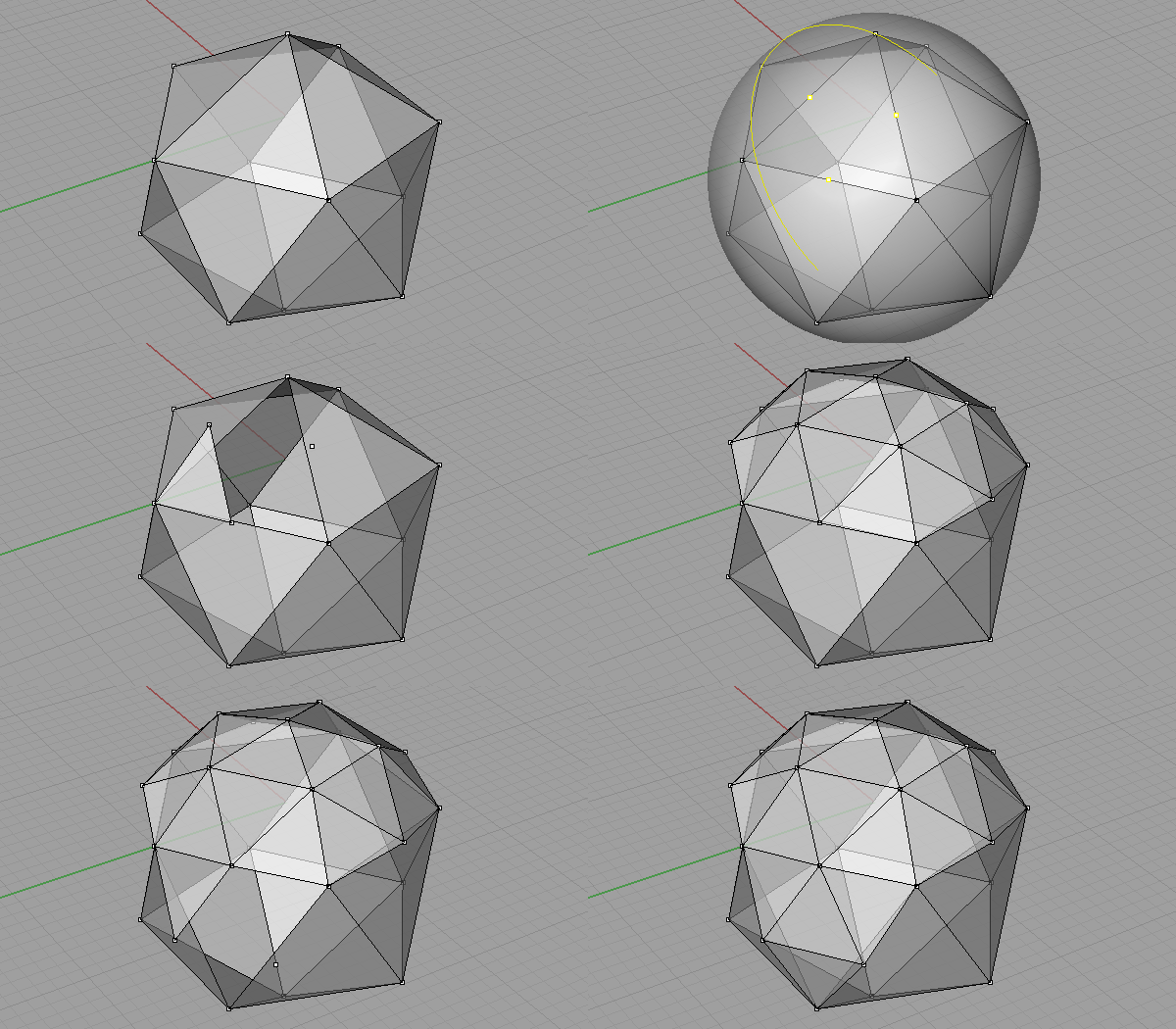
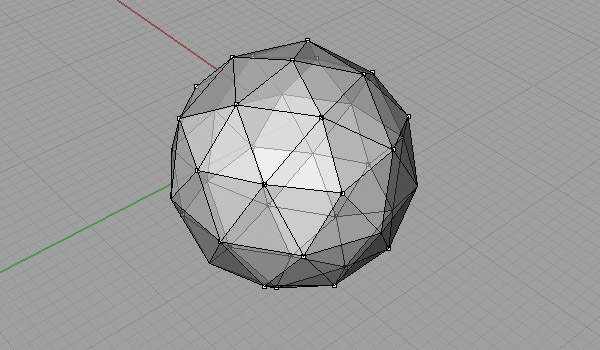
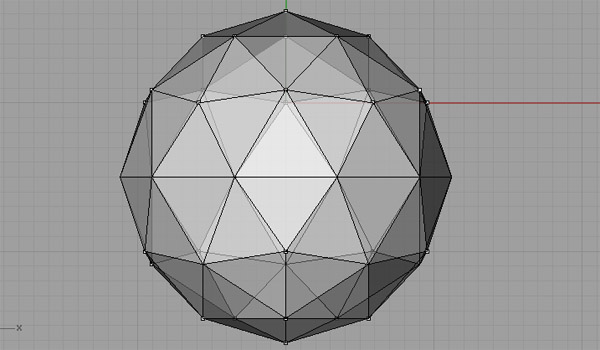
This website is full of details and alternatives to this interesting practice of modeling a Geodesic Sphere.
“…Now, also, to introduce another principle, which is dealing in great circles and spheres, and the word GEODESIC. Geodesic means the most economical relationship between events between any two events. The great circles on spheres are geodesics. There is a shorter distance between any two points on a sphere on the great circle than there is on any of the lesser circles. A great circle is defined as a line formed on the sphere by a plane going through cutting through the center of the sphere. The equator is just such. Each of the planes of longitude goes through the center of the sphere so those are great circles…”
Buckminster Fuller, “Everything I Know”, Session 2, Part 6
Cite this post
Related Posts
Geodesic Dome
January 28, 2024
Geodesic refers to the shortest path between two points on a curved surface. It is based on the principles of geodesy, which is the science of measuring the Earth’s shape. On the other hand, in architecture and design, a geodesic dome is a spherical or hemispherical structure consisting of a network of geodesic lines (great-circle arcs) forming triangles. Therefore, the dome’s framework provides strength and stability, distributing stress throughout its structure. Buckminster Fuller popularized and developed the concept of the…
Fibonacci Sphere
April 12, 2023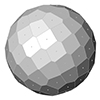
This website explains the problem and several solutions. I managed to implement the formulas to convert a 2D square grid into spherical coordinates. The Fibonacci Sphere is one of the solutions to the equal distribution of points on a sphere. It is not the best solution to this problem. But it is regarded as a quick and efficient one. Suitable for me. I developed this Grasshopper code by studying the above website and some other sources. The code starts with…
Spherical Cycloid
April 2, 2024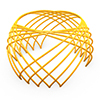
Today’s beautiful curve is the spherical cycloid. It is a cycloid, rolling on a 3d circular path rather than a straight and 2d one. There are algebraic explanations of this curve. Therefore, I find it interesting to experiment with them, since it is more interesting than the regular planar cycloids, epicycloids, and hypocycloids. This curve is believed to have been studied first by Jean Bernoulli in 1732. The interesting and playful part of this is the resulting curve is always…
Modeling and Unrolling Mecon
December 14, 2024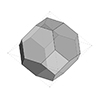
The truncated octahedron is an Archimedean solid, characterized by a mix of hexagonal and square faces, and it has a very symmetrical and regular structure. Buckminster Fuller called this solid “Mecon”. The truncation process includes the cutting the edges of a polyhedron. We do this by dividing every edge of the polyhedron into 1/3s. Then, we carefully re-connect these division points to generate new, planar polygons. In the case of a truncated octahedron, we transform the 8 regular triangular faces…
Modeling and Unrolling Dymaxion
December 14, 2024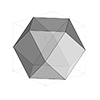
Buckminster Fuller used the term “dymaxion” for a variety of his designs, and one of these was the dymaxion map. It was based on the geometry of a polyhedron. While the dymaxion map is more directly related to the icosahedron, Fuller’s work often involved using other polyhedral shapes. One of them is the cuboctahedron. He used this term for various conceptual and practical designs, particularly in the context of his ideas on efficiency and structure. The cuboctahedron itself is notable…