
Modeling and Unrolling Mecon
The truncated octahedron is an Archimedean solid, characterized by a mix of hexagonal and square faces, and it has a very symmetrical and regular structure. Buckminster Fuller called this solid “Mecon”. The truncation process includes the cutting the edges of a polyhedron. We do this by dividing every edge of the polyhedron into 1/3s. Then, we carefully re-connect these division points to generate new, planar polygons. In the case of a truncated octahedron, we transform the 8 regular triangular faces into 8 regular hexagons and 6 squares. In this short tutorial video, I am showing this process of modeling and unrolling the mecon in Rhinoceros software. This is a beginner exercise in the basic modeling and transformation commands.
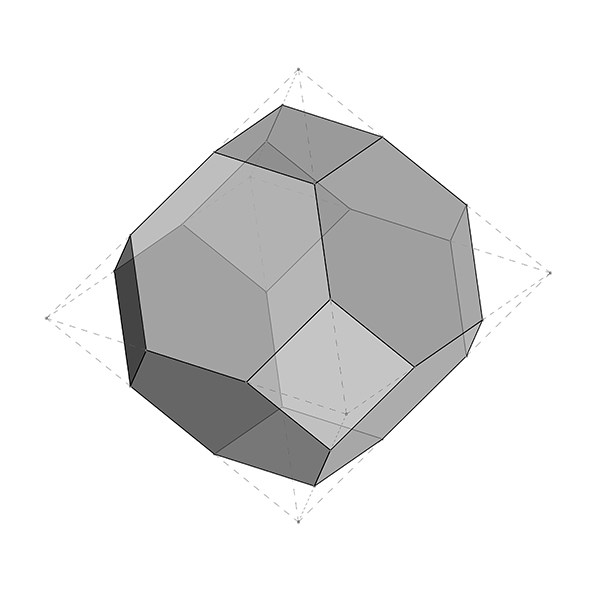
This video series showcases various in-class exercises I conducted in a freshman-year Architectural Geometry course. Using Rhinoceros software, we explore Euclidean constructions, basic drawing and transformation commands, fundamental fractals, regular and semi-regular tessellations, patterns, and modeling techniques, including unrolling polyhedra. These short drawing exercises are also beneficial for junior-level architects, interior designers, industrial designers, and enthusiasts from other disciplines. I will be publishing exercises each week on my blog and other platforms. So, here is today’s exercise on modeling and unrolling Mecon.
The software used in this course is Rhinoceros 3d (www.rhino3d.com). However, if you want to find out more and see the whole list of this video series, you can check my YouTube channel at www.youtube.com/@designcodingnet. The music of this video is ‘Luminance’ by Scott Buckley (CC-BY 4.0). www.scottbuckley.com.au
Cite this post
Related Posts
Modeling and Unrolling Dymaxion
December 14, 2024
Buckminster Fuller used the term “dymaxion” for a variety of his designs, and one of these was the dymaxion map. It was based on the geometry of a polyhedron. While the dymaxion map is more directly related to the icosahedron, Fuller’s work often involved using other polyhedral shapes. One of them is the cuboctahedron. He used this term for various conceptual and practical designs, particularly in the context of his ideas on efficiency and structure. The cuboctahedron itself is notable…
Modeling and Unrolling Buckyball
December 14, 2024
A Buckyball, (or Fullerene), is a molecule of 60 carbon atoms with a structure resembling a soccer ball. It is a specific type of fullerene, often referred to as C60, where the carbon atoms form a series of pentagons and hexagons in a pattern that creates a spherical shape. This structure is similar to the arrangement found in a truncated icosahedron, with 12 pentagonal and 20 hexagonal faces. The buckyball is named after architect Buckminster Fuller, who popularized geodesic domes,…
Modeling and Unrolling Truncated Tetrahedron
December 14, 2024
Truncation in mathematics and geometry refers to cutting off parts of a shape, typically the vertices, edges, or other extremities, to create a new modified figure. This process is often used with polygons, polyhedra, or functions. A truncated tetrahedron is a polyhedron we can derive from a regular tetrahedron by truncating (cutting off) its four vertices. This process creates a new shape with additional faces while maintaining its symmetry. In this tutorial video, I am modeling and unrolling a truncated…
Modeling and Unrolling Truncated Tetrahedron
March 10, 2024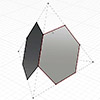
Truncation refers to the process of shortening something by removing parts. You can apply truncation to numbers, text, or data in various contexts. A truncated polyhedron is a geometric solid formed by truncating the vertices of a regular polyhedron. Truncation involves cutting off the corners or vertices of the polyhedron in such a way that the original faces become polygons with new edges. This process creates new faces at the truncated vertices. It often results in a shape that is…
Modeling and Unrolling Octahedron
December 12, 2024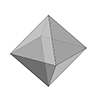
An octahedron is a three-dimensional polyhedron with eight triangular faces, six vertices, and twelve edges. It is one of the Platonic solids and has high symmetry, with all of its faces being equilateral triangles. A regular octahedron can be visualized as two pyramids joined at their bases. It has the same number of faces as a cube has vertices, and the same number of vertices as a cube has faces. The octahedron is also dual to the cube, meaning that…