designcoding
About Table of Contents Keywords Monthly Archive
Support designcoding!

#vector-field

13 posts

Differential Growth

June 16, 2025

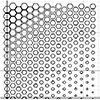
Differential growth is a process where different parts of a structure grow at different rates, leading to complex forms. After watching this, I decided to try it in Grasshopper. Here, differential growth mimics this behavior by applying rules such as Repulsion to avoid crowding or overlapping, Cohesion to keep parts connected or within a range, and Insertion to add new elements when a part stretches too far. The algorithm I present here simulates a differential growth process starting from a…

Parametric Bricks

January 17, 2024

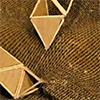
In 2016, archi-union architects and fab-union intelligent engineering completed the renovation of the art gallery in Shanghai, China. The distinctive feature of the building was the robotic masonry fabrication of the brick facades. The undulating and waving parametric bricks were increasingly becoming popular after the introduction of parametric design tools such as Grasshopper and the works of Gramazio & Kohler at ETH Zurich since 2008, I guess. I made two Grasshopper experiments in 2012 and 2013 to generate such structures….

Vector Fields Exercise

April 4, 2023

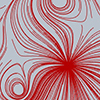
Fields is a native group of components available since the very early version of Grasshopper. In today’s Design Computing class, we studied it again with the first-year design students. I studied these interesting and beautiful shapes earlier here, here, here, and here. The one you see below is a short in-class exercise about vector fields. The exercise aims to show the Grasshopper’s capabilities in form-finding studies via Field Lines. The definition starts with the generation of a set of random…

Canopy of Vector Fields

April 26, 2015

Utilizing “Force Field” components of Grasshopper to show my students how it is easy to develop flexible surfaces in design. The classical parametric canopy design is introduced in this video: In vector calculus, a vector field is an assignment of a vector to each point in a subset of space. A vector field in the plane, for instance, can be visualized as a collection of arrows with a given magnitude and direction each attached to a point in the plane….

Force Fields in Grasshopper

March 17, 2015

Finally, I had a chance to test and understand the force fields tab in Grasshopper. It creates a continuous vector field inside of a given boundary. Therefore, it is very useful if you want to create an effect of the continuous presence of a force, such as gravity. The Wikipedia definition of a vector field is very basic and understandable: In vector calculus and physics, a vector field is an assignment of a vector to each point in a subset of space. For instance, a vector field in the…

Force Fields in ARCH362

March 17, 2015

This year’s Parametric Modeling class starts with some of the very basic use of Grasshopper concepts. This definition is a practical start-up of using force fields in the architectural design process. However it does not compute any physical phenomena (such as circulation of people, wind, or anything else), but shows a simple way to tell Grasshopper about walls that push the field, and points that pull the field. I’ll post more of this kind of basics, hopefully along with some student…

Landscape Extensions Final: Digital Sketch

February 1, 2015

This is the final Grasshopper sketch of our graduate studio conducted together with Fulya Akipek at Yıldız Technical University Computational Design Unit. The project was about designing parametric “Landscape Extensions” at Kabataş Park in İstanbul. I hope I’ll be able to post the actual student works and the material system, but now; only the final result of the digital sketch we’ve developed together with students is presented here. This was a kind of “sketchy” definition that came up as an…

Edge Bundling

February 17, 2014

I’ve been searching for a way to implement edge bundling on Grasshopper. It is an effective visualization technique that you can use in connectivity diagrams. There are a couple of different approaches to this problem. It is a nice way to analyze common paths within crowded graphs. I’ve found several entries in the Grasshopper blog about this subject, but only implementing Kangaroo seemed to be a complete solution. My approach is of course not a scientific one, but after the…

Force Fields Revisited

November 2, 2013

Force fields might be one of the most influential component sets of Grasshopper. Thus it also becomes a de-facto standard design approach like the Voronoi subdivision. There are beautiful examples of this mathematical solution. Here is a good explanation of mathematics underneath, and here are my previous studies. I tried to use the Grasshopper’s force field components and see how it looks like when animated. Thus, multiple spin forces are merged together in this definition. Therefore, the overall effect of field…

Force Fields

April 26, 2013

I’ve seen beautiful examples of similar compositions made using vector field components in Grasshopper. I just tried to make my own animate field lines to see how they float over force dynamics. In essence, these compositions could also be done using regular vector components but the field components make life much easier by merging different forces together rather quickly. As you see below, it is a quite small definition that creates beautiful complexity. Although we know every single parameter of a…

1 2 »
  • Chapters

    • Algorithms
    • Discourses
    • Fabrications
    • Studios
  • Explore

    • All Keywords
    • Table of Contents
    • Monthly Archive
    • #voronoi
    • #snub-square
    • #wave
    • #curvature
    • #parametric-curve
    • #revit
    • #sandblasting
    • #vbnet
    • #sinan
    • #philosophy-of-language
    • #vector-field
    • #simulation
    • #dürer
    • #art
    • #kuka-prc
    • #galapagos
    • #quad
    • #design-competition
    • #euclidean-construction
    • #computational-geometry
  • Search

  • Support designcoding!

  • Enjoying designcoding? Support me on Patreon to keep it growing. Thank you!

  • copyright 2026 designcoding.net | about | privacy policy | end user license agreement