
Differential Growth
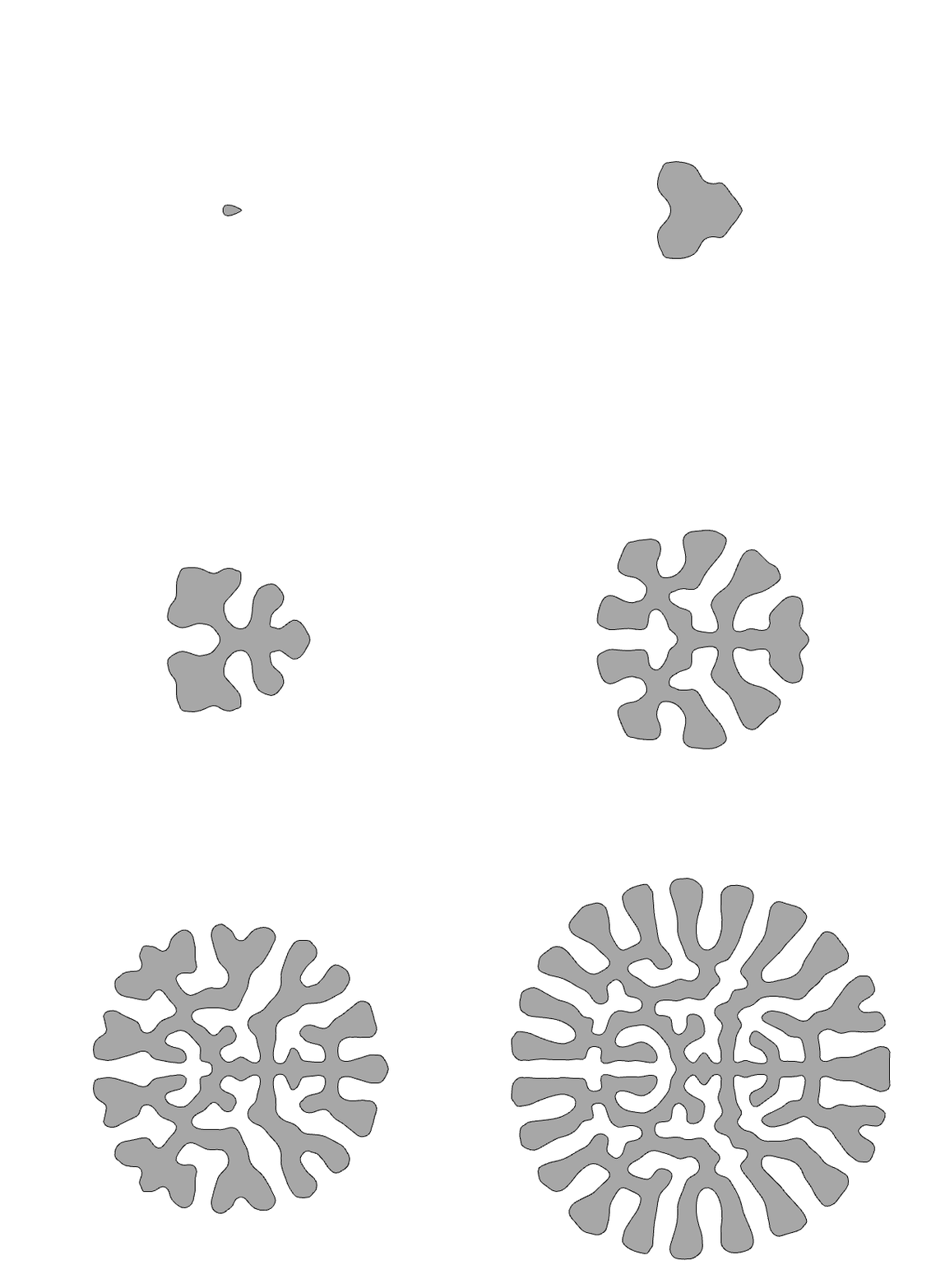
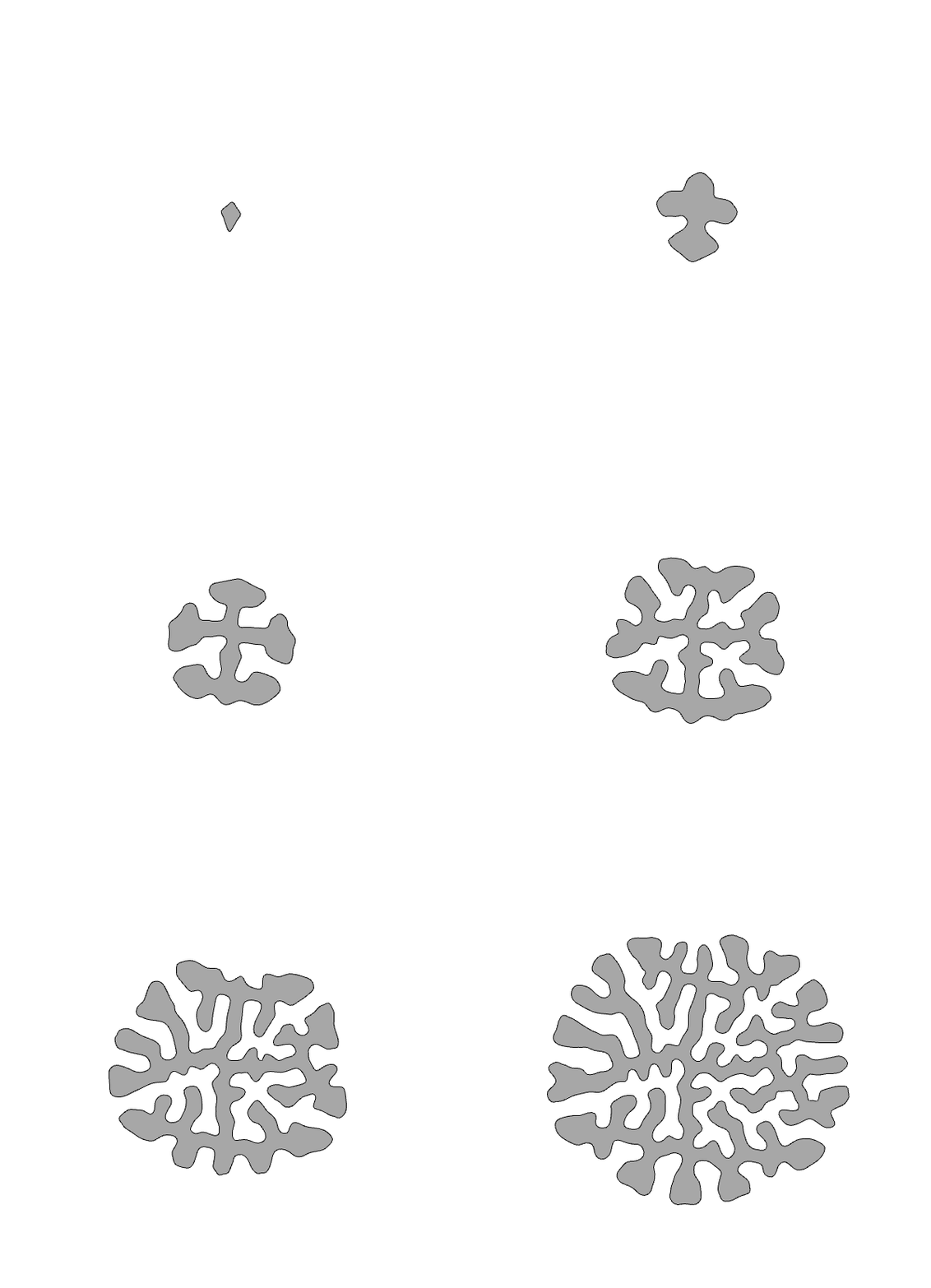
Differential growth is a process where different parts of a structure grow at different rates, leading to complex forms. After watching this, I decided to try it in Grasshopper. Here, differential growth mimics this behavior by applying rules such as Repulsion to avoid crowding or overlapping, Cohesion to keep parts connected or within a range, and Insertion to add new elements when a part stretches too far. The algorithm I present here simulates a differential growth process starting from a set of points along a curve. All agents apply repulsion forces to each other if they are within a certain distance. Each agent checks its neighbors: it pushes or pulls them. Additionally, when two neighbors become too far apart, the code inserts a new (point) agent. Over time, this interaction leads to growing patterns shown below:
I developed this Grasshopper Python code in Rhino 8 (Python 3). This means it will NOT work in Rhino 7. Crv is the initial curve for the starting agents. I is the distance threshold above which a new agent is inserted. R is the range within which global repulsion is applied. K is the scaling factor for force accumulation. Q is the damping coefficient (controls how fast they slow down). N is the maximum number of agents. When Run is triggered, it triggers one iteration of the simulation. I attached a Grasshopper Timer component to repeat it. The outputs are the points and the vectors. This implementation makes some optimizations, but it still checks every boid with every other. So it becomes very (really) slow when you increase the N value too much. Below is the Python code inside the Grasshopper definition. You can find the definition at the bottom of this page.
import rhinoscriptsyntax as rs
import math
insertDistance = I
repulsionDistance = R
k = K
q = Q
def vector_add(a, b):
	return [a[0]+b[0], a[1]+b[1], a[2]+b[2]]
def vector_subtract(a, b):
	return [a[0]-b[0], a[1]-b[1], a[2]-b[2]]
def vector_scale(v, s):
	return [v[0]*s, v[1]*s, v[2]*s]
def vector_length(v):
	return math.sqrt(v[0]**2 + v[1]**2 + v[2]**2)
def vector_unitize(v):
	length = vector_length(v)
	if length == 0:
		return [0,0,0]
	return [v[0]/length, v[1]/length, v[2]/length]
def vector_distance_sq(a, b):
	return (a[0]-b[0])**2 + (a[1]-b[1])**2 + (a[2]-b[2])**2
class Boid():
	def __init__(self, pos, vel):
		self.pos = list(pos)
		self.vel = list(vel)
	def updateVel(self, i):
		forces = [0,0,0]
		for boid in flock:
			if boid != self:
				dis = vector_distance_sq(boid.pos, self.pos)
				if dis < repulsionDistance ** 2:
					dif = vector_subtract(boid.pos, self.pos)
					dif = vector_unitize(dif)
					dif = vector_scale(dif, -1 / dis)
					forces = vector_add(forces, dif)
		n_boid = flock[i-1]
		p_boid = flock[(i+1) % len(flock)]
		p_dis = vector_distance_sq(p_boid.pos, self.pos)
		p_dif = vector_subtract(p_boid.pos, self.pos)
		p_dif = vector_unitize(p_dif)
		p_dif = vector_scale(p_dif, 1 / p_dis)
		if p_dis < (insertDistance * 0.5) **2:
			p_dif = vector_scale(p_dif, -1)
		forces = vector_add(forces, p_dif)
		n_dis = vector_distance_sq(n_boid.pos, self.pos)
		n_dif = vector_subtract(n_boid.pos, self.pos)
		n_dif = vector_unitize(n_dif)
		n_dif = vector_scale(n_dif, 1 / n_dis)
		if n_dis < (insertDistance * 0.5) **2:
			n_dif = vector_scale(n_dif, -1)
		forces = vector_add(forces, n_dif)
		forces = vector_scale(forces, k)
		self.vel = vector_add(self.vel, forces)
	def updatePos(self):
		self.pos = vector_add(self.pos, self.vel)
		self.vel = vector_scale(self.vel, q)
def check_insert_particles(flock):
	i = 0
	while i < len(flock):
		boidA = flock[i]
		boidB = flock[(i + 1) % len(flock)]
		dis = vector_distance_sq(boidA.pos, boidB.pos)
		if dis > insertDistance**2:
			pos = vector_scale(vector_add(boidA.pos, boidB.pos), 0.5)
			vel = vector_scale(vector_add(boidA.vel, boidB.vel), 0.5)
			flock.insert(i+1, Boid(pos, vel))
		else:
			i += 1
def reset_flock():
	points = rs.CurvePoints(Crv)
	points = rs.CullDuplicatePoints(points)
	center = rs.CurveAreaCentroid(Crv)[0]
	for point in points:
		vel = vector_subtract(point, center)
		vel = vector_unitize(vel)
		boid = Boid(point, vel)
		flock.append(boid)
if "ready" not in globals() or Reset:
	ready = True
	flock = []
	reset_flock()
if ready and Run:
	if len(flock) < N:
		check_insert_particles(flock)
	for i, boid in enumerate(flock):
		boid.updateVel(i)
	for boid in flock:
		boid.updatePos()
pos = [rs.CreatePoint(*boid.pos) for boid in flock]
vel = [rs.CreateVector(*boid.vel) for boid in flock]Cite this post
Related Posts
Flow Map on Terrains
September 11, 2026
We previously looked at the terrain generator script we used in midterm projects with first-year architecture students over here. Later on, we added a few analysis modules to this tool. You might remember the slope analysis tool from this link. Today’s topic is another type of analysis: flow. The idea for this code wasn’t actually mine; I developed it by looking at an existing script based on Serkan Uysal’s suggestion. Unfortunately, I don’t know who originally wrote it. Keeping track…
Wandering Simulator
March 9, 2024
In 1986, Craig Reynolds developed an algorithm aiming to model the flocking behavior of birds, which remains a cult method used in flock simulations today. In my initial study, the bird-oids (boids) have no rules or limitations, just chilling randomly on the screen. I call this initial version Wandering Simulator. There are several reasons why this fundamental simulation is difficult in Grasshopper and Python, our parametric design interface. In Grasshopper (data flow modeling), pushing the back doors a bit is…
Syntax, Meaning, and Wasp
August 24, 2026
The question of how form emerges in architecture has always been one of the most fundamental debate topics of computational design. When I was a graduate student, we used to examine how abstract language structures made of words and rules turned into spatial and geometric systems. In this post, starting from the reflection of linguistic theories on architecture, we will talk about the logic of discrete aggregation that we study in the first year Design Computing courses. At the same…
Damped Harmonic Motion
October 7, 2026
Have you ever thought about making a damped pendulum in Grasshopper? I have no idea why, but I did. I just decided to transfer a Python snippet I found online into a Grasshopper definition. Here, the Initial Angle (Radians) Number slider sets the initial angle to any value from 0 to Pi. The letter G represents the acceleration due to gravity (approximately 9.81 m/s2). This is the primary force pulling the pendulum downward. As you know, pendulums wouldn’t swing without…
Solar Position
May 6, 2012
Experimenting with various plug-ins for solar calculations, I found Daniel Da Rocha’s robust implementation of the solar position algorithm in vb.net. It calculates the solar angle of any place and time. Although it’s written in the old vb.net component, it still works great. I’m trying to create a fast and easy workflow to optimize Grasshopper models based on solar directions. This is done by projecting faces to the solar planes and checking how much of their area is included in…