
Syntax, Meaning, and Wasp
The question of how form emerges in architecture has always been one of the most fundamental debate topics of computational design. When I was a graduate student, we used to examine how abstract language structures made of words and rules turned into spatial and geometric systems. In this post, starting from the reflection of linguistic theories on architecture, we will talk about the logic of discrete aggregation that we study in the first year Design Computing courses. At the same time, it is possible to exercise it quickly using the Grasshopper plug-in Wasp. This is such a comfortable educational setting today, compared to 2000s.
From Language to Architecture: Shape Grammars
In the 1960s, Noam Chomsky‘s generative linguistics theories showed that language could produce an infinite number of meaningful sentences with a limited number of symbols and production rules. This idea quickly had a big impact on the Design Methods Movement of the 1960s and 70s. As we see in Christopher Alexander’s “A Pattern Language” study, cities and buildings, just like words and grammar rules, could be divided into defined parts and relationship networks connecting these parts (although Alexander was not advocating this as a design methodology). However, in these early theories, syntax, form and structure were in the foreground. Semantics and meaning was rather ignored. This is why, the acceptance of a valid design method in the architectural application areas, always remained limited. I know this is a very fast and brief generalization. But back then, the tension between technical know-how, and the matter of meaning was at its peak. Maybe it is still like that right now.
Geometric Rules, L-Systems, and Emergence
One of the first big steps carrying text-based rules into the geometric universe was L-Systems (Lindenmayer Systems) and then, the famous Shape Grammars, developed by G. Stiny and J. Gips in the 1970s. L-Systems and the parallel rewriting rules, allowed us to simulate growth patterns in nature and fractal structures. In this blog, I experimented such systems numerous times. The strongest side of shape grammars is the emergence of sub-shapes during the process that were not explicitly defined in the initial rules by the designer. The system reads new relationships from the result, and continues to develop over these new emergent shapes. At least, this was the answer to several criticisms. I remember the very first post in designcoding 15 years ago.. In the graduate school, I had the chance to take the Shape Grammars course from Prof. Birgül Çolakoğlu. She was a PhD student of Dr. Stiny.
Iteration in Grasshopper: From Anemone to Wasp
We have two options, if we want to try shape grammar rules in Grasshopper. The first one is a little traditional. Using Orient3D and looping add-ons such as Anemone. This would be useful in taking a base module and putting it into sequential loops with orientation planes. I experimented this in QuickShaper 20 years ago. One day, I want to revisit and try this through the famous Froebel blocks exercise. The second and quicker way can be a ready-made add-on such as Wasp. It is very powerful in connection-based aggregation. Developed by Andrea Rossi, Wasp looks at the connectors and collision logic instead of pure geometric transformation. This is why, it gives more architecturally sound results.
In Wasp, the process basically has four steps:
- Part Definition (Wasp_Basic Part): The designed base module geometry is imported into the environment.
- Connection Points (Wasp_Connection From Direction): From which surfaces or points of the module it can connect to other parts and in which direction it will lock is determined. Names like A, B, C are given to the connections.
- Rule Generator (Wasp_Rules Generator): How connections match with each other is defined (e.g., A > A, B > B, A > B, or C > C).
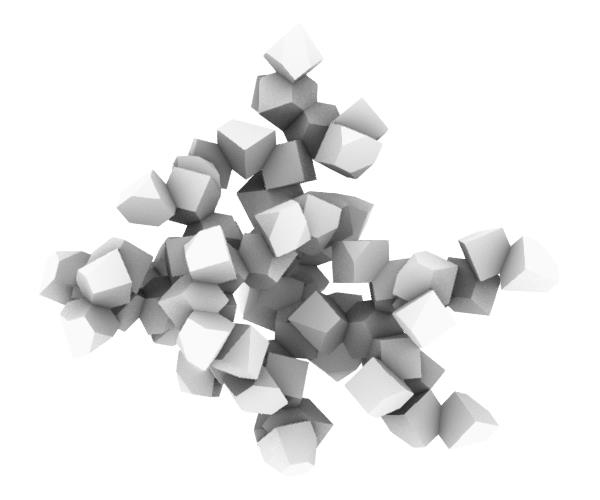
- Stochastic Aggregation (Wasp_Stochastic Aggregation): The defined rules are combined with collision tests preventing parts from overlapping and random orientations, turning into a complex mass made of many parts.
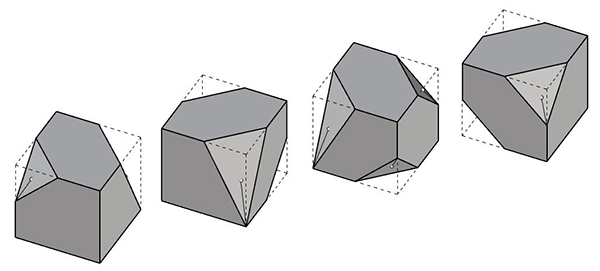
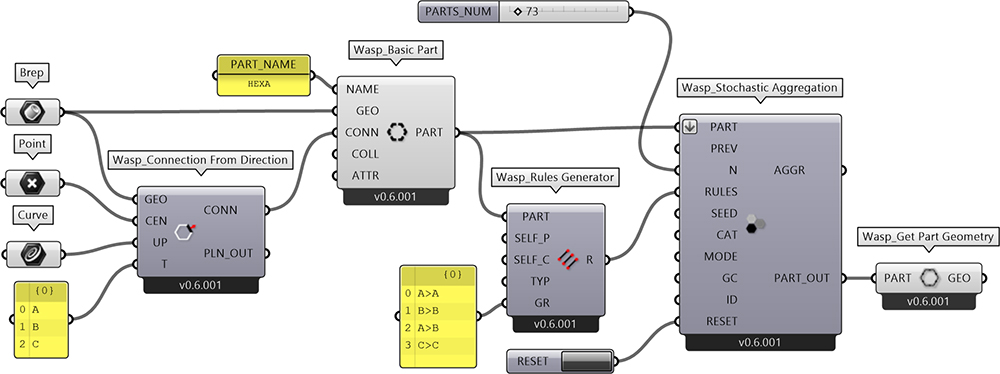
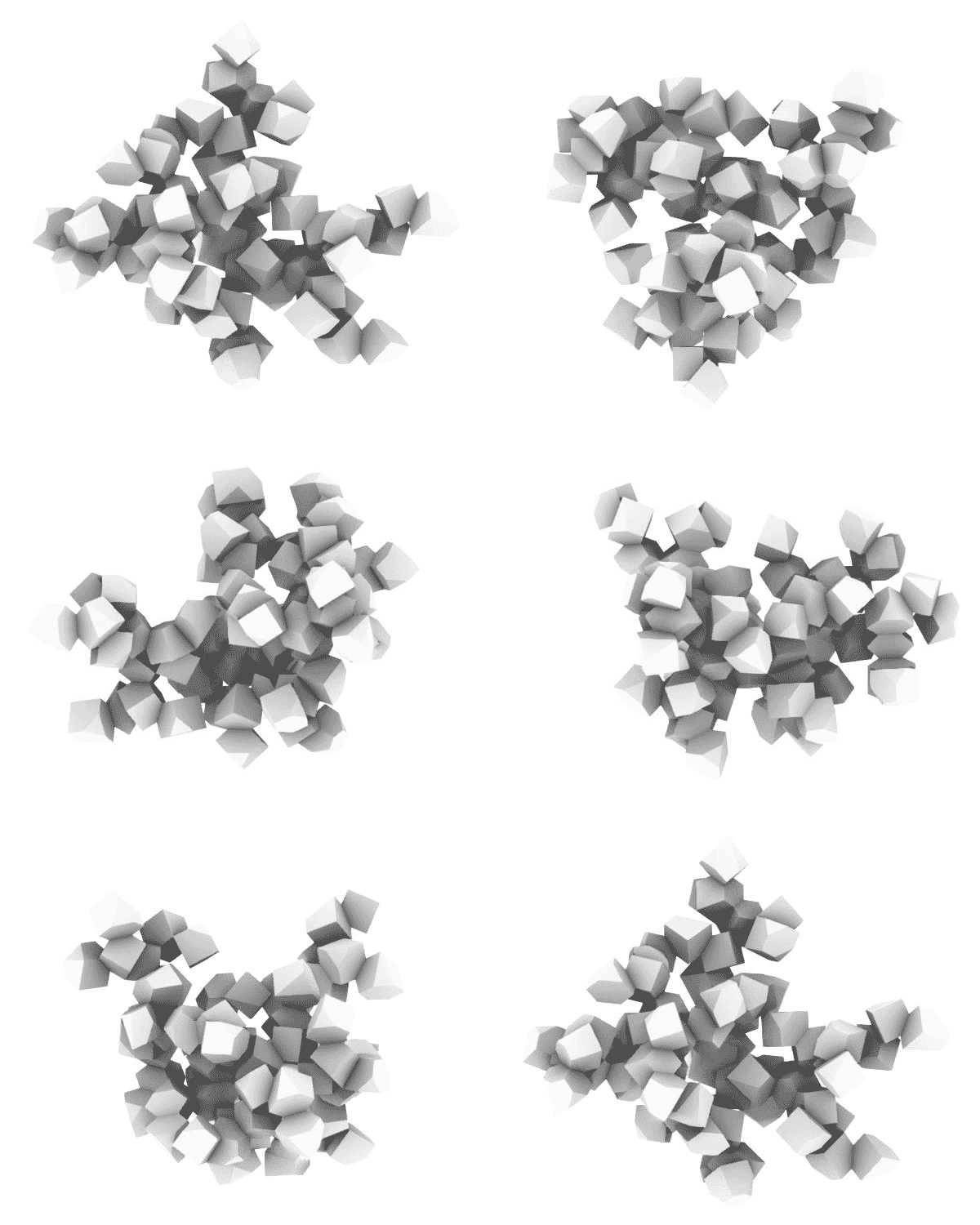
In my trial, the add-on components gave an “Old” warning, but they worked fine. To distinguish the components, I used the “Bifocals” add-on, which writes their names on them.
Conclusion
Wasp and similar discrete aggregation tools provide a strong ground for modular architecture, prefabrication, and digital fabrication processes. Simple rules applied to a single part can produce unexpected and rich spatial organizations. Starting from a simple rule and reaching complex architectural structures that match the physical world is one of the most exciting research areas of computational design. There are numerous “pavilion” experiments made in the schools and workshops around the globe. However, the dimension of meaning that we mentioned at the very beginning will continue to remain an open debate.
Formal grammars working only with formal rules and leaving meaning out reminds me of Gottlob Frege‘s famous distinction of Sinn (Sense) and Bedeutung (Reference) in the beginning years of philosophy of language. Formal grammar and shape grammars treat symbols and geometric elements only as abstract elements (syntactic elements) processed according to rules. In other words, the system works completely with internal syntax; what it corresponds in the external world (reference) or what it expresses in a spatial/cultural context (sense) is outside the scope of the rule set. I think, this is not an accident; it is a requirement for the theory to exist. Because, Frege’s project was already looking for the existence and the limits of the application area of an objective logic independent of humans. My readings started to show that Frege, compared to more interesting figures like Russell and especially Wittgenstein, might be someone more quiet, but actually laying deeper foundations.
Cite this post
Related Posts
Why is the Hilbert Curve Beautiful?
April 8, 2025
The Hilbert Curve is one of the results of David Hilbert’s vision of mathematics as a network of symbolic systems. Defined in 1891, this curve is a fractal that fills a two-dimensional plane with a one-dimensional line in the limit. It exhibits self-similarity. It emerged from representing higher-dimensional spaces through continuous, lower-dimensional entities. A curve that grows within a bounded area remains continuous but non-differentiable. Yet it possesses infinite length. Perhaps no one will ever truly see or fully grasp…
Geography of the Unsayable
August 30, 2026
Everything starts with an image in the mind, with a cinematic dream: the great white cliffs at the end of the movie, “Atonement”. While the waves are hitting the shore, that reunion that can never happen. But the moment we take our first step, that abstract feeling of Ludwig’s hard reality smacks us: “The world is everything that is the case; it is the totality of facts, not of things.” The exact departure times on the station boards, the numbers…
On Reason, Language, and Power
October 8, 2026
Thomas Hobbes’s 1651 work, Leviathan, was written in Paris, where he had fled the English Civil War because of his royalist leanings. In this work, Hobbes defines Leviathan as a strong state authority. To do so, he is compelled to develop certain definitions concerning human and societal nature. In this week’s Digital Culture Readings class, we focused on the fifth chapter of Leviathan, titled “Of Reason, and Science.” While eagerly awaiting my students’ papers, I present my own response paper…
A Programmable World
October 1, 2026
The mandatory course Readings on Digital Culture in the Graduate Program in Architectural Design at Istanbul Bilgi University began with the introductory chapter of Charlie Gere’s Digital Culture. We will write a response paper every week. I have completed my response to the first reading. The reading begins with the parallel development of the Industrial Revolution and capitalism. It then follows this history up to the emergence of today’s computers. It looks at how money gradually became a more abstract…
Differential Growth
June 16, 2025
Differential growth is a process where different parts of a structure grow at different rates, leading to complex forms. After watching this, I decided to try it in Grasshopper. Here, differential growth mimics this behavior by applying rules such as Repulsion to avoid crowding or overlapping, Cohesion to keep parts connected or within a range, and Insertion to add new elements when a part stretches too far. The algorithm I present here simulates a differential growth process starting from a…