
On Reason, Language, and Power
Thomas Hobbes’s 1651 work, Leviathan, was written in Paris, where he had fled the English Civil War because of his royalist leanings. In this work, Hobbes defines Leviathan as a strong state authority. To do so, he is compelled to develop certain definitions concerning human and societal nature. In this week’s Digital Culture Readings class, we focused on the fifth chapter of Leviathan, titled “Of Reason, and Science.” While eagerly awaiting my students’ papers, I present my own response paper below:
Hobbes’s definition of human reasoning was quite sharp. He argues that human reasoning is a kind of arithmetic calculation performed with common names (language) assigned to things. He states that, just as in arithmetic, errors can occur in reasoning; however, this does not make arithmetic itself bad. Humans make errors, not reason. Reflecting the political situation of his era and the impact of the civil war, he extends this condition to the errors made by the majority (democracy?). While imposing his own definition of right reason, he (ironically) critiques this very mode itself. While rejecting others’ correct definitions and trying to prove his own right, Hobbes uses geometry. What is interesting here is not Hobbes’s claims or his critique, but the role played by geometry. He treats thinking as a chain and states that each link must be completed step-by-step, like an algorithm.
Hobbes emphasizes that abstract and baseless philosophical discussions (such as metaphysical concepts) conducted by severing the meanings of words are not mere errors, but are mentally entirely “meaningless and absurd.” Hobbes’s way of defining the seven errors that lead to absurd propositions is quite interesting. According to him, failing to follow the correct method (the method of construction that starts with definitions, as in geometry) drags philosophers into these absurdities. Hobbes’s definitions of error and absurdity directly reminded me of Wittgenstein’s first philosophy. Although Hobbes’s purpose here is to demonize democracy and free will, render them useless paradoxes, and declare them “absurd,” it is fascinating to see traces of the modern “linguistic turn” in such an ancient text. Both thinkers attribute these propositions, which they characterize as absurd and useless, to the misuse of language.
Making the epistemological distinction between Science and Fact-based Knowledge (Sense & Memory), Hobbes goes for a very sharp separation here. Sense and memory are merely past data. Science, on the other hand, goes beyond this to become knowledge of consequences and causal dependencies among data. Thanks to science, human beings learn to produce similar results from similar causes in the future, building on what they can currently do (causality and the power of foresight).
Hobbes states that children in the pre-linguistic period do not yet possess reason. The majority of the public also acts according to experience and random chance in their daily lives; they do not even know what science is, and they think of geometry as a kind of witchcraft. Here, I felt how sharp a turn Wittgenstein’s second philosophy represents. Wittgenstein does not see a child’s learning of language as memorizing the mental equivalents of words or performing a logical calculation. The child learns language through practice, actions, and social interaction, just as they learn to play a game. Language is not a computational tool, but a social activity with rules. Hobbes attributes the basis of errors and absurdities to “not starting with precise definitions.” Wittgenstein, arguing the exact opposite, states that words do not have essential definitions, and meaning exists through the use of words within language (meaning as use). The child learns language not by taking definitions, but by observing the functions of words in practical life.
Here, while celebrating the clear, pure, and absolute nature of reason, Hobbes also adopts the scientific method as his guiding principle. Although the World context is entirely different today, and Hobbes has nothing to do with today’s problems, we have read an early example in the history of thought of attempts to bring reasoning and mathematics closer together. Today, we witnessed an early fossil from 1651 in the fields of science and epistemology. Last week we saw the intellectual current driven by Capitalism and the Industrial Revolution, which led to cultural, social, and economic transformations based on this epistemological shift. The computability of thought is still a subject of debate today. Computational methods in design and architecture seem to be one of the modern battlegrounds of this ancient epistemological fracture.
Notes
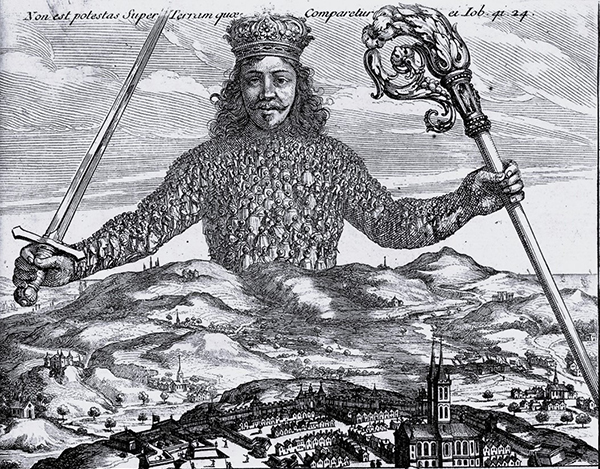
Leviathan is a dragon-like sea monster in mythology (originating in the Old Testament). It symbolizes chaos, uncontrollable forces of nature, and invincibility. Thomas Hobbes deliberately gave this name to his famous political philosophy book published in 1651. In Hobbes’s philosophy, Leviathan represents the state, which possesses absolute power and authority to protect people from their own destructive nature and the “war of all against all.” According to Hobbes, to ensure social order, peace, and security, the state must possess a mighty, feared, and unquestionable sovereign power, like this legendary monster. In the book’s frontispiece illustration, it is depicted as a gigantic sovereign whose body is composed of thousands of human figures.
Thomas Hobbes was born in England in 1588, during the Spanish Armada’s attack on England. He was educated in classical languages and scholastic philosophy at the University of Oxford. At a young age, he undertook tutelage in an aristocratic family and traveled to Europe. During this process, he met important thinkers and scientists of the era in France and Italy (such as Galileo Galilei and René Descartes) and was deeply influenced by mathematics, mechanics, and the philosophy of physics. The English Civil War (1642–1651) was a bloody civil war between the Royalists and the forces of Parliament. This war plunged the country into great chaos and a vacuum of authority. The destruction and turmoil brought by the war directly showed Hobbes how destructive human nature can be when left without rules and authority (inspiring the idea of the “war of all against all” in his work). Because of his views defending monarchy and absolute power, Hobbes became a target for pro-Parliamentary forces. Believing his life was no longer safe and that he might be arrested, he fled to France (Paris) in the early 1640s and lived there in exile for many years. He wrote his most famous work, Leviathan, during this exile period in France and published it in London in 1651. After his exile, he was allowed to return to England. Although he was criticized in the later period of his life for debates over geometry and certain disagreements with the church, he enjoyed royal protection. He died in 1679 at the age of 91.
Cite this post
Related Posts
A Programmable World
October 1, 2026
The mandatory course Readings on Digital Culture in the Graduate Program in Architectural Design at Istanbul Bilgi University began with the introductory chapter of Charlie Gere’s Digital Culture. We will write a response paper every week. I have completed my response to the first reading. The reading begins with the parallel development of the Industrial Revolution and capitalism. It then follows this history up to the emergence of today’s computers. It looks at how money gradually became a more abstract…
Geography of the Unsayable
August 30, 2026
Everything starts with an image in the mind, with a cinematic dream: the great white cliffs at the end of the movie, “Atonement”. While the waves are hitting the shore, that reunion that can never happen. But the moment we take our first step, that abstract feeling of Ludwig’s hard reality smacks us: “The world is everything that is the case; it is the totality of facts, not of things.” The exact departure times on the station boards, the numbers…
Syntax, Meaning, and Wasp
August 24, 2026
The question of how form emerges in architecture has always been one of the most fundamental debate topics of computational design. When I was a graduate student, we used to examine how abstract language structures made of words and rules turned into spatial and geometric systems. In this post, starting from the reflection of linguistic theories on architecture, we will talk about the logic of discrete aggregation that we study in the first year Design Computing courses. At the same…
Why is the Hilbert Curve Beautiful?
April 8, 2025
The Hilbert Curve is one of the results of David Hilbert’s vision of mathematics as a network of symbolic systems. Defined in 1891, this curve is a fractal that fills a two-dimensional plane with a one-dimensional line in the limit. It exhibits self-similarity. It emerged from representing higher-dimensional spaces through continuous, lower-dimensional entities. A curve that grows within a bounded area remains continuous but non-differentiable. Yet it possesses infinite length. Perhaps no one will ever truly see or fully grasp…