
Calculemus!
Leibniz was the topic of last week’s Readings on Digital Culture class. Although he is often presented as one of the ancestors of modern computing and digital technology, I doubt that is entirely accurate. He made big contributions to metaphysics, logic, law, and mathematics. He was also a social butterfly of his age, connected with a large number of people and writing tens of thousands of letters. From an early age, he seems to have an almost infinite desire for learning. Leibniz appears to have enjoyed developing really big ideas and visions. A universal language, the binary system, a calculating machine, calculus: these are among his most visible, well-known contributions, and they continue to appear in different forms throughout our intellectual and technological lives. Many books have been written about him, and his work has been examined from numerous philosophical, historical, and scientific perspectives. I started reading some of them and put that selected bibliography below. What interests me is not simply what he accomplished, but what drove him to pursue so many different things. Below is what I wrote while thinking about three of them:
Bits and pieces
Leibniz’s interest in the binary number system is one of the most frequently mentioned aspects of its connection to today’s computers. In binary, we represent numbers using 0 and 1. Modern computers represent information using bits; ultimately, they operate on the same system. However, we must be careful when drawing these similarities. Leibniz did not develop the binary system in the form used in modern electronic computers. His interest in the binary system carried metaphysical meanings as much as mathematical ones (it reminded me of Lacan’s text on the void). Still, the historical line is clear: the dream of using symbols, processing symbols according to rules, and carrying out these operations through machines. That would be the ultimate conclusion if you had naturally thought this way. As computer infrastructure, using the binary system made a lot of sense. Of course, we can see an intellectual kinship here, but Leibniz (perhaps lucky that he had yet to see computers and transistors) was able to view this separately as a general philosophy as well. This is a philosophy not just about technologies in specific fields, but a worldview entirely based on particulars, through pieces.
Was Leibniz’s universal language a programming language?
Leibniz’s characteristica universalis project was rooted in the desire to express thoughts and concepts through a clear and systematic symbolic language. To this, he added the claim that reasoning could be carried out through specific operations. The languages that humans use every day (knowingly or unknowingly) and computer programming languages operate through clearly defined symbols and rules. But are a spoken language and a programming language the same thing? The difference between programming languages and Leibniz’s project goes deeper. Leibniz’s concern here was to question whether, if we could express our thoughts clearly and systematically enough, we could perform mechanical operations on them. For example, Python is a general-purpose programming language. Leibniz’s universal language, however, is a much broader project that encompasses not only computation but also the expression of concepts and human reasoning. Therefore, I don’t think Python is one of the realized forms of this project. What he imagined was something much more general (universal), capable of relating not just geometric algorithms, but every kind of concept within human thought on the exact same platform. It is hard to dream. And I think no; it’s still more general than what AI does today.
Shall we also shape Calculemus! for design?
Calculemus!” is a Latin phrase by Gottfried Wilhelm Leibniz meaning “Let us calculate!” It reflects his visionary idea that all logical, philosophical, and scientific disputes could be resolved through formal calculation rather than endless debate.
Triggering our occupational deformations and traumas once again, come, let’s adapt Leibniz’s Calculemus to computational design and digital architecture thought. Behind Polymath’s call lies a desire to clearly express thoughts and to process them within the framework of specific rules. This expresses his belief in logical and symbolic methods. However, this is not proof that Leibniz believed all problems (especially those related to design) could be solved mechanically. It is problematic when we use the ideas of such thinkers to serve our own purposes, and even engage in quote-mining to do so. This is why I try to be as skeptical as possible here.
In computational design, we express the design problem not merely as a form, but as a system consisting of relationships, rules, constraints, and transformations. We have been told this for 25 years. Focusing on the final product is over; long live the process and the system! I don’t remember any other discipline that destroys its own field of production with methodological anxiety. For instance, nowadays, when designing panels on a surface, we are no longer content with just drawing the final form. We celebrate variation, not automation. We define the panel geometry, surface curvature, connection conditions, manufacturing limits, and material properties. When these relationships are formalized, we can calculate different design possibilities, compare results, and search for solutions that satisfy specific conditions. Here, the designer does not merely produce a form. They establish a system that determines the conditions under which forms can emerge. This is the story we already know and are always told, isn’t it? Sometimes it seems that we are mixing good old automation with a broader methodological concept (or dream) of variation.
Leibniz’s thought is also about treating complex problems as a system of parts (particulars) and relationships that can be operated upon. This is a perspective we also encounter in calculus, and in his monads. Perhaps monads (the smallest units of everything physical and non-physical, possessing their own internal workings) are an even more radical starting point for this way of thinking. Yet, it looks like there is an important difference between logical calculation and design. On the horizon of design, there is rarely a single perfect outcome. There are conflicting aesthetic, functional, structural, and economic criteria. Computation can make these conflicts visible, generate alternatives, and support evaluation, but it cannot inherently decide which outcome is “the best and right one and only one”. Even Leibniz does not load this responsibility onto the method. An error in calculation is not a flaw of the process (system) itself. Humans can make calculation errors too. Therefore, using computational tools does not automatically increase the value of the outcome. Consequently, the value of the results we lose by focusing on the process cannot be restored simply by increasing its methodological sophistication.
On the other hand, making a problem computable determines not only the method of solution, but also how we define the problem in itself. For the designer, the question is no longer just “What form do I want?” It is simultaneously, “What relationships, rules, and constraints should I define so that this form can emerge; what other forms can also derive from this same system?” From here, we hope for a design discovery. There are serious benefits to being careful and balanced here. The number of techniques, tools, and technologies a person can learn is limited.
Ultimately, Leibniz’s vision of a universal language and the ideal of monads did not gain acceptance as he had dreamed. Numerous other thoughts on the philosophy of language, logic, and mathematics were developed after him. Still, we can view Leibniz as a key representative of the transformation process that moved logic from philosophy to mathematics.
Selected bibliography
- Wilson, C. (1989). Leibniz’s metaphysics: A historical and comparative study. Princeton University Press. https://www.jstor.org/stable/j.ctv3hh4mn
- Deleuze, G. (1993). The fold: Leibniz and the baroque (T. Conley, Trans.). University of Minnesota Press. (Original work published 1988; digital copy accessed via Scribd: https://www.scribd.com/doc/267416688/Gilles-Deleuze-Leibniz-and-the-Baroque)
- Strickland, L., & Lewis, H. (Eds.). (2022). Leibniz on binary: The invention of computer arithmetic. MIT Press. https://scispace.com/pdf/leibniz-on-binary-1ree6msh.pdf
- Dugas, R. (1988). A history of mechanics. Dover Publications. (Original work published 1955; digital copy accessed via Internet Archive: https://ia801408.us.archive.org/24/items/in.ernet.dli.2015.140578/2015.140578.A-History-Of-Mechanics.pdf)
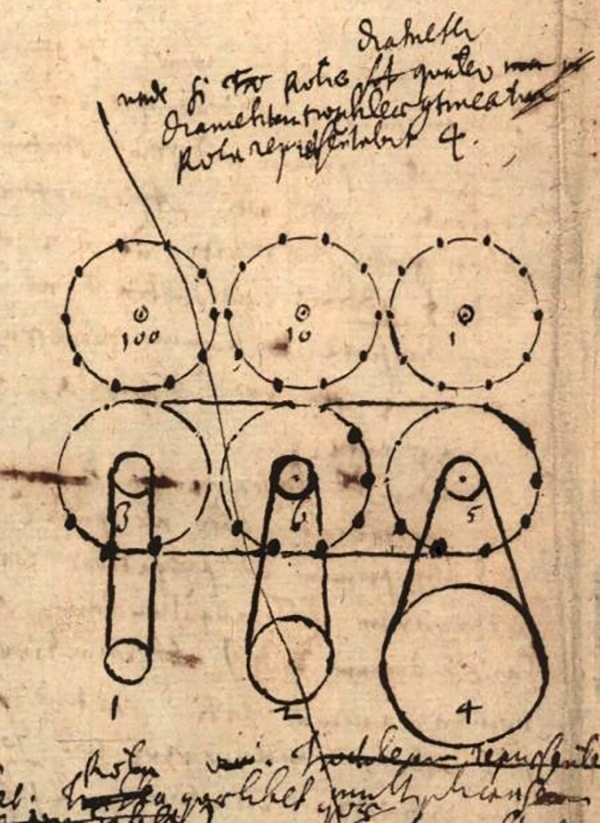
First calculator design: The number in the middle row is added to the top row. (Photo: Gottfried Wilhelm Leibniz Library, Lower Saxony State Library, https://blog.hnf.de/herr-leibniz-und-die-erfindung-der-rechenmaschine/)
Cite this post
Related Posts
A Programmable World
October 1, 2026
The mandatory course Readings on Digital Culture in the Graduate Program in Architectural Design at Istanbul Bilgi University began with the introductory chapter of Charlie Gere’s Digital Culture. We will write a response paper every week. I have completed my response to the first reading. The reading begins with the parallel development of the Industrial Revolution and capitalism. It then follows this history up to the emergence of today’s computers. It looks at how money gradually became a more abstract…
On Reason, Language, and Power
October 8, 2026
Thomas Hobbes’s 1651 work, Leviathan, was written in Paris, where he had fled the English Civil War because of his royalist leanings. In this work, Hobbes defines Leviathan as a strong state authority. To do so, he is compelled to develop certain definitions concerning human and societal nature. In this week’s Digital Culture Readings class, we focused on the fifth chapter of Leviathan, titled “Of Reason, and Science.” While eagerly awaiting my students’ papers, I present my own response paper…
Geography of the Unsayable
August 30, 2026
Everything starts with an image in the mind, with a cinematic dream: the great white cliffs at the end of the movie, “Atonement”. While the waves are hitting the shore, that reunion that can never happen. But the moment we take our first step, that abstract feeling of Ludwig’s hard reality smacks us: “The world is everything that is the case; it is the totality of facts, not of things.” The exact departure times on the station boards, the numbers…
Syntax, Meaning, and Wasp
August 24, 2026
The question of how form emerges in architecture has always been one of the most fundamental debate topics of computational design. When I was a graduate student, we used to examine how abstract language structures made of words and rules turned into spatial and geometric systems. In this post, starting from the reflection of linguistic theories on architecture, we will talk about the logic of discrete aggregation that we study in the first year Design Computing courses. At the same…
Why is the Hilbert Curve Beautiful?
April 8, 2025
The Hilbert Curve is one of the results of David Hilbert’s vision of mathematics as a network of symbolic systems. Defined in 1891, this curve is a fractal that fills a two-dimensional plane with a one-dimensional line in the limit. It exhibits self-similarity. It emerged from representing higher-dimensional spaces through continuous, lower-dimensional entities. A curve that grows within a bounded area remains continuous but non-differentiable. Yet it possesses infinite length. Perhaps no one will ever truly see or fully grasp…