designcoding
About Table of Contents Keywords Monthly Archive
Support designcoding!

#sphere

6 posts

Spherical Cycloid

April 2, 2024

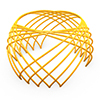
Today’s beautiful curve is the spherical cycloid. It is a cycloid, rolling on a 3d circular path rather than a straight and 2d one. There are algebraic explanations of this curve. Therefore, I find it interesting to experiment with them, since it is more interesting than the regular planar cycloids, epicycloids, and hypocycloids. This curve is believed to have been studied first by Jean Bernoulli in 1732. The interesting and playful part of this is the resulting curve is always…

Fibonacci Sphere

April 12, 2023

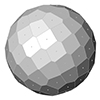
This website explains the problem and several solutions. I managed to implement the formulas to convert a 2D square grid into spherical coordinates. The Fibonacci Sphere is one of the solutions to the equal distribution of points on a sphere. It is not the best solution to this problem. But it is regarded as a quick and efficient one. Suitable for me. I developed this Grasshopper code by studying the above website and some other sources. The code starts with…

Sixty Square Sphere

February 21, 2013

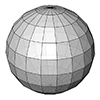
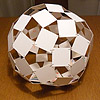
This was a couple of weeks ago, together with my six-year-old son Mete, we decided to make a “ball” out of old memory cards. I was curious about a subdivision method, using only planar quadrilaterals to construct a sphere (named Sixty Square Sphere. There are a couple of models on www. Of course look much better than mine:=). However, my son was expecting a “ball” to play. Then, both of our expectations have been partially met, I think. You see…

Spherical Attraction

November 28, 2012

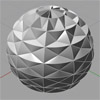
Today’s Architectural Geometry course was about platonic solids and different attractor objects in introducing component-based design systems. Benay’s idea was both pedagogical and interesting to test in Grasshopper. I searched for the most fundamental type of attractor solid in creating a composition such as this; There is a subdivided sphere and an attractor sphere. The pull component works great here. You may use multiple attractor solids or different shapes such as platonic solids as attractors. It is quite an easy…

Modeling a Geodesic Sphere

May 23, 2012

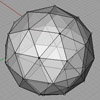
Not all of them, but when you get the idea, you’ll see there are lots of different alternatives for creating Fuller’s famous Geodesic Domes (Although in fact, he is not the inventor of it). I was playing with Platonic Solids in Rhino and realized that the “Pull” command is very useful in subdividing objects. I modeled this in Rhino 4. First, take a regular Icosahedron and divide it. Because, this is the simplest way for modeling a Geodesic sphere, by…

Eschers Tessellations

March 29, 2012

After Puzzling, I tried to establish more of Escher’s basic grid transformations using Grasshopper’s native components. This definition simulates Escher’s transformation of four-cornered grids. The postulate is based on the fact that every quadrilateral (or triangular) planar shape can create regular tessellations without gaps or overlaps. In the traditional method, this tessellation is achieved by rotating the shape 180 degrees and copying afterward. However, in Grasshopper we simply define the fifth point for each shape and divide subsurfaces into four…

  • Chapters

    • Algorithms
    • Discourses
    • Fabrications
    • Studios
  • Explore

    • All Keywords
    • Table of Contents
    • Monthly Archive
    • #circle
    • #3d-max
    • #calculus
    • #descartes
    • #rhombicosidodecahedron
    • #robot
    • #le-corbusier
    • #simulation
    • #buckyball
    • #unity
    • #sandblasting
    • #fibonacci
    • #stellated-solid
    • #eps-foam
    • #enneahedron
    • #parametric-curve
    • #snub-square
    • #photoshop
    • #platonic-solid
    • #arduino
  • Search

  • Support designcoding!

  • Enjoying designcoding? Support me on Patreon to keep it growing. Thank you!

  • copyright 2026 designcoding.net | about | privacy policy | end user license agreement