designcoding
About Table of Contents Keywords Monthly Archive
Support designcoding!

#polygon

10 posts

Constructing Irregular Tiling

December 11, 2024
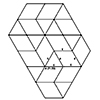
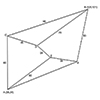
Using a compass and straightedge enables precise geometric constructions, allowing for the creation of complex tessellations. To begin these constructions, a single starting point is sufficient. Circles, which represent a collection of points at a specific distance from the center, and straight lines, which represent a collection of points in a particular direction, are utilized for geometric constructions. In this short tutorial, we move on with the beginner-level drawing exercises. This time, I am drawing an irregular tiling with triangles…
Drawing Hexaflake

December 11, 2024

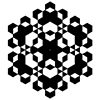
The term “hexa” generally refers to the number six, derived from the Greek word. It is commonly used in mathematics, geometry, and other scientific fields to indicate six-sided shapes or structures. A hexagon is a polygon with six sides and six angles. It is one of the regular polygons, meaning all of its sides and angles are equal. A hexahedron is a polyhedron with six faces. The most well-known example is the cube, which has six square faces, twelve edges,…

Constructing Irregular Polygons

December 11, 2024

The geometric shapes constructed using only a compass and straightedge have significantly influenced the development of reasoning and logic that underpin modern science. This non-numerical approach is also known as the Synthetic Geometry. Before René Descartes introduced Analytic Geometry, this method was widely studied and practiced. In “Elements”, Euclid explores fundamental rules, such as ‘The straight line between two points is the shortest,’ and derives all geometric truths from simple, observable principles, built up step by step through logical deduction….

Constructing Regular Polygons

December 11, 2024

The practical geometry of the ancient Egyptian “rope-stretchers” delineated land after the annual flooding of the Nile River. Thus, the term “geometry” derives from the Greek words “gaia” (earth) and “metria” (measurement). Greek mathematicians used compass and straightedge to perform similar calculations on paper. This abstract thinking allowed for insights into the underlying logic, independent of the accuracy of hand tools. So, the abstract “circle” and “line” constructed by perfect compasses and straightedges can be seen as a reflection of…

Drawing Polygon Spiral

December 11, 2024

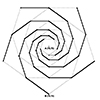
A spiral is a curve that begins at a central point and continuously moves outward, either getting larger (in an outward spiral) or smaller (in an inward spiral). It often revolves around a central point or axis. Spirals are fascinating because they appear in many aspects of nature, mathematics, and art. In this drawing exercise, I utilized several commands to draw such a system. However, this drawing is not a curved spiral but rather a segmented one. In this basic…

Drawing Butterfly Curve

December 10, 2024

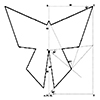
In mathematics, “curve” describes one-dimensional objects or line shapes, regardless of their curvature. Straight lines, polylines, and curved lines all fall under the category of “curves.” You may remember working with equation graphs in high school math classes. For instance, a first-degree equation produces straight-line graphs, while higher-degree equations, like “x squared,” create curved graphs. In this context, we focus on degree-1 curves, drawing straight-line segments using the polyline command. In Rhinoceros, the software refers to all objects, whether curved…

Sierpinski Triangle

February 20, 2024

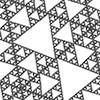
Today’s computational curve is the beautiful Sierpinski Triangle. It is a fractal named after the Polish mathematician Waclaw Sierpinski, who described it in 1915, though it had been previously described by other mathematicians. It is a self-replicating pattern that arises from a simple recursive process. To construct the fractal, you start with an equilateral triangle and then repeatedly remove smaller equilateral triangles from its interior, leaving holes. Each iteration involves dividing each triangle into four smaller triangles and removing the…

Star Lattice

May 15, 2023

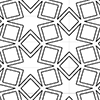
This is the six-pointed star lattice definition in Grasshopper. The definition is generating CNC or laser-ready results as seen below. In this code, first, I developed a common star pattern by exploding a hexagonal grid. The tricky part of this definition is the last part. There, you can see how you can use the Region Union (RUnion) component to add thickness to a pattern we have drawn before. The operation here will require trimming and extending commands under normal conditions….

Polygon Fractals with Rhino Python

August 2, 2017

We will see a simple Rhino Python exercise here. I called these Polygon Fractals (or Pentaflakes sometimes). It is both educational and fun to play with them. In Rhino, it can be a good exercise for basic CAD commands and transformations such as move, copy, and scale, and precision drawing operations such as object snapping. Also, in Grasshopper, it can be a good challenge for looping. In Rhino Python, it is already a good exercise for understanding Python and the…

Emergent Polygons

November 14, 2011

This is my first post in designcoding, dated 14.11.2011. I revisited the code and decided to re-publish it in 2024. Hello World! This is the Emergent Polygons definition, one of the first Grasshopper studies I made while learning the language. This is a very efficient programming language for designers and architects since it utilizes geometric relationships very intuitively. I think it will be more popular and widely used in the upcoming years. Last year, I started my experiments on this….

  • Chapters

    • Algorithms
    • Discourses
    • Fabrications
    • Studios
  • Explore

    • All Keywords
    • Table of Contents
    • Monthly Archive
    • #shape-grammars
    • #tree
    • #sandblasting
    • #cuboctahedron
    • #b-spline
    • #mosque
    • #dual
    • #curvature
    • #sinan
    • #3d-model
    • #truncated
    • #anemone
    • #responsive
    • #dodecahedron
    • #non-euclidean
    • #phyllotaxis
    • #grid
    • #buckyball
    • #truchet
    • #cnc-milling
  • Search

  • Support designcoding!

  • Enjoying designcoding? Support me on Patreon to keep it growing. Thank you!

  • copyright 2026 designcoding.net | about | privacy policy | end user license agreement