
Constructing Regular Polygons
The practical geometry of the ancient Egyptian “rope-stretchers” delineated land after the annual flooding of the Nile River. Thus, the term “geometry” derives from the Greek words “gaia” (earth) and “metria” (measurement). Greek mathematicians used compass and straightedge to perform similar calculations on paper. This abstract thinking allowed for insights into the underlying logic, independent of the accuracy of hand tools. So, the abstract “circle” and “line” constructed by perfect compasses and straightedges can be seen as a reflection of the “theory of Forms”, as described by Plato. As he famously stated, “The forms are the perfect and unchanging ideas that the world of sense is a poor imitation of”. In this video, I am constructing regular polygons with a compass and ruler.
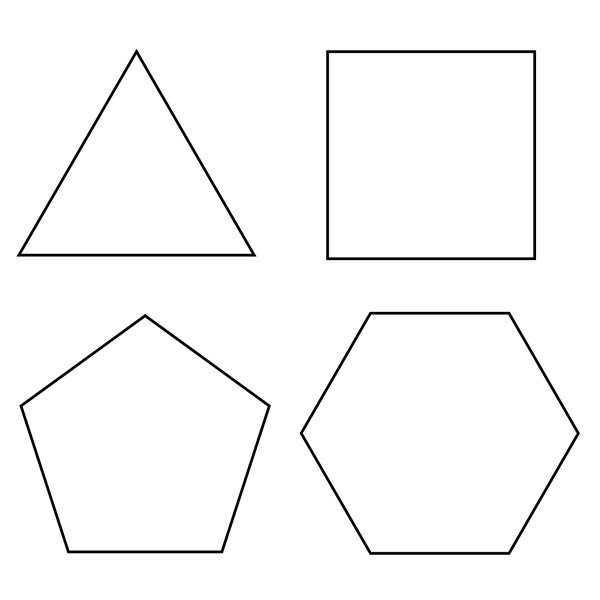
In this video series, I present a variety of in-class exercises from my first-year Architectural Geometry course. Using Rhinoceros software, we delve into Euclidean constructions, basic drawing and transformation commands, introductory fractals, regular and semi-regular tessellations, patterns, modeling, and unrolling polyhedra. Therefore, these concise drawing exercises are beneficial for junior architects, interior designers, industrial designers, and enthusiasts from other disciplines. I’ll be sharing exercises each week on my blog and other platforms. So, today’s exercise is constructing regular polygons.
The software used in this course is Rhinoceros 3d (www.rhino3d.com). However, if you want to find out more and see the whole list of this video series, you can check my YouTube channel at www.youtube.com/@designcodingnet. The music of this video is ‘Within Our Nature’ by Scott Buckley (CC-BY 4.0). www.scottbuckley.com.au
Cite this post
Related Posts
Constructing Irregular Tiling
December 11, 2024
Using a compass and straightedge enables precise geometric constructions, allowing for the creation of complex tessellations. To begin these constructions, a single starting point is sufficient. Circles, which represent a collection of points at a specific distance from the center, and straight lines, which represent a collection of points in a particular direction, are utilized for geometric constructions. In this short tutorial, we move on with the beginner-level drawing exercises. This time, I am drawing an irregular tiling with triangles…
Constructing Irregular Polygons
December 11, 2024
The geometric shapes constructed using only a compass and straightedge have significantly influenced the development of reasoning and logic that underpin modern science. This non-numerical approach is also known as the Synthetic Geometry. Before René Descartes introduced Analytic Geometry, this method was widely studied and practiced. In “Elements”, Euclid explores fundamental rules, such as ‘The straight line between two points is the shortest,’ and derives all geometric truths from simple, observable principles, built up step by step through logical deduction….
Drawing Butterfly Curve
December 10, 2024
In mathematics, “curve” describes one-dimensional objects or line shapes, regardless of their curvature. Straight lines, polylines, and curved lines all fall under the category of “curves.” You may remember working with equation graphs in high school math classes. For instance, a first-degree equation produces straight-line graphs, while higher-degree equations, like “x squared,” create curved graphs. In this context, we focus on degree-1 curves, drawing straight-line segments using the polyline command. In Rhinoceros, the software refers to all objects, whether curved…
Drawing Hexaflake
December 11, 2024
The term “hexa” generally refers to the number six, derived from the Greek word. It is commonly used in mathematics, geometry, and other scientific fields to indicate six-sided shapes or structures. A hexagon is a polygon with six sides and six angles. It is one of the regular polygons, meaning all of its sides and angles are equal. A hexahedron is a polyhedron with six faces. The most well-known example is the cube, which has six square faces, twelve edges,…
Drawing Polygon Spiral
December 11, 2024
A spiral is a curve that begins at a central point and continuously moves outward, either getting larger (in an outward spiral) or smaller (in an inward spiral). It often revolves around a central point or axis. Spirals are fascinating because they appear in many aspects of nature, mathematics, and art. In this drawing exercise, I utilized several commands to draw such a system. However, this drawing is not a curved spiral but rather a segmented one. In this basic…