designcoding
About Table of Contents Keywords Monthly Archive
Support designcoding!

#tetrahedron

8 posts

Modeling and Unrolling Truncated Tetrahedron

December 14, 2024
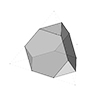
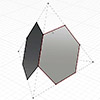
Truncation in mathematics and geometry refers to cutting off parts of a shape, typically the vertices, edges, or other extremities, to create a new modified figure. This process is often used with polygons, polyhedra, or functions. A truncated tetrahedron is a polyhedron we can derive from a regular tetrahedron by truncating (cutting off) its four vertices. This process creates a new shape with additional faces while maintaining its symmetry. In this tutorial video, I am modeling and unrolling a truncated…
Modeling and Unrolling Tetrahedron

December 12, 2024

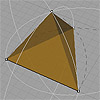
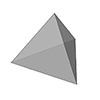
A tetrahedron is a three-dimensional shape with four triangular faces, four vertices, and six edges. It is the simplest polyhedron and, in its regular form, has equilateral triangles as faces, with all edges of equal length. Thus, known as one of the Platonic solids, a regular tetrahedron is highly symmetrical, and its shape is considered stable and efficient in many natural and man-made structures. In this short tutorial video, I am modeling and unrolling a tetrahedron. I studied this platonic…

Modeling and Unrolling Truncated Tetrahedron

March 10, 2024

Truncation refers to the process of shortening something by removing parts. You can apply truncation to numbers, text, or data in various contexts. A truncated polyhedron is a geometric solid formed by truncating the vertices of a regular polyhedron. Truncation involves cutting off the corners or vertices of the polyhedron in such a way that the original faces become polygons with new edges. This process creates new faces at the truncated vertices. It often results in a shape that is…

Folding a Truncated Tetrahedron

February 12, 2023

While digging through the lecture archive, I found this video I made in 2017. We introduce Platonic solids and Archimedean solids in the Design Geometry course at Istanbul Bilgi University. This video shows how we can create an Archimedean solid, the Truncated Tetrahedron, by folding it from a flat sheet. While doing this, I intersected the spheres by using the relations between the side lengths of the solid, and I calculated the rotation angles accordingly. First of all, I drew…

Tetrahedral Helix and Snake Game

January 2, 2015

This is the Grasshopper definition that generates a tetrahedral helix (also called as Boerdijk-Coxeter helix) but in a funny way. This geometry is also a solution for tangent spheres. I generated the helix using Anemone components for recursion and gave it a little bit of responsiveness. I don’t know if it depends on the speed of your CPU but if it is slow enough, you’ll see the snake game of tetrahedral helix as it is driven by your input from a…

Tetrahedron Quick Way

May 20, 2012

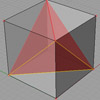
The tetrahedron is a popular platonic solid for designers. We’ve explained how to draw them using equilateral triangles here before. Recently I’ve found (sorry, lost the web address) a much quicker way of modeling a Tetrahedron using a cube. It’s very simple, just connecting the three opposite corners of the cube automatically makes them equal, resulting in the four equal faces. Of course this time you’ll have to calculate the actual edge length, but if you use the “box diagonal”…

Truncated Tetrahedron

December 21, 2011

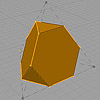
A truncated tetrahedron is an Archimedean solid, created by slicing a tetrahedron. Its faces are regular hexagons and triangles. Assuming you’ve created a tetrahedron, first join its faces to create a closed polysurface. Now, you may recreate the lines of the tetrahedron’s edges, either by drawing them or generating them (Curve / Curve from Objects / Duplicate Edge). While the edge lines are selected, hit (Curve / Point Object / Divide Curve / Number of Segments) and type 3 to create…

Construction of Tetrahedron

December 19, 2011

The tetrahedron is a platonic solid with four equal triangular faces (equilateral), six equal edges, and four vertices. In the construction of a tetrahedron, we will look closer at length transfers using compass-like tools in two- and three-dimensional space. To define the edge length of the first triangle, start with any two points in Cartesian space. Using a compass (arc or circle), draw two arches (or circles) using your initial points as corners and the distance between your points as…

  • Chapters

    • Algorithms
    • Discourses
    • Fabrications
    • Studios
  • Explore

    • All Keywords
    • Table of Contents
    • Monthly Archive
    • #voronoi
    • #tensegrity
    • #circle
    • #paper
    • #tangent
    • #tetrahedron
    • #random
    • #photoshop
    • #noise
    • #anemone
    • #tree
    • #kuka-prc
    • #processing
    • #brick
    • #image-sampler
    • #folding
    • #design-competition
    • #sinan
    • #fourier
    • #responsive
  • Search

  • Support designcoding!

  • Enjoying designcoding? Support me on Patreon to keep it growing. Thank you!

  • copyright 2026 designcoding.net | about | privacy policy | end user license agreement