
Modeling and Unrolling Truncated Tetrahedron
Truncation in mathematics and geometry refers to cutting off parts of a shape, typically the vertices, edges, or other extremities, to create a new modified figure. This process is often used with polygons, polyhedra, or functions. A truncated tetrahedron is a polyhedron we can derive from a regular tetrahedron by truncating (cutting off) its four vertices. This process creates a new shape with additional faces while maintaining its symmetry. In this tutorial video, I am modeling and unrolling a truncated tetrahedron in Rhinoceros software using basic commands. I studied the same topic in another post here, here, and here before. This time, this beautiful polyhedron is a topic of our Architectural Geometry class.
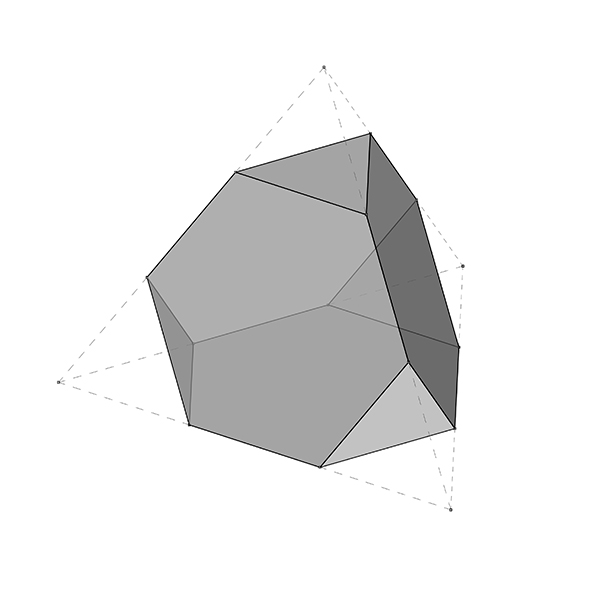
In this video series, I demonstrate in-class exercises from the Architectural Geometry course I teach to first-year students. Using Rhinoceros software, we explore Euclidean constructions, basic drawing, and transformation commands. In addition, we study introductory fractals, regular and semi-regular tessellations, patterns, modeling, and unrolling polyhedra. These short drawing exercises are beneficial for junior architects, interior designers, industrial designers, and others interested in related disciplines. I’ll be posting exercises weekly on my blog and other platforms. So, today’s exercise is about modeling and unrolling truncated tetrahedron.
The software used in this course is Rhinoceros 3d (www.rhino3d.com). However, if you want to find out more and see the whole list of this video series, you can check my YouTube channel at www.youtube.com/@designcodingnet. The music of this video is ‘Beautiful Oblivion’ by Scott Buckley (CC-BY 4.0). www.scottbuckley.com.au
Cite this post
Related Posts
Modeling and Unrolling Truncated Tetrahedron
March 10, 2024
Truncation refers to the process of shortening something by removing parts. You can apply truncation to numbers, text, or data in various contexts. A truncated polyhedron is a geometric solid formed by truncating the vertices of a regular polyhedron. Truncation involves cutting off the corners or vertices of the polyhedron in such a way that the original faces become polygons with new edges. This process creates new faces at the truncated vertices. It often results in a shape that is…
Folding a Truncated Tetrahedron
February 12, 2023
While digging through the lecture archive, I found this video I made in 2017. We introduce Platonic solids and Archimedean solids in the Design Geometry course at Istanbul Bilgi University. This video shows how we can create an Archimedean solid, the Truncated Tetrahedron, by folding it from a flat sheet. While doing this, I intersected the spheres by using the relations between the side lengths of the solid, and I calculated the rotation angles accordingly. First of all, I drew…
Truncated Tetrahedron
December 21, 2011
A truncated tetrahedron is an Archimedean solid, created by slicing a tetrahedron. Its faces are regular hexagons and triangles. Assuming you’ve created a tetrahedron, first join its faces to create a closed polysurface. Now, you may recreate the lines of the tetrahedron’s edges, either by drawing them or generating them (Curve / Curve from Objects / Duplicate Edge). While the edge lines are selected, hit (Curve / Point Object / Divide Curve / Number of Segments) and type 3 to create…
Modeling and Unrolling Mecon
December 14, 2024
The truncated octahedron is an Archimedean solid, characterized by a mix of hexagonal and square faces, and it has a very symmetrical and regular structure. Buckminster Fuller called this solid “Mecon”. The truncation process includes the cutting the edges of a polyhedron. We do this by dividing every edge of the polyhedron into 1/3s. Then, we carefully re-connect these division points to generate new, planar polygons. In the case of a truncated octahedron, we transform the 8 regular triangular faces…
Modeling and Unrolling Tetrahedron
December 12, 2024
A tetrahedron is a three-dimensional shape with four triangular faces, four vertices, and six edges. It is the simplest polyhedron and, in its regular form, has equilateral triangles as faces, with all edges of equal length. Thus, known as one of the Platonic solids, a regular tetrahedron is highly symmetrical, and its shape is considered stable and efficient in many natural and man-made structures. In this short tutorial video, I am modeling and unrolling a tetrahedron. I studied this platonic…