designcoding
About Table of Contents Keywords Monthly Archive
Support designcoding!

#folding

22 posts

Modeling Folds Relief Pattern

December 16, 2024
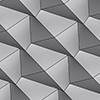
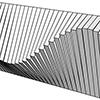
In art, design, and geometry, folding involves bending or creasing a material, such as paper, fabric, or other flexible materials into defined shapes or patterns. In this short tutorial video, I am modeling a folds relief pattern. This pattern stands out due to its resemblance to a collapsible folding system, combining both structural and aesthetic qualities. We refer to it as a folds relief pattern because it also mimics a relief design, creating light and shadow effects. This video series…
Folding Sphenoid Hendecahedron

December 15, 2024

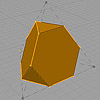
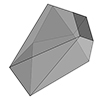
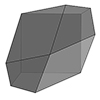
The sphenoid hendecahedron is a unique and interesting polyhedron. As the name implies, a “hendecahedron” is a polyhedron with 11 faces, while “sphenoid” refers to a specific type of shape that is often unusual, asymmetrical, and typically wedge-shaped. This polyhedron fills space, packing 3D space without gaps or overlaps. Its convex shape allows it to tessellate efficiently. Therefore, space-filling polyhedra play a crucial role in understanding tessellations and geometric arrangements, showing how to occupy 3D space without leaving any voids…

Folding Herschels Enneahedron

December 15, 2024

The Herschel nonahedron is a canonical polyhedron whose skeleton is the Herschel graph. It has 11 vertices, 18 edges, and 9 faces. Of the edges, 6 are short and 12 are long. It is characterized by having nine faces (hence the prefix “ennea” meaning nine in Greek). In this short tutorial video, I am folding Herschel’s enneahedron. To do that, I am constructing the interior angles of this polyhedron using its unrolled net. First, I am drawing the net by…

Folding Truncated Cuboctahedron

December 14, 2024

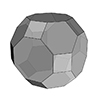
A truncated cuboctahedron is an Archimedean solid, meaning it is a highly symmetrical, convex polyhedron with identical vertices and faces of regular polygons. As its name suggests, you can create the truncated cuboctahedron by truncating (cutting off) the vertices of a cuboctahedron. A cuboctahedron is a rectified cube. After you model it, you can divide all its edges into 1/3s. Then, connect those division points to draw the squares, hexagons, and octagons. In this short tutorial video, I am folding…

Calatrava Door

May 12, 2023

Santiago Calatrava, a celebrated Spanish architect, structural engineer, sculptor, and painter, is renowned worldwide for his groundbreaking and futuristic designs, which frequently fuse architecture with engineering and artistry. Among his many notable works is the door design at Ernsting Warehouse in Coesfeld, Germany, constructed in 1985. I call this Calatrava Door because this design showcases Calatrava’s keen sense of functionality and geometry, with aluminum slats arranged vertically and connected along a curved line using hinges. When you raise the frame,…

Folding a Truncated Tetrahedron

February 12, 2023

While digging through the lecture archive, I found this video I made in 2017. We introduce Platonic solids and Archimedean solids in the Design Geometry course at Istanbul Bilgi University. This video shows how we can create an Archimedean solid, the Truncated Tetrahedron, by folding it from a flat sheet. While doing this, I intersected the spheres by using the relations between the side lengths of the solid, and I calculated the rotation angles accordingly. First of all, I drew…

Folding Pattern: Folding Experiments (3)

January 21, 2023

This is the continuation of the physical prototyping project of a folding pattern from 9 years ago. I simulate the folding pattern using the Rhino Grasshopper Kangaroo. As seen in the video, this is possible thanks to the pre-set hinge positions on the Rhino model. Thus, the folding motion can be animated on the screen. You can download and try the Grasshopper code. I often use this code in my ARCH 362 Parametric Modeling course. I think it is possible…

Evolution Door: Folding Experiments (2)

December 25, 2022

Here is the Grasshopper implementation of the famous Evolution Door design by Klemens Torggler. The code I used here is from my course on Parametric Modeling. This Grasshopper algorithm is a good exercise for the basics of Kangaroo. I attached several goal objects to a special mesh object created in Rhinoceros. Kangaroo’s goal objects work as expected to simulate the folding door behavior. I used the goal objects to fix some of the corner points and fix the edge lengths….

Folding Experiments: Basics (1)

December 6, 2022

We will try to create collapsible structures in this new series called Folding Experiments. In this example, we will be using Grasshopper and Kangaroo components to understand the Folding Experiments: Basics first. Like other projects, this is a Parametric Modeling course exercise that usually includes primary Grasshopper usage. In our first example, we will try to fold a mesh object. To be able to fold a surface like origami, we need to define the folding creases and faces. The most…

Cut – Fold – Craft Student Works

February 15, 2018

The Cut & Fold & Craft exercise is the mid-term project for last year’s Computation-based Basic Design Studio at İstanbul Bilgi University Faculty of Architecture. I really enjoyed the technique called Kirigami. Most of the projects are not flat-foldable but they are all cut from a single sheet of paper. This technique seemed a little bit limiting at the beginning, but the students managed to design very interesting compositions in the end. Below are some of the student works. I…

1 2 3 »
  • Chapters

    • Algorithms
    • Discourses
    • Fabrications
    • Studios
  • Explore

    • All Keywords
    • Table of Contents
    • Monthly Archive
    • #processing
    • #designcoding
    • #delaunay-triangulation
    • #rhombus
    • #hotwire-cutting
    • #kangaroo
    • #tetrahedron
    • #tangent
    • #fourier
    • #robot
    • #tiling
    • #deformation
    • #3d-printing
    • #text
    • #solar-analysis
    • #eps-foam
    • #hyperbolic-paraboloid
    • #spiral
    • #random
    • #computational-geometry
  • Search

  • Support designcoding!

  • Enjoying designcoding? Support me on Patreon to keep it growing. Thank you!

  • copyright 2026 designcoding.net | about | privacy policy | end user license agreement