
Folding Pattern: Folding Experiments (3)
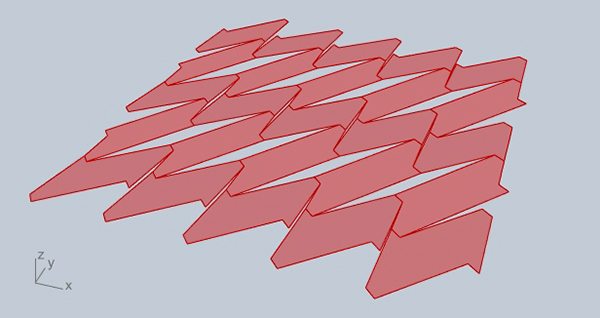
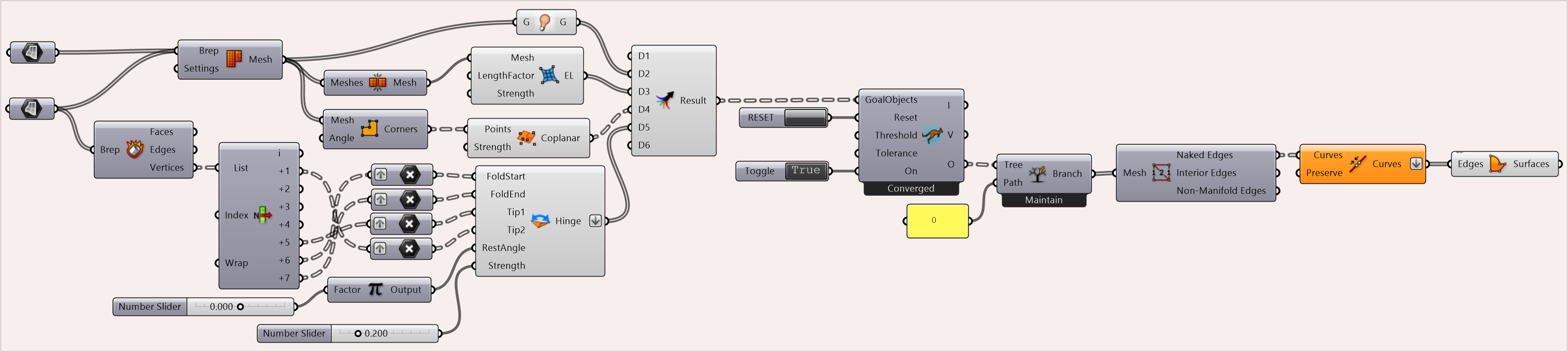
This is the continuation of the physical prototyping project of a folding pattern from 9 years ago. I simulate the folding pattern using the Rhino Grasshopper Kangaroo. As seen in the video, this is possible thanks to the pre-set hinge positions on the Rhino model. Thus, the folding motion can be animated on the screen. You can download and try the Grasshopper code. I often use this code in my ARCH 362 Parametric Modeling course. I think it is possible to design different patterns similar to this. This pattern is based on a project we worked on earlier. Unfortunately, the website where we got the pattern design is no longer available. It’s a good exercise to design such patterns that include angled hinge arrays this way.
Today, folded structures are not as popular as they used to be. Because they are difficult to manufacture and actuate realistically and reliably. However, in terms of design education, this topic remains pedagogically relevant. In the parametric modeling course, that’s why it’s still the topic of the week. Students are excited about making a design that can animate. They are also investigating the geometric rules that make this animation possible. But as with any digital production exercise, this becomes a homework assignment that must also include physical production in the real world. Therefore, in the future, I can do workshops where such designs and simulations are carried out with digital production techniques. For now, we will be in Grasshopper and Kangaroo only. Here is a video from 2014:
Cite this post
Related Posts
Evolution Door: Folding Experiments (2)
December 25, 2022
Here is the Grasshopper implementation of the famous Evolution Door design by Klemens Torggler. The code I used here is from my course on Parametric Modeling. This Grasshopper algorithm is a good exercise for the basics of Kangaroo. I attached several goal objects to a special mesh object created in Rhinoceros. Kangaroo’s goal objects work as expected to simulate the folding door behavior. I used the goal objects to fix some of the corner points and fix the edge lengths….
Folding Experiments: Basics (1)
December 6, 2022
We will try to create collapsible structures in this new series called Folding Experiments. In this example, we will be using Grasshopper and Kangaroo components to understand the Folding Experiments: Basics first. Like other projects, this is a Parametric Modeling course exercise that usually includes primary Grasshopper usage. In our first example, we will try to fold a mesh object. To be able to fold a surface like origami, we need to define the folding creases and faces. The most…
Tensile Fabric with Kangaroo
September 25, 2026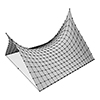
How much work we did last year for first-year architectural education! The tensile fabric study we carried out using Grasshopper Kangaroo in “Design Computing”, a first-year course I coordinated alongside my colleague Serkan Uysal, served as a baseline for the material research addressed in the Basic Design studio at that time. Such geometric optimizations in Kangaroo are no longer surprising or novel to anyone. However, experiencing these tools and possibilities in architectural education in the very first year offers a…
Kangaroo 2 Test
April 27, 2015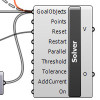
After several readings, I’ve understood the way of working the new and very interesting feature of Kangaroo 2: “Grab”. Now, we can actually grab the Grasshopper objects from Rhino viewport! Also, on one hand, the new Kangaroo has a very special way of working (not common to us, native Grasshopper users) and on the other hand, it is very very easy to use and understand now. I loved that. Here is the classical truss exercise I’ve made with my students…
Calatrava Door
May 12, 2023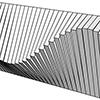
Santiago Calatrava, a celebrated Spanish architect, structural engineer, sculptor, and painter, is renowned worldwide for his groundbreaking and futuristic designs, which frequently fuse architecture with engineering and artistry. Among his many notable works is the door design at Ernsting Warehouse in Coesfeld, Germany, constructed in 1985. I call this Calatrava Door because this design showcases Calatrava’s keen sense of functionality and geometry, with aluminum slats arranged vertically and connected along a curved line using hinges. When you raise the frame,…