
Prototype Cut-Fold
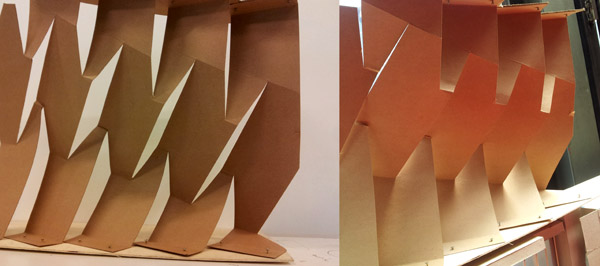
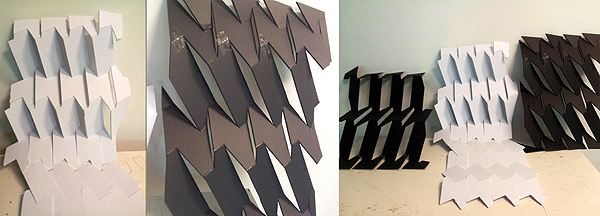
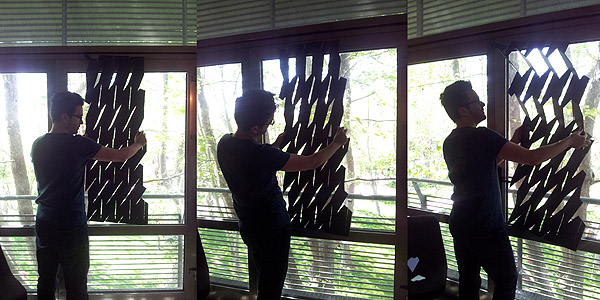
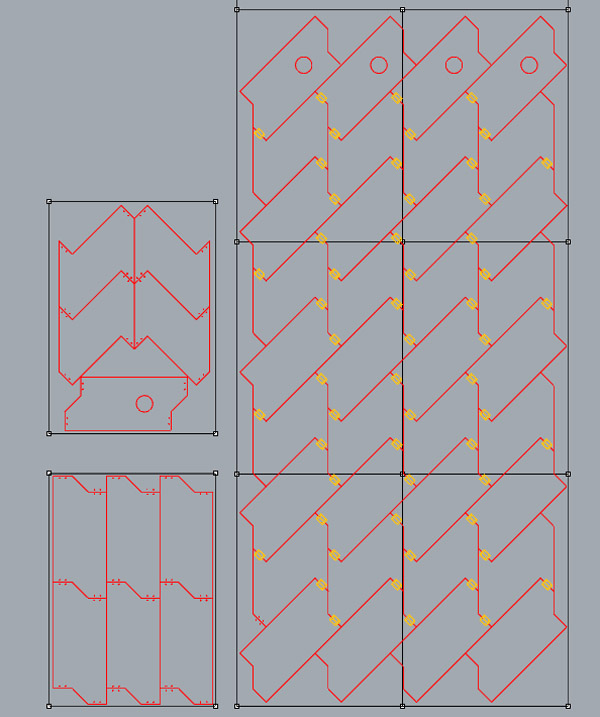
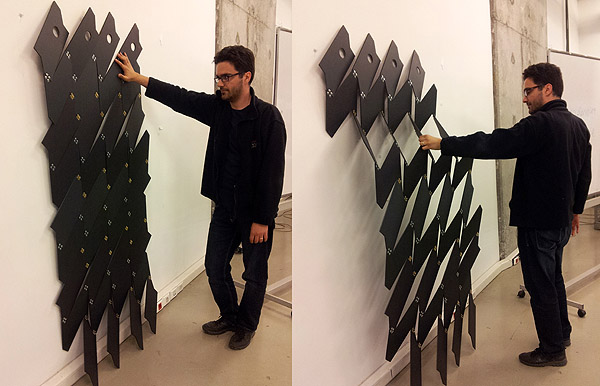
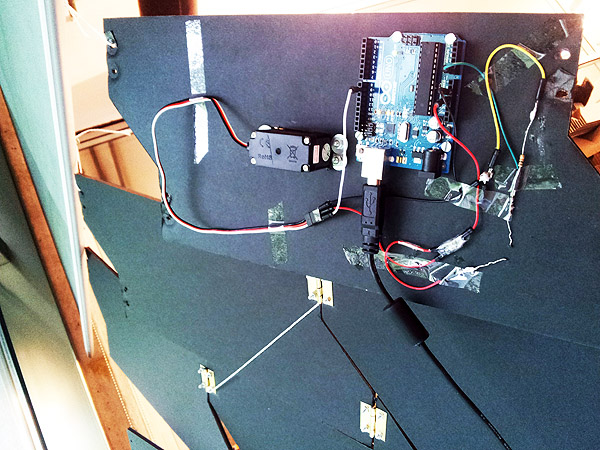
Inspired by this cut-fold pattern, we developed a prototype with Fulya Akipek. The first experiments were made from 3mm thick foamboards and they worked very well with 50×70 plates. However, when the project gets bigger and bigger, we needed to add a joint detail and use 5mm thick foamboards to achieve our goal (that is to develop a 1m by 2.5m shutter system). Then, we tried to animate its folding behavior by adding an Arduino setting with one motion sensor and a standard 11kg-cm torque continuous servo. This was another prototype we introduced at the “Animate Patterning” workshop, where students developed advanced versions of this system. This is the first try. More tests in different material thicknesses and patterns. First working prototype from 3mm foamboard and a regular cut pattern. It was small enough to form without a joint, we just score the edges so that they would rotate. However, for the bigger tests, we needed to put hinges in order to sustain structural stability. This is the standard regular pattern and plates to be sent to laser. Below is the final outcome. Then, we added a simple Arduino setting, including a light sensor and a continuous servo. Here is the result:
Cite this post
Related Posts
The Kirigami Fold
May 23, 2014
Third and the final outcome of the Animate Patterning workshop is coordinated by Mehmet Ali. Students tried to develop a kirigami-like surface animation (which is also a good solution to my one-servo question) while they studies numerous variations. They ended up with this panel, ready to be moved by Arduino; The workshop is organized together with Mehmet Ali Altın and Fulya Akipek. Students are, Murat Akırmak, Gizem Ceyhanlıer, Cem Kıyak, Bartu Can, Tuğba Levent, Seda Orhan, Gizem Gümüşkaya, Yunus Emre…
The Miura Fold
May 23, 2014
This is one of the works of the three-day workshop at Eskişehir Anadolu University, called “Animate Patterning“. This project is based on our previous folding experiment posted here, while students advanced it, testing a folding style called “Miura”. They built a 2.5m x 1m folding pattern, explained briefly here. After analyzing, and testing the folding technique, they drew the tessellation composed of a single parallelogram. They joined the structure together with hinges and screws. Finally, an Arduino setting is added including a continuous…
The Cogwheel
May 23, 2014
Here is another student project from the three-day workshop we conducted together with Fulya Akipek and Mehmet Ali Altın. Briefly, the idea was to develop a system of cogwheels that spin together to animate an entire pattern. It was about to develop a kinetic system with a simple Arduino-based setup, probably with one servo and a motion sensor. The integration of the cogwheels system and the underlying pattern was interesting research. Although it seemed very simple for a servo setup,…
Kinetic Tessellation
May 12, 2014
This is one of the ideas we’ve tested for the workshop “Animate Patterning“. Apart from the pattern that turns around, the torque, rotation radius and speed of the servo, weight, connection detail, and a number of foamboards become important inputs for this design. In the three-day workshop, one group of students interpreted this idea of using several moving layers and creating an emergent pattern at the perceptual level. However their project was slightly different from this one, I’ll post their…
Life Sciences
April 30, 2014
Here is the video of the project Life Sciences, designed together with Fulya Akipek, and engineered by Filika Interactive. To be presented in the 2014 Vitra Contemporary Architecture Series Exhibition, Life Sciences is an interactive project produced by Filika Interactive using Openframeworks following the conceptual and visual design by Fulya Özsel Alipek and Tuğrul Yazar. The project is an interactive presentation of the content obtained from the interviews made with primary education students by artists in a visual structure that resembles a…