designcoding
About Table of Contents Keywords Monthly Archive
Support designcoding!

#islamic-pattern

9 posts

Deformation of Islamic Patterns

March 2, 2024

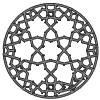
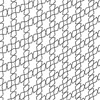
This is the new version of my previous study on the deformation of Islamic Patterns. I love the purity and simplicity of the geometric construction processes of these patterns. It is possible to observe them in many places in many different forms. By continuing this work, I aimed to highlight the pattern deformations that map out all the variation possibilities of these patterns. Unlike previous versions, this time I aimed to achieve results ready for laser-cutting production. As you will…

Hexagonal Star Lattice

December 18, 2023

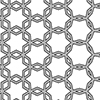
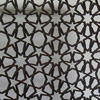
Here are the variations of classical six-pointed star patterns generated by Grasshopper. Generally, you can see these patterns under the title “Islamic patterns” because they are frequent in the decorations of mosques and palaces. I studied these patterns in Grasshopper earlier in these posts. I always find this an interesting geometry exercise. This time, my main goal was to develop a useful code only with the native Grasshopper components that create laser-cut-ready products of hexagonal star lattice. Thus, I made…

Star Lattice

May 15, 2023

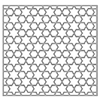
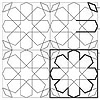
This is the six-pointed star lattice definition in Grasshopper. The definition is generating CNC or laser-ready results as seen below. In this code, first, I developed a common star pattern by exploding a hexagonal grid. The tricky part of this definition is the last part. There, you can see how you can use the Region Union (RUnion) component to add thickness to a pattern we have drawn before. The operation here will require trimming and extending commands under normal conditions….

Testing Spatial Deformation

September 13, 2013

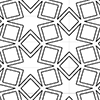
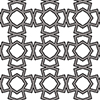
Instead of searching for an iterated and rule-based variety, this method captures instances of spatial deformation by transforming the hyperframe. This liberates us from a classical understanding of pattern deformations that are enframed within regular polygons, mostly rectangles or hexagons. Grasshopper has a built-in component to study such variety. The spatial Deform component gets vectors as inputs and transforms any given geometric object according to it. This website has also another nice use of this component.

Parametric Patterning Studies 2008 Exhibition

September 2, 2013

This was my first parametric patterning study we conducted together with Birgül Çolakoğlu at Yıldız Technical University in 2008. It was based on the pattern exercises we’ve experienced with BOT Graduate Students as a preliminary study within a Computational Design Studio. Later, the CNC fabrications were exhibited at İstanbul Bilgi University Digital Design Symposium. The exercise was about analyzing and reconstructing regular İslamic Patterns via MaxScript. After fundamental instructions about the language, students are encouraged to generate and fabricate patterns. Below…

PatGen: Islamic Pattern Generator

February 27, 2013

It was the 2008, eCAADe Presentation at Antwerp together with Birgül Çolakoğlu and Serkan Uysal. This paper presents a student work developed in the Introduction to Computational Design graduate course titled “Designing the Design” at Yildiz Technical University. The course focuses on the use of algorithms as design tools, rather than coding experiments. The course runs parallel to the shape grammar course. There, we study the basic concepts of computation through visual design exercises. So, the shape grammar course teaches…

Islamic Patterns of Semi-Regular Tessellations

October 22, 2012

The intricate harmony of the Islamic Patterns is amazing. The geometry of this and other Islamic pattern designs are explained in the 3rd chapter of Craig S. Kaplan’s Ph.D. dissertation. I constructed a semi-regular tessellation, particularly the 4.8 because it seems to open interesting explorations that mostly emerge from truncated squares. We know equilateral triangles and hexagons are also fundamental shapes for this task. However, the dual nature of the semi-regular tessellations makes a difference in most compositions. First, I…

Spatial Mapping made Easy

April 19, 2012

Trying to further improve my experience in parametric modeling, I’m mixing and joining old definitions to reveal different potentials. I’m experiencing spatial mapping or morphing in Grasshopper. This is an equivalent form of the “flow along surface” command in Rhinoceros. It re-builds a geometric composition over another space (from world XY coordinates onto a surface with UV coordinates here) This is especially useful in creating surface compositions from famous tessellations such as Voronoi. There are lots of things I can…

Parquet Deformation of Star Patterns

February 3, 2012

This is another starting point for pattern generation study in a dataflow environment. I tried to implement the parquet deformation of Islamic patterns in Grasshopper. I studied Hankin’s method of Islamic Pattern generation. Then I tried to simulate his process beginning with basic regular tiling (regular hexagonal tessellation). Craig S. Kaplan (here) explains this and other methods in his dissertation. A Simple Foundation We have already experienced the result of exploding any hexagonal grid, shifting its points with the help…

  • Chapters

    • Algorithms
    • Discourses
    • Fabrications
    • Studios
  • Explore

    • All Keywords
    • Table of Contents
    • Monthly Archive
    • #pvc-hose
    • #wave
    • #frege
    • #sinan
    • #archimedean-solid
    • #buckminster-fuller
    • #phyllotaxis
    • #macro
    • #moebius
    • #hyperbolic
    • #icosahedron
    • #stone
    • #paneling
    • #designcoding
    • #noise
    • #delaunay-triangulation
    • #animation
    • #islamic-pattern
    • #koch
    • #logic
  • Search

  • Support designcoding!

  • Enjoying designcoding? Support me on Patreon to keep it growing. Thank you!

  • copyright 2026 designcoding.net | about | privacy policy | end user license agreement