
Spatial Mapping made Easy
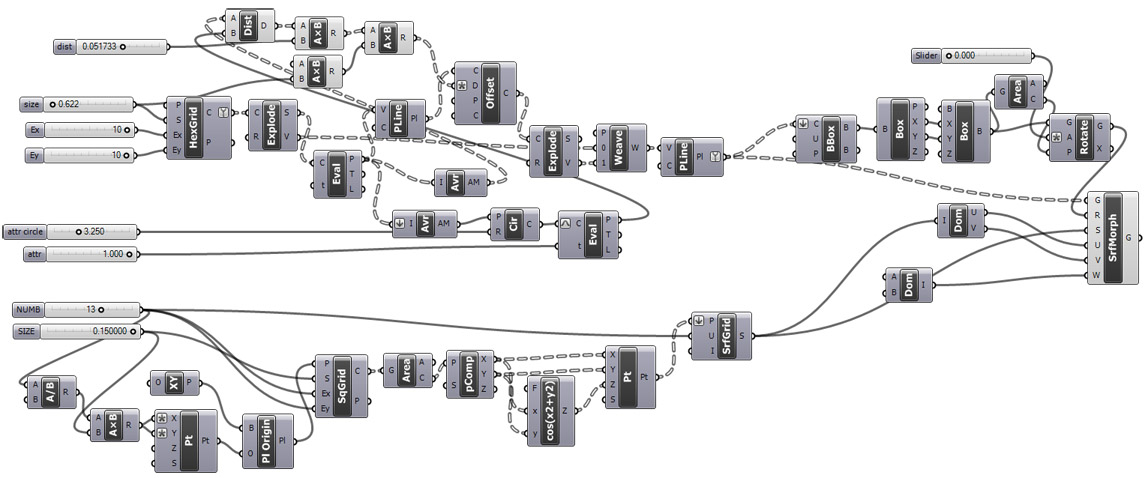
Trying to further improve my experience in parametric modeling, I’m mixing and joining old definitions to reveal different potentials. I’m experiencing spatial mapping or morphing in Grasshopper. This is an equivalent form of the “flow along surface” command in Rhinoceros. It re-builds a geometric composition over another space (from world XY coordinates onto a surface with UV coordinates here) This is especially useful in creating surface compositions from famous tessellations such as Voronoi. There are lots of things I can do with this functionality. Here is the first example of reconstructing the previous work of Islamic patterns (here) onto a parametric surface (described here). This saves me lots of time; a non-uniform parquet deformation is projected onto the space of the surface with equation cos(x2+y2). There is a point attractor on the reference pattern that travels on a planar circle. However, not itself, but the “ghost” of that point is also projected on the surface.
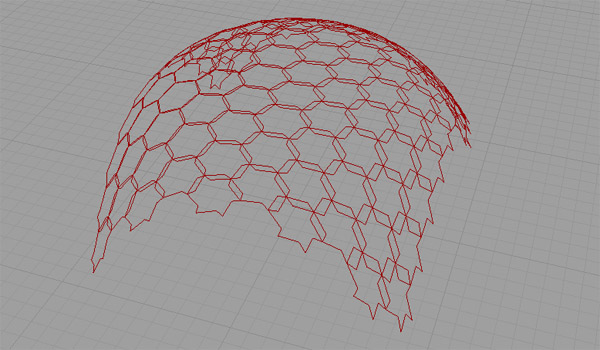
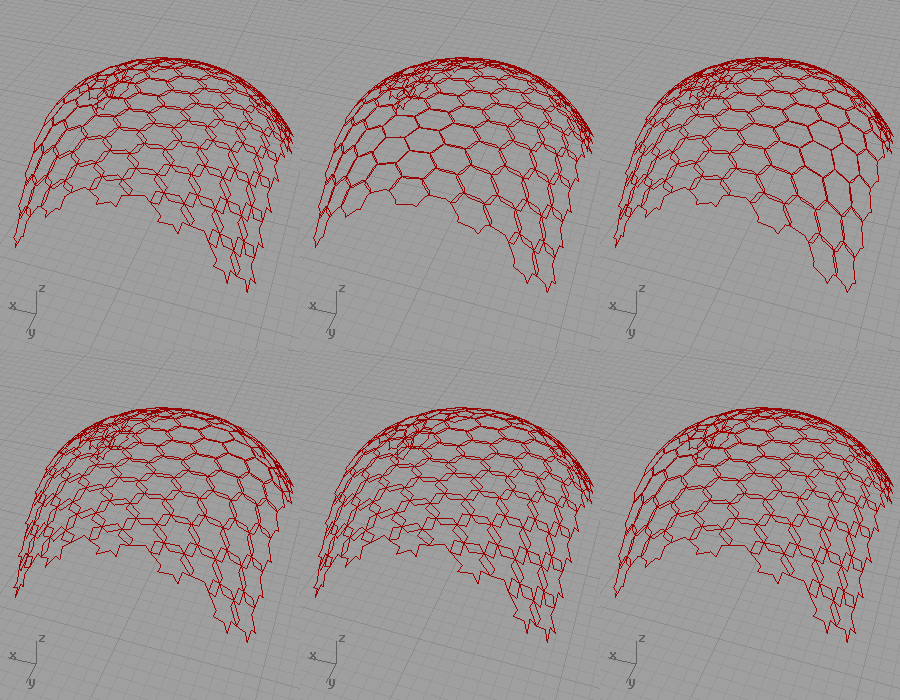
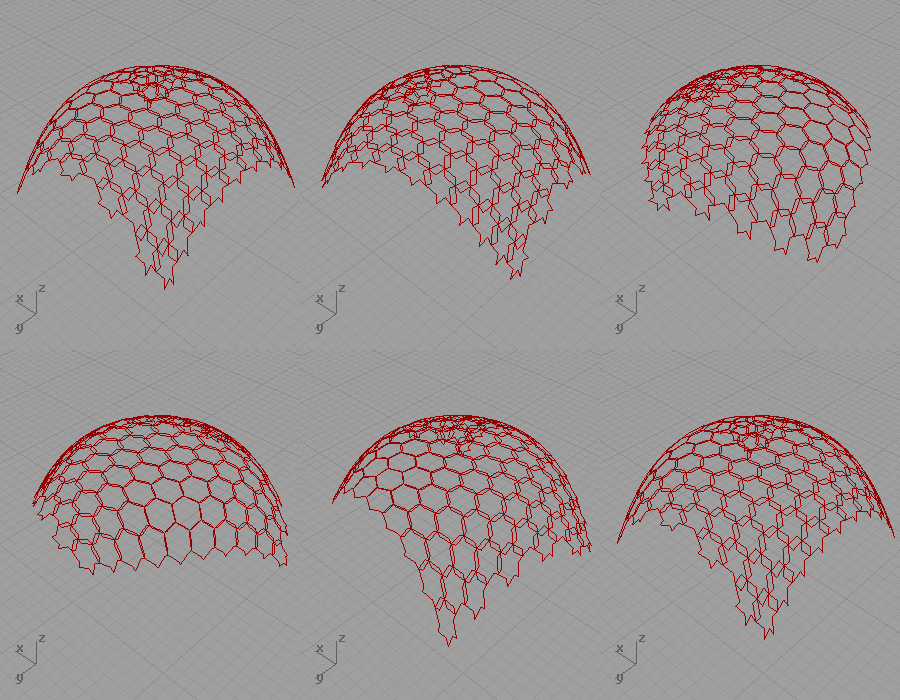
The second animation rotates the bounding box so that curves are rotated-projected. The third animation (below) is the study of surface coordinates that no longer uses the surface itself, but rather incorporates with the manifold, the abstract space it represents. It simply scales the bounds of the surface equation. This is somehow both terrifying and beautiful, how a constant increase of a slider parameter creates those movements on the surface. (Be patient if the animation loads slowly) Again, I fell in love with mathematics.

Cite this post
Related Posts
Testing Spatial Deformation
September 13, 2013
Instead of searching for an iterated and rule-based variety, this method captures instances of spatial deformation by transforming the hyperframe. This liberates us from a classical understanding of pattern deformations that are enframed within regular polygons, mostly rectangles or hexagons. Grasshopper has a built-in component to study such variety. The spatial Deform component gets vectors as inputs and transforms any given geometric object according to it. This website has also another nice use of this component.
Parquet Deformation of Star Patterns
February 3, 2012
This is another starting point for pattern generation study in a dataflow environment. I tried to implement the parquet deformation of Islamic patterns in Grasshopper. I studied Hankin’s method of Islamic Pattern generation. Then I tried to simulate his process beginning with basic regular tiling (regular hexagonal tessellation). Craig S. Kaplan (here) explains this and other methods in his dissertation. A Simple Foundation We have already experienced the result of exploding any hexagonal grid, shifting its points with the help…
Breaststroke Surface Revisited
January 24, 2013
Previous studies on trigonometric surface equations showed me an interesting alternative. This is the modification of the breaststroke surface definition. This time, I’m trying to fix the equation and change input values in a fashion that the waves of the surface are not symmetrical. Here are a few experiments on it; (Size, 44.8, X=10, Y=5, animating X’s from 0 to 32) (Size: 42, X=7, Y=5, animating X’s from 0 to 32) The equation is (cos(y²) – sin((x/5)-y²)) * 10. This…
Breaststroke Surface
July 17, 2012
This was before Spherical Fantasies, while I was trying to update my surface equation definition. In between designerly intentions and mathematical facts, it’s hard to maintain a process, while keeping the definition yet simple and open to exploration. A little tired of mathematical definitions, I started to give names to the animate surfaces I develop. Like the Spherical one, this is also a trigonometric equation of z = cos(x) + sin(x-y2) / 2. The most boring part of these is…
Spherical Fantasies
July 16, 2012
This is about conforming distortions on surfaces and creating imperfect (say ugly) surfaces. I started with planar surfaces, however, I continued with spherical ones. There are interesting results when applying trigonometric functions to spherical surfaces. Example surface equations: Please be patient if animations are loading slowly. But they represent a way of creating free-form-looking surfaces, highly mathematical behind the scene. As you see, I used the UVW coordinate system of the sphere, subdivided into 20 pieces. W represents the amount…