
Breaststroke Surface
This was before Spherical Fantasies, while I was trying to update my surface equation definition. In between designerly intentions and mathematical facts, it’s hard to maintain a process, while keeping the definition yet simple and open to exploration.
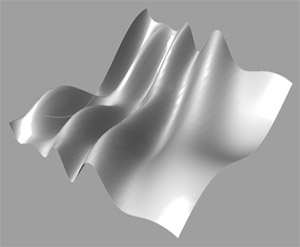
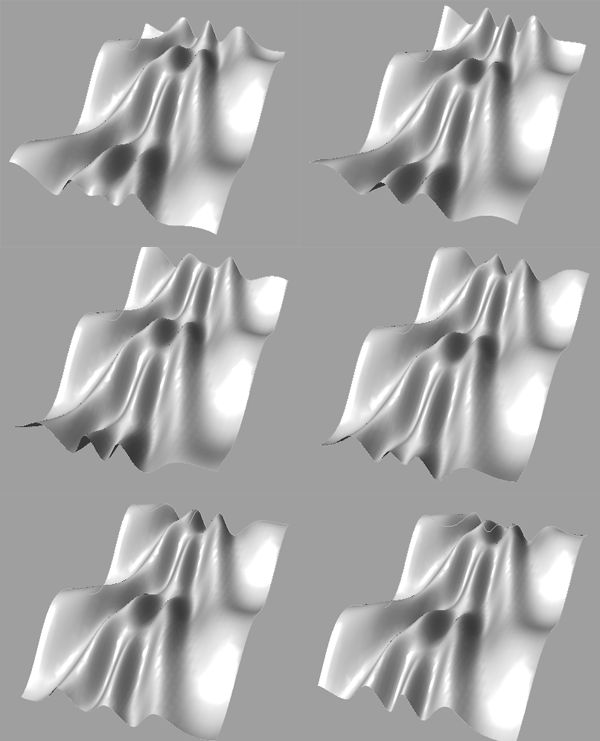
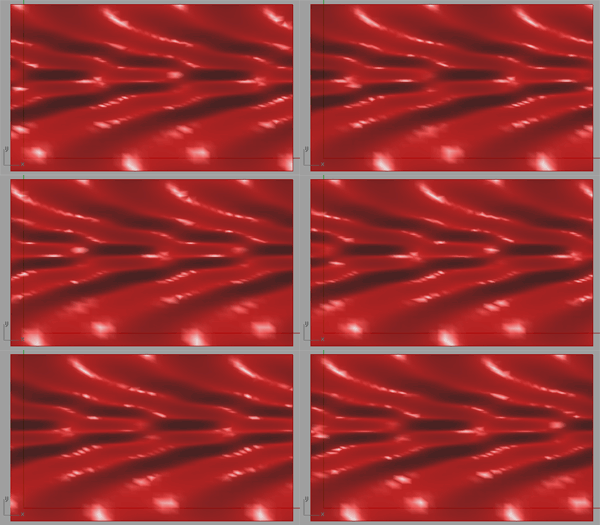
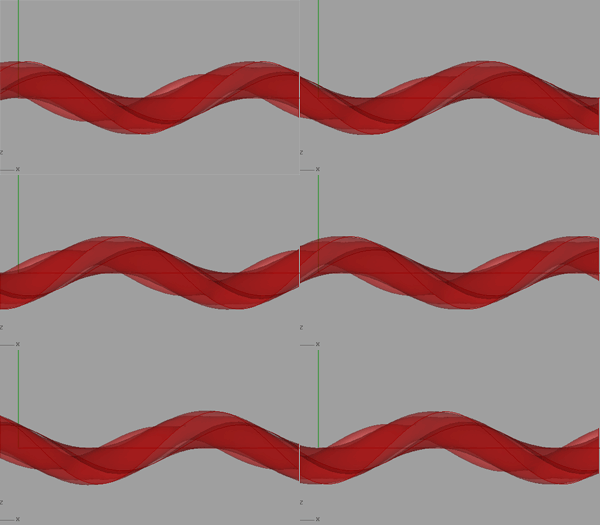
A little tired of mathematical definitions, I started to give names to the animate surfaces I develop. Like the Spherical one, this is also a trigonometric equation of z = cos(x) + sin(x-y2) / 2. The most boring part of these is becoming the sliders. I wanted to create a simple surface that is animate, having no single form. Recently I found a way to manipulate form using native Grasshopper (without Firefly of GHowl) to take the system’s date to apply it to the definition in real-time. Maybe I’ll try sketching on such surfaces that are highly dependent on the actual time and date it is run. For example, I want it to close down at night time to get some rest, or open up in the mornings to become a shelter for people who are taking a coffee and breakfast. We need passions and dreams to go on living, however naive they are.
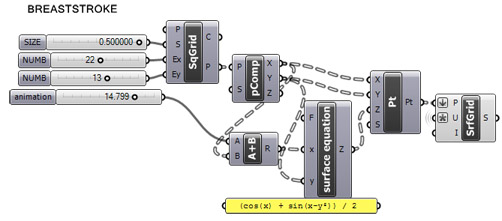
The updated definition is here:
Cite this post
Related Posts
Breaststroke Surface Revisited
January 24, 2013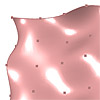
Previous studies on trigonometric surface equations showed me an interesting alternative. This is the modification of the breaststroke surface definition. This time, I’m trying to fix the equation and change input values in a fashion that the waves of the surface are not symmetrical. Here are a few experiments on it; (Size, 44.8, X=10, Y=5, animating X’s from 0 to 32) (Size: 42, X=7, Y=5, animating X’s from 0 to 32) The equation is (cos(y²) – sin((x/5)-y²)) * 10. This…
Spherical Fantasies
July 16, 2012
This is about conforming distortions on surfaces and creating imperfect (say ugly) surfaces. I started with planar surfaces, however, I continued with spherical ones. There are interesting results when applying trigonometric functions to spherical surfaces. Example surface equations: Please be patient if animations are loading slowly. But they represent a way of creating free-form-looking surfaces, highly mathematical behind the scene. As you see, I used the UVW coordinate system of the sphere, subdivided into 20 pieces. W represents the amount…
Spatial Mapping made Easy
April 19, 2012
Trying to further improve my experience in parametric modeling, I’m mixing and joining old definitions to reveal different potentials. I’m experiencing spatial mapping or morphing in Grasshopper. This is an equivalent form of the “flow along surface” command in Rhinoceros. It re-builds a geometric composition over another space (from world XY coordinates onto a surface with UV coordinates here) This is especially useful in creating surface compositions from famous tessellations such as Voronoi. There are lots of things I can…
Scary Patterns
August 6, 2026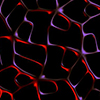
While digging through my archives, I found an old animation I made in 2023. Back then, I was generating patterns with Parakeet. Thanks to this talented add-on, I managed to create a nice pattern by dressing a different component onto a Snub Square tiling base. However, for some reason, things started turning into a horror movie after that. MultiPipe was popular back then. So, I converted this pattern into surfaces using MultiPipe and attempted an animation using Rhino’s rendered viewport…
Chamfered Polyhedra
April 2, 2025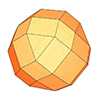
I had been researching Goldberg Polyhedra for a while. While exploring how to perform chamfer operations in Grasshopper, I found some interesting results. I want to share them with you. In this Grasshopper project, I reused my previous work, where I built a dodecahedron using the golden ratio. Essentially, all I did was add the Fillet Edge component. I don’t use this component much, so I learned it through this process. At one point, I realized I had created a…