designcoding
About Table of Contents Keywords Monthly Archive
Support designcoding!

#gauss

5 posts

Voronoi Bubbles

November 11, 2026
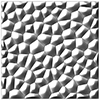
Informal use of Voronoi diagrams can be traced back to Descartes in 1644 Peter Gustav Lejeune Dirichlet used two-dimensional and three-dimensional Voronoi diagrams in his study of quadratic forms in 1850. British physician John Snow used a Voronoi-like diagram in 1854 to illustrate how the majority of people who died in the Broad Street cholera outbreak lived closer to the infected Broad Street pump than to any other water pump. Voronoi diagrams are named after Georgy Feodosievych Voronoy who defined…
Gaussian Curvature

September 23, 2026

The development of geometry began by measuring the world as discrete objects. Moving beyond measuring nature, it evolved into reasoning, calculation, and mathematics. Platonic solids were one of the most elegant and beautiful ideas reached by geometry. Pondering why there are only five of them was a tribute to collective human intelligence. Earlier in this blog, we modeled polyhedra, like the Platonic solids, using geometric construction methods. This process was like solving a puzzle. To construct a point whose distances…

Gaussian Curvature and Surface Paneling

January 24, 2019

As the design of free-form architectural surfaces becomes easier, questioning and foreseeing the feasibility of the construction of these surfaces becomes important. Such an inquiry requires sufficient knowledge of architectural geometry besides the knowledge of materials and structural systems. In this article, we present a preliminary example of a guide. It supports the design and production process of building surfaces with different geometric properties is presented. This guide aims to reveal the relationship between Gaussian curvature and surface paneling. It…

Points by Curvature

April 26, 2012

This is the basic form of a surface division, based on curvature. As each point on the surface has a curvature value, this might be used to dispatch those values and see the points at flat and curved parts of the surface. I used my favourite surface equation definition (here) as implemented equation of cos(x)+cos(y) in the animation below.

Surface Component based on Gaussian Curvature

December 22, 2011

This experiment is based on a traditional surface-component definition. However, the variation of components is associated with Gaussian curvature. We just control the subdivision and a multiplier value. Results are interesting in as an educational tool to explain NURBS surface curvature and its utilization for Design Geometry. Different surface shapes generate exciting results. Of course, this could be much improved by recognizing positive and negative curvature values, (probably only accepting positive ones maybe).

  • Chapters

    • Algorithms
    • Discourses
    • Fabrications
    • Studios
  • Explore

    • Table of Contents
    • Monthly Archive

    • All Keywords
    • #unrolling
    • #boolean
    • #hilbert
    • #workshop
    • #le-corbusier
    • #lacan
    • #cairo-pentagonal
    • #dodecahedron
    • #dirichlet
    • #text
    • #moulding
    • #timer
    • #art
    • #parametric-curve
    • #archimedean-solid
    • #hexagon
    • #curvature
    • #processing
    • #rhombicosidodecahedron
    • #tetrakaidecahedron
  • Search

  • Support designcoding!

  • Enjoying designcoding? Support me on Patreon to keep it growing. Thank you!

  • copyright 2026 designcoding.net | about | privacy policy | end user license agreement