designcoding
About Table of Contents Keywords Monthly Archive
Support designcoding!

#circle

8 posts

Discrete Fourier Transform

May 8, 2025
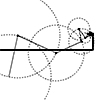
The Fourier Transform is a powerful mathematical technique that allows us to analyze the different frequency components within a signal or shape. Its discrete version, the Discrete Fourier Transform (DFT), is used when working with numerical data. I studied the Fourier Series here before. One of the most fascinating aspects of the DFT is that it can represent a signal or shape using rotating circles (or vectors). Each circle corresponds to a specific frequency, amplitude, and phase. When connected in…
Constructing Tangent Circles

December 11, 2024

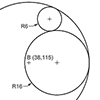
In geometry, “tangent” refers to a scenario where a line, curve, or surface touches another at exactly one point without crossing or leaving a gap. A tangent line to a circle is a straight line that touches the circle at only one point, and it is perpendicular to the radius at that point. Two circles can be tangent either internally or externally. Geometric constructions using a compass and straightedge can help accurately calculate tangent circles. Thus, the “constructing tangent circles”…

Attractor Basics

June 29, 2023

In this short tutorial, I want to give Grasshopper beginners the basics of how we create attractor systems. The Grasshopper definition you see in the below figure is the equivalent of array-type copying operations in CAD. However, unlike in CAD programs, here we are dealing with multiple generations of objects rather than transformations. Attractor Basics: Data Matching In the application you see in the figure below, each row of the hexagonal grid created with HexGrid has a different radius value….

Circle from Three Points

November 1, 2013

I learned this method from the open math resources website. I couldn’t help myself repeat it in Rhinoceros. It was quite fun to solve circle tangency problems in 2D, this is one of them: drawing the circle that passes three given points, not using ready-made commands but only geometric tools of the circle (compass) and ruler (line). Here is the sequence of it: First of all, we need to know that the circle we are looking for is centered somewhere…

Tangent Circles Exercise

November 19, 2012

The first-year Architectural Geometry course includes Euclidean constructions as a study of associative geometry. We have exercised the below questions to study this topic. These are three mutually tangent circles, that can be drawn using only a compass and ruler, without built-in tangency functions in Rhino. Such exercises are expected to improve students’ reasoning. We believe architectural geometry education should encourage a conception that allows students to think about what they are doing and control their process, rather than just…

Circle Packing Experiments

October 3, 2012

Since last week, I’m very curious about circle packing. There are a couple of complete solutions on the internet. I’m still in the early steps of such a solution yet. A full circle packing means that it does not include any gaps and each circle is tangent to all possible neighbors. Sounds easy in Grasshopper but I couldn’t see any solution yet. There are some circle-packing attempts but they have gaps. Also, I don’t want to use an evolutionary solver…

Conformal Circle Packing

September 19, 2012

After a couple of days of studying the mysterious Doyle spiral, I’ve decided to test an approach of circle packing from conformal mapping. First, I tried to understand the Poincare disk (earlier at here, here, and here and here). I used it as the hyperbolic representation of space on a two-dimensional plane. Then, I linked a regular hexagonal grid and rebuilt it after the hyperbolic distortion. This led me to find the below hexagonal grid. Therefore, it looks like a suitable…

Circle Crossing

December 25, 2011

I am learning Grasshopper. In this Circle Crossing definition, I tried to create the above pattern (also described in Sunflower Spiral) as simply as possible, this definition creates not only spirals but is also capable of more tessellations I guess. Maybe a three-dimensional equivalent might be studied in the future. As you can see from the definition, I started with a large circle. Then, I divided it into segments and placed new circles centered on them. Finally, I divide the…

  • Chapters

    • Algorithms
    • Discourses
    • Fabrications
    • Studios
  • Explore

    • All Keywords
    • Table of Contents
    • Monthly Archive
    • #tetrahedron
    • #polygon
    • #minimal-surface
    • #unrolling
    • #canopy
    • #geodesic
    • #parametric-curve
    • #workshop
    • #eps-foam
    • #cube
    • #le-corbusier
    • #facade
    • #aperiodic
    • #complex-number
    • #stone
    • #hoopsnake
    • #truncated
    • #sandblasting
    • #non-euclidean
    • #attractor
  • Search

  • Support designcoding!

  • Enjoying designcoding? Support me on Patreon to keep it growing. Thank you!

  • copyright 2026 designcoding.net | about | privacy policy | end user license agreement