designcoding
About Table of Contents Keywords Monthly Archive
Support designcoding!

#bezier-curve

13 posts

Aletheia

November 14, 2026
My interest in polyhedra, Bézier curves, and other computer-generated geometric and mathematical abstractions does not come from a desire to model nature. What draws me to them is their sort of “alienness.” These are not objects we encounter ready-made in the natural world; they are constructed by the human mind. Yet once we construct them, they are no longer subject solely to our minds. The moment we define a tetrahedron, a Bézier curve, or any other geometric structure, relationships, necessities,…
Curve Continuity

November 13, 2026

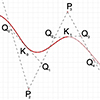
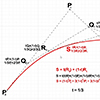
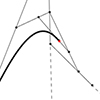
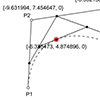
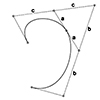
Continuity in piecewise Bézier curves was one of the important topics of our first-year architecture geometry course. Here, I will briefly summarize what this course attempts to convey. Since there are many ways to define it, I have summarized them below and tried to indicate how each is perceived visually. C0: Position Continuity This refers simply to the end-to-end connection of two Bézier curve segments; there are no gaps between the curves. The endpoint of the first curve is on…

Guitar Shape

November 2, 2026

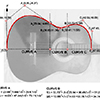
Traditionally, when shaping a guitar form, a luthier relies on a combination of craftsmanship and precise geometric tools. This process involves mastering wood-bending techniques around rigid molds, guided by physical templates to achieve the desired acoustic and aesthetic curves. Curves, once more I love talking about this so much. Could my obsession with Bézier curves be OCD? The history of curved shape construction reflects a transformative journey from physical craftsmanship to sophisticated digital computation, primarily driven by the demands of…

Calculating a Guitar’s Surface Area with Bézier Curves

August 27, 2024

Below is the first paper of my son, Mete Yazar. It is about a mathematical and geometric exercise of calculating the surface area of an arbitrary shape (a classical guitar’s body panel). He did a good job in utilizing Bezier/de Casteljau curves and generating the parametric equations of the piecewise curve. I helped him to validate the results by using rhinoceros CAD software. Therefore, it seems that his calculations are correct. In this paper, we attempted to calculate a guitar’s…

B-Spline Decomposition

February 6, 2024

This is a short video tutorial on the B-Spline decomposition I studied earlier here. This tutorial demonstrates how to decompose a B-Spline curve into Bezier curves using Rhino. Despite the original Bezier-de Casteljau algorithm requiring degree+1 control points, Rhino allows drawing a degree-3 curve with any number of control points. By examining knot points and dividing segments appropriately, the B-Spline curve can be manually subdivided into Bezier curves. This involves placing control points, dividing segments, and connecting points in a…

Parametric point on a Bezier curve

February 1, 2024

In this short tutorial, I am going to show you how to locate a parametric point on a Bezier curve. This will be a third-degree cubic Bezier curve. So, I start by placing four control points. I name these points from P0 to P3. Then, I connect them by a polyline in order. I explode the polyline into the segments. The parameter of my point must be a number between 0 and 1. I will divide the segments, so I…

B-Spline Construction

January 25, 2024

I have been studying the Bezier-De Casteljau algorithm for several years. Last week, I finally managed to understand and implement B-Spline Construction in Rhino and Grasshopper Python code, using the Cox-De Boor algorithm. This algorithm calculates the effect of control points on a B-Spline with many control points. After this, I am not limited to the degree+1 control points. This animation shows both algorithms working together. This Rhino Python code in a Grasshopper definition can handle three tasks. The first…

Bezier Function Extractor

December 26, 2023

Today’s curve is the beautiful Bezier curve. A series of linear interpolations between the coordinates of control points describe a Bezier curve. So, I created a simple tool in Grasshopper called Bezier Function Extractor to experiment with this elegant construction. In the linear form (degree 1) the linear interpolation between 2 points (P1 and P2). The point at parameter t (0<= t <= 1); Q = tP1 + (1-t)P2. In the second degree, we need three points (P1, P2, and…

Compass only Construction of Bézier Curves

September 2, 2021

This is a new paper published in Nexus Network Journal. I tried to implement euclidean constructions by compass in the approximation of famous parametric curves; Bézier curves, and B-Splines. Then, I created the algorithms to calculate the number of steps on a compass-only construction of Bézier curves. I developed a simple Python script to simulate the geometric constructions. However, I have been studying this topic for nearly four years. In the future, I wish that it would be a good…

Drawing a Basis Spline with Cubic Bézier Spans

May 1, 2018

I realized this method of constructing basis splines from given control points while searching for a way to teach students about basis splines. I couldn’t find an easy and visual method to create clamped basis splines by connecting simple cubic Bézier spans. It is a tough job and requires lots of complex equations. However, I suddenly realized that there is a special way of doing that. So I decided to share this with the people searching for an easy way…

1 2 »
  • Chapters

    • Algorithms
    • Discourses
    • Escapes
    • Fabrications
    • Studios
  • Explore

    • Table of Contents
    • Monthly Archive

    • All Keywords
    • #cube
    • #wave
    • #octahedron
    • #shape-grammars
    • #kangaroo
    • #parakeet
    • #pvc-hose
    • #gyroid
    • #artificial-intelligence
    • #islamic-pattern
    • #nesting
    • #folding
    • #koch
    • #beauty
    • #sphere
    • #fourier
    • #descartes
    • #unrolling
    • #cycloid
    • #escher
  • Search

  • Support designcoding!

  • Enjoying designcoding? Support me on Patreon to keep it growing. Thank you!

  • copyright 2026 designcoding.net | about | privacy policy | end user license agreement