
Compass only Construction of Bézier Curves
This is a new paper published in Nexus Network Journal. I tried to implement euclidean constructions by compass in the approximation of famous parametric curves; Bézier curves, and B-Splines. Then, I created the algorithms to calculate the number of steps on a compass-only construction of Bézier curves. I developed a simple Python script to simulate the geometric constructions. However, I have been studying this topic for nearly four years. In the future, I wish that it would be a good foundation for my further education.
This article reveals a mathematical bridge between compass-only geometric constructions and parametric curves. Therefore, a set of construction algorithms are presented. I used these algorithms to locate points on any Bézier curve or B-Spline by using an abstract compass. They aim to translate the B-Spline definition of Paul de Casteljau into the modified versions of compass-only constructions explained by Aleksandr Kostovskii. I developed several computer scripts to simulate these constructions while calculating and minimizing their computational complexities.
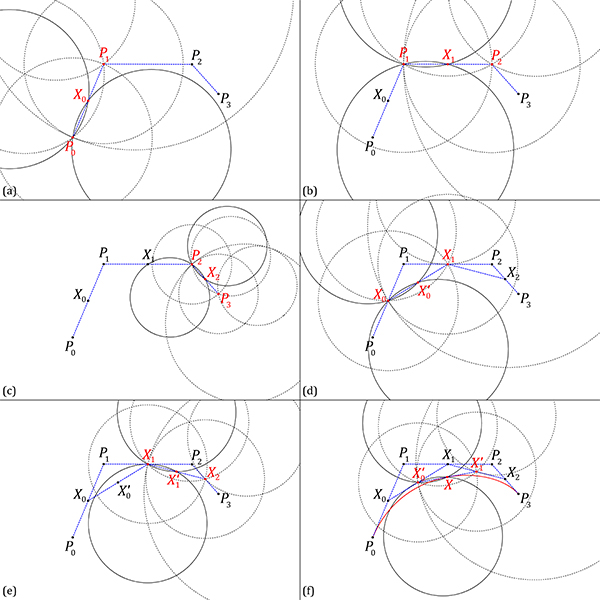
Compass construction of a point on a cubic Bézier curve (d=3, t=0.5). But, it is difficult to explain here. In short, I am using compass-only constructions to simulate the linear interpolation of two points.
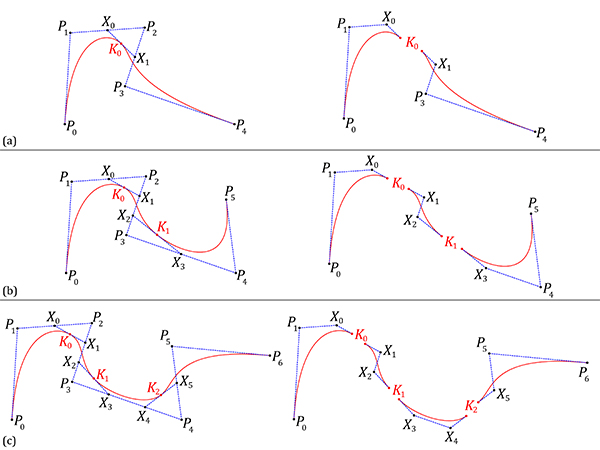
Compass-only de-construction pattern of several cubic B-Splines (d=3), locating their knots. Thus, it divides any given cubic B-Spline into its spans.
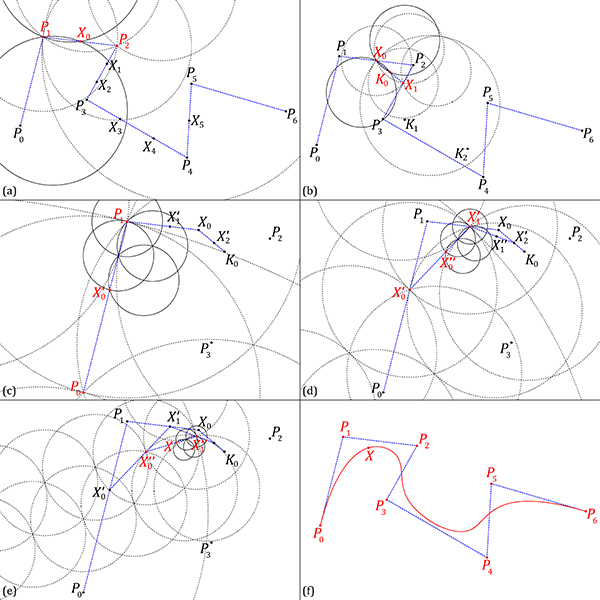
Calculation of the minimum number of compass operations required to construct a point at t = 0.6 on any span of a cubic B-Spline with seven control points (p=7, d=3).
You can find the full paper here. It explains the details and number of steps on a compass only construction of Bézier curves.
Cite this post
Related Posts
B-Spline Decomposition
February 6, 2024
This is a short video tutorial on the B-Spline decomposition I studied earlier here. This tutorial demonstrates how to decompose a B-Spline curve into Bezier curves using Rhino. Despite the original Bezier-de Casteljau algorithm requiring degree+1 control points, Rhino allows drawing a degree-3 curve with any number of control points. By examining knot points and dividing segments appropriately, the B-Spline curve can be manually subdivided into Bezier curves. This involves placing control points, dividing segments, and connecting points in a…
Parametric point on a Bezier curve
February 1, 2024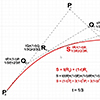
In this short tutorial, I am going to show you how to locate a parametric point on a Bezier curve. This will be a third-degree cubic Bezier curve. So, I start by placing four control points. I name these points from P0 to P3. Then, I connect them by a polyline in order. I explode the polyline into the segments. The parameter of my point must be a number between 0 and 1. I will divide the segments, so I…
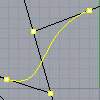
I realized this method of constructing basis splines from given control points while searching for a way to teach students about basis splines. I couldn’t find an easy and visual method to create clamped basis splines by connecting simple cubic Bézier spans. It is a tough job and requires lots of complex equations. However, I suddenly realized that there is a special way of doing that. So I decided to share this with the people searching for an easy way…
Constructing Irregular Tiling
December 11, 2024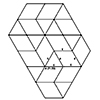
Using a compass and straightedge enables precise geometric constructions, allowing for the creation of complex tessellations. To begin these constructions, a single starting point is sufficient. Circles, which represent a collection of points at a specific distance from the center, and straight lines, which represent a collection of points in a particular direction, are utilized for geometric constructions. In this short tutorial, we move on with the beginner-level drawing exercises. This time, I am drawing an irregular tiling with triangles…
Constructing Snub Square Tiling
December 11, 2024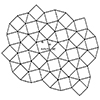
Snub Square Tiling is a semi-regular tessellation of the plane, composed of two squares and three regular triangles at each vertex. The arrangement of these two regular shapes seamlessly covers the plane without any gaps or overlaps. It is one of the eight semi-regular tessellations known in geometry. The dual of Snub Square Tiling is Cairo Pentagonal Tiling, which we will explore later. In this short tutorial, I am drawing and constructing the Snub Square Tiling by using an abstract…