designcoding
About Table of Contents Keywords Monthly Archive
Support designcoding!

#attractor

17 posts

Basic Grid Deformation

July 5, 2023

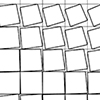
I am still trying to find the simplest solution to some geometric definitions. This is why I called this Grasshopper definition “Basic Grid Deformation”. Here you see the Curve Proximity (CrvProx) component in use. This component calculated the shortest distance between two curves. I think the underpinnings of this component are very interesting. I hope I can code it in Python one day. In order to see the result more clearly, the Previews of the Interpolate Curve (IntCrv) and Square…

Attractor Basics

June 29, 2023

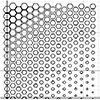
In this short tutorial, I want to give Grasshopper beginners the basics of how we create attractor systems. The Grasshopper definition you see in the below figure is the equivalent of array-type copying operations in CAD. However, unlike in CAD programs, here we are dealing with multiple generations of objects rather than transformations. Attractor Basics: Data Matching In the application you see in the figure below, each row of the hexagonal grid created with HexGrid has a different radius value….

Point Waves

May 29, 2023

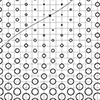
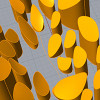
Here is another basic exercise in Grasshopper. This exercise “Point Waves” creates wave-like deformations on the grids of points. The major function of the definition is to calculate the distances from every point of a grid to an attractor point, with the help of Distance (Dist). Then it sorts them from the smallest to the largest (= closest to farthest) with the Sort List (Sort) component. This component takes and matches two lists of the same size, called key (K)…

ARCH362 Basics

March 17, 2015

Another tutorial we’ve analysed together with ARCH362 students last week was the one that mimics Zaha Hadid’s Kartal Masterplan. Although the project of Zaha Hadid was pretty much controversial among Turkey’s architectural critics (and most people also), we’re not dealing with how successful or “ugly” it is, but the most simple version of the technique that generated such forms. We have a term “çakma” in Turkish that means “conscious imitation, possibly full of errors”. But however, this “çakma Kartal Project” example has…

Fracture

September 2, 2013

Fracture is a simple effect experiment on Grasshopper. Although it is not the best tool for an interactive media installation regarding its performance, I tried to use it as a simple sketching tool for concept development. It is the sketch of a material system we are working on nowadays for an Exhibition. The initial diagram of Grasshopper includes a nested Voronoi subdivision broken by moving attractor points. It is not fast enough for a real-time interaction yet, because of the…

Atatürk Cultural Center

June 20, 2013

The story of Atatürk Cultural Center (in Turkish: Atatürk Kültür Merkezi – AKM) dates back to the 1930s. Auguste Perret designed the first version of the project and started the construction in the late ’30s. However, war and financial problems halted the construction. The project continued in the early 1950s with major updates and extensions. Faruk Akçer and Rüknettin Güney were responsible for this second version. Hayati Tabanlıoğlu designed the last version of the building. He studied the previous version…

Minimal Parquet Deformations

January 28, 2013

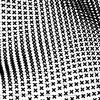
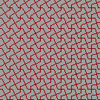
Is it possible to model a two-way parquet deformation using only native components of Grasshopper? In this definition, I limited myself to 10 of them. Parquet deformations are a very interesting and pedagogical topic to teach some of the basics of contemporary parametric modeling. This post explains a minimal parquet deformations algorithm in Grasshopper. However, this has its own limitations. You will see that the definition generates the attractor graph curve. Because the graph input tool creates the magic here….

Inflating Grids

December 28, 2012

After playing with vector fields in 2d (here) it was quite easy to create a 3d surface deformation. Here is my first experiment on a regular triangular grid’s three-dimensional behavior within a vector space, that includes a point charge of varying z coordinates. That makes field lines escape to a bounding box, instead of a bounding rectangle. Again, you may play with force decay, the number of samples, and the “grid blast” parameter, which is just a t-value evaluation of…

Spherical Attraction

November 28, 2012

Today’s Architectural Geometry course was about platonic solids and different attractor objects in introducing component-based design systems. Benay’s idea was both pedagogical and interesting to test in Grasshopper. I searched for the most fundamental type of attractor solid in creating a composition such as this; There is a subdivided sphere and an attractor sphere. The pull component works great here. You may use multiple attractor solids or different shapes such as platonic solids as attractors. It is quite an easy…

Attractor point in DesignScript

November 19, 2012

This is my first try at DesignScript syntax. It is quite easy to understand and on-screen reference help seems to work well. It creates regular AutoCAD entities when you run. One of the most important concepts of this language is said to be a kind of associativity that updates objects when any parameter is changed while the script is running. However such associativity is not possible after the script has finished running. If you want to use the regular imperative…

1 2 »
  • Chapters

    • Algorithms
    • Discourses
    • Fabrications
    • Studios
  • Explore

    • All Keywords
    • Table of Contents
    • Monthly Archive
    • #hotwire-cutting
    • #regulations
    • #wood
    • #buckminster-fuller
    • #text
    • #semi-regular
    • #macro
    • #graph-mapper
    • #contouring
    • #3d-max
    • #visualization
    • #kuka-prc
    • #art
    • #cnc-milling
    • #circle
    • #muqarnas
    • #stellated-solid
    • #attractor
    • #timer
    • #brick
  • Search

  • Support designcoding!

  • Enjoying designcoding? Support me on Patreon to keep it growing. Thank you!

  • copyright 2026 designcoding.net | about | privacy policy | end user license agreement