
Point Waves
Here is another basic exercise in Grasshopper. This exercise “Point Waves” creates wave-like deformations on the grids of points.
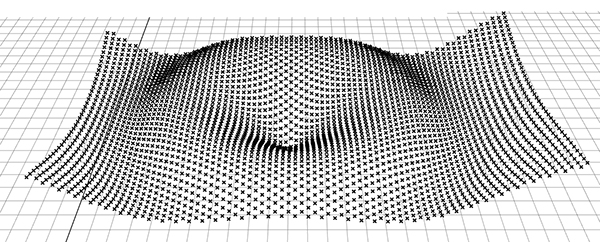
The major function of the definition is to calculate the distances from every point of a grid to an attractor point, with the help of Distance (Dist). Then it sorts them from the smallest to the largest (= closest to farthest) with the Sort List (Sort) component. This component takes and matches two lists of the same size, called key (K) and value (A), and sorts the list of keys from smallest to largest, while simultaneously changing the order of the values in the value list. Thus, we have a list of points ordered parallel to the distances. Note that we flattened both lists. We connect ordered points to the P input of the Point Oriented (Pt) component. Then we manipulate the Z coordinates with a Graph Mapper.
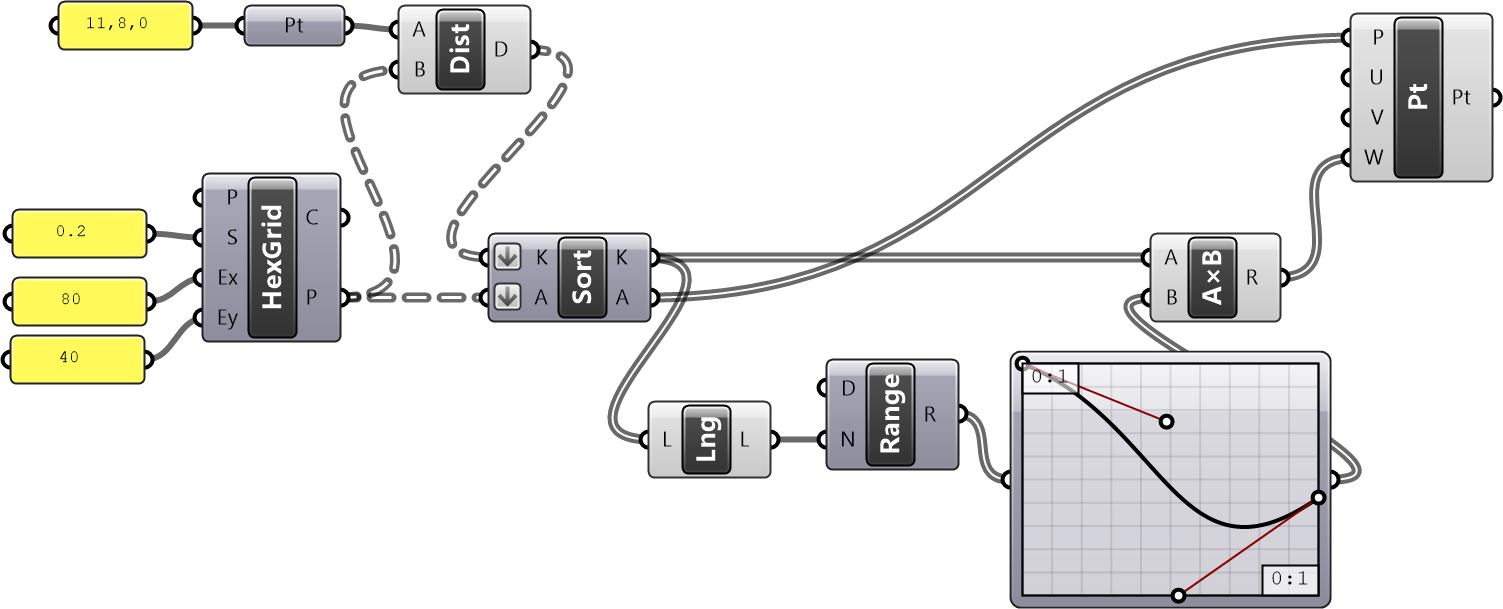
We obtained evenly spaced numbers between 0 and 1 with the help of a standard Range component. Then connected it to a standard Graph Mapper (Graph). Thus, we generated intervals, which are always between 0 and 1. This guarantees the working algorithm, regardless of the number of points. We used List Length (Lng) component to find the number of segments this range should be divided into. The output of the Graph Mapper (Graph) is the numbers that are determined by the function curve. This falls between 0 and 1. Since these settings are the default settings of Graph Mapper (Graph), there is no need to make any changes. We multiply the outputs of Graph Mapper (Graph) using Multiplication (AxB). Finally, we connect the result to the W input of Point Oriented (Pt). This makes the points shift in the Z-axis. Here is the Grasshopper file for the point waves:
Cite this post
Related Posts
Graph Waves with Attractor Geodesic
January 25, 2012
The regular component design technique can be further improved by adding several manipulations. The purpose of this study was to create a surface component that reacts to an inherent parameter (actually a geodesic curve on the surface). However, within the process of parametric modeling, diverse formal potentials emerged. Most interesting results are achieved by adding a graph parameter to control the waves of reaction while splitting the surface as stripes. It is created in the recently updated version (0.8.00066) of…
Minimal Parquet Deformations
January 28, 2013
Is it possible to model a two-way parquet deformation using only native components of Grasshopper? In this definition, I limited myself to 10 of them. Parquet deformations are a very interesting and pedagogical topic to teach some of the basics of contemporary parametric modeling. This post explains a minimal parquet deformations algorithm in Grasshopper. However, this has its own limitations. You will see that the definition generates the attractor graph curve. Because the graph input tool creates the magic here….
Wave Generator
April 17, 2024
Here is a wave generator code I developed using Grasshopper and Python. While searching for a solution to the realistic water simulations, I came up with the Gerstner Waves. I tried to implement it. However, I came up with this final result, which is not a Gerstner Wave generator, but a much simpler one. It combines many user-fed wave components and calculates the resulting single wave. I played with this code for hours with different components. So, it is worth…
Graph Surface
December 24, 2011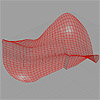
This time, in order to develop a potential “dummy” surface for Grasshopper experiences, I built a better definition. The Graph Surface definition uses a polygon as a basis, divides the edges and moves them according to various parameters. It’s fun to play with mapping different graph types and various polygons and subdivision values. Surprisingly, this definition led me to a wide range of possibilities I haven’t planned. Especially, shifting the graph along the edge of polygon (as seen above) creates interesting…
Graph Mapping Edge Surface
December 19, 2011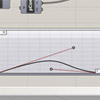
The smooth and continuous nature of the “Sine Surface” has garnered significant popularity among designers and architects alike. This captivating curved surface offers a visually pleasing aesthetic that adds an elegant touch to various design projects. Its flowing contours and gentle undulations create a sense of harmony and organic beauty. Recently, I delved into this with the help of Grasshopper’s Graph Mapping functionality, I began my artistic journey. Although I encountered some initial challenges, I managed to generate a series…