
Graph Waves with Attractor Geodesic
The regular component design technique can be further improved by adding several manipulations. The purpose of this study was to create a surface component that reacts to an inherent parameter (actually a geodesic curve on the surface). However, within the process of parametric modeling, diverse formal potentials emerged. Most interesting results are achieved by adding a graph parameter to control the waves of reaction while splitting the surface as stripes. It is created in the recently updated version (0.8.00066) of Grasshopper. This method of surface manipulation can be further improved by adding more attractors and more control over the reactions of stripes.
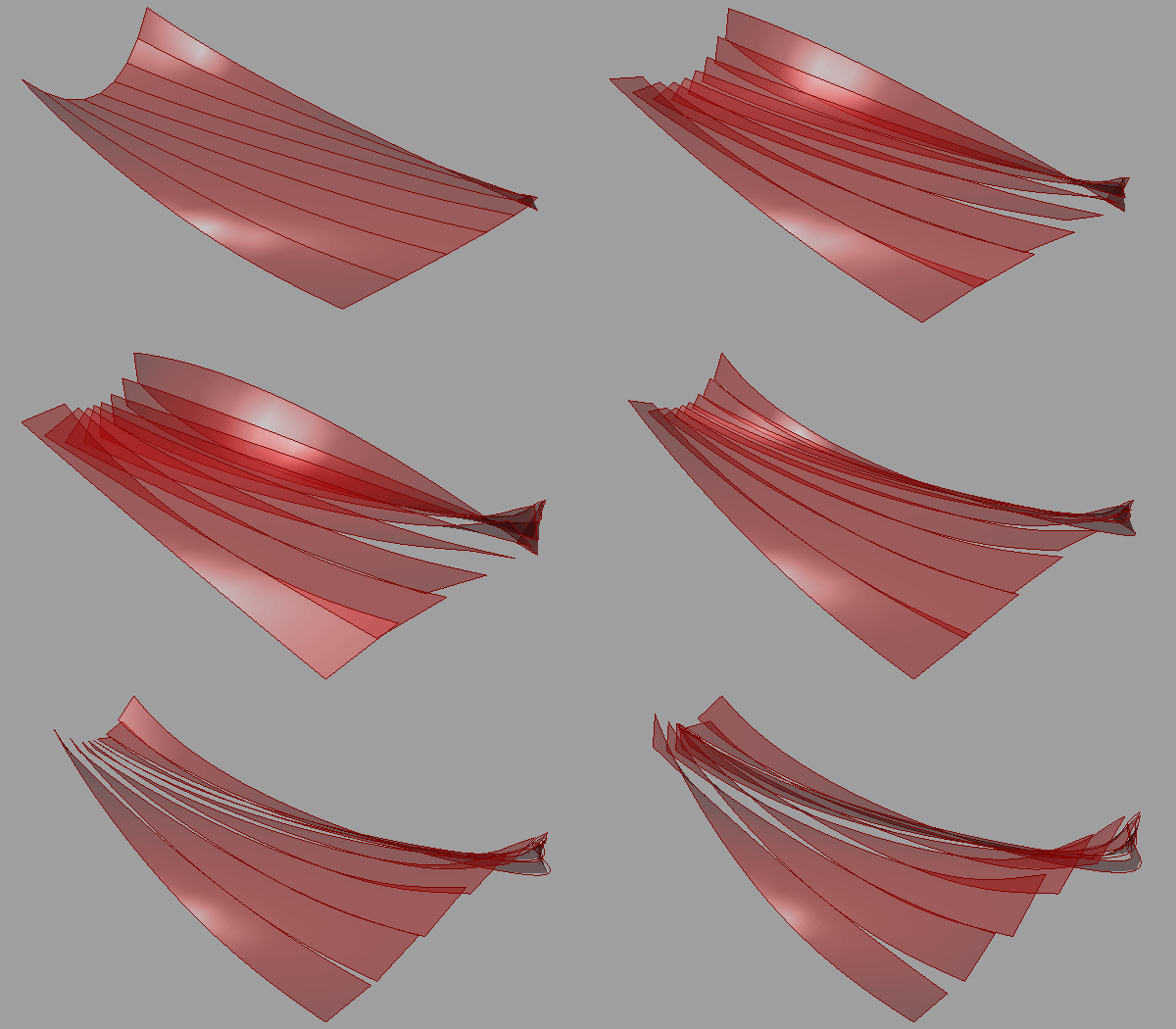
Unfortunately, the graph component still does not animate its values. I captured some screenshots to give you an idea of how this works in a bezier graph.
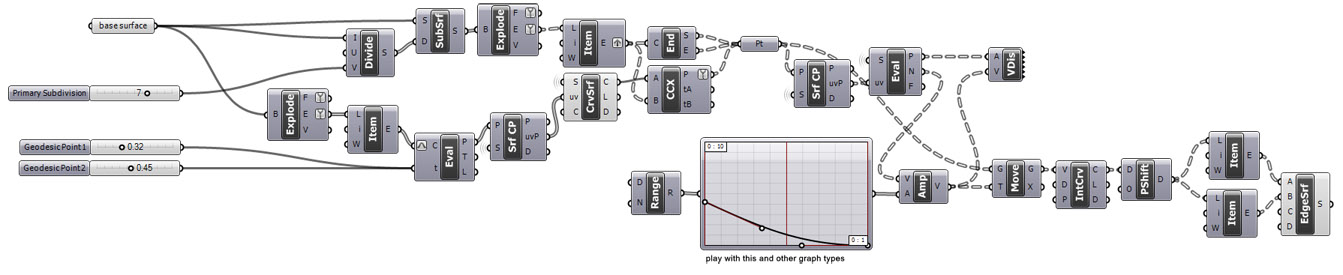
The parametric definition is simple and fast as I always prefer.
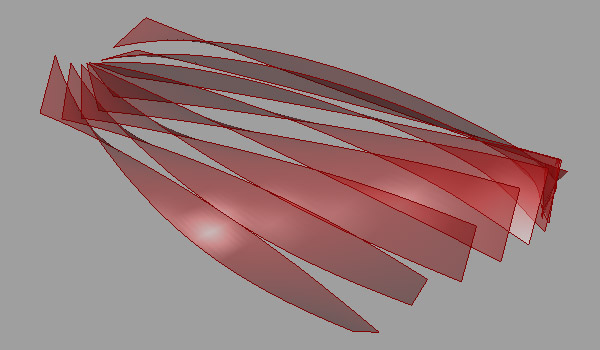
Using different graph types creates unexpected results. For example, parabola graphs reflect more dramatic bending effects on the stripes.
Cite this post
Related Posts
Point Waves
May 29, 2023
Here is another basic exercise in Grasshopper. This exercise “Point Waves” creates wave-like deformations on the grids of points. The major function of the definition is to calculate the distances from every point of a grid to an attractor point, with the help of Distance (Dist). Then it sorts them from the smallest to the largest (= closest to farthest) with the Sort List (Sort) component. This component takes and matches two lists of the same size, called key (K)…
Wave Generator
April 17, 2024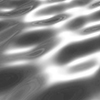
Here is a wave generator code I developed using Grasshopper and Python. While searching for a solution to the realistic water simulations, I came up with the Gerstner Waves. I tried to implement it. However, I came up with this final result, which is not a Gerstner Wave generator, but a much simpler one. It combines many user-fed wave components and calculates the resulting single wave. I played with this code for hours with different components. So, it is worth…
Parquet Deformation of Star Patterns
February 3, 2012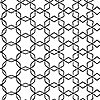
This is another starting point for pattern generation study in a dataflow environment. I tried to implement the parquet deformation of Islamic patterns in Grasshopper. I studied Hankin’s method of Islamic Pattern generation. Then I tried to simulate his process beginning with basic regular tiling (regular hexagonal tessellation). Craig S. Kaplan (here) explains this and other methods in his dissertation. A Simple Foundation We have already experienced the result of exploding any hexagonal grid, shifting its points with the help…
Basic Curve Attractor
January 31, 2012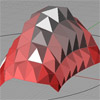
This study includes three main topics related to the basics of Grasshopper. The first one is the surface subdivision, the parametric definition of a surface component, that is, in this case, a simple pyramidal object. The second thing is the associative behavior of surface components with an external parameter, that is another entity in space; a curve. Traditionally, this is simply demonstrated by The important thing here is to find a method to compare each object (here it is the…
Geodesic Dome
January 28, 2024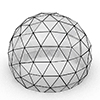
Geodesic refers to the shortest path between two points on a curved surface. It is based on the principles of geodesy, which is the science of measuring the Earth’s shape. On the other hand, in architecture and design, a geodesic dome is a spherical or hemispherical structure consisting of a network of geodesic lines (great-circle arcs) forming triangles. Therefore, the dome’s framework provides strength and stability, distributing stress throughout its structure. Buckminster Fuller popularized and developed the concept of the…