
Basic Curve Attractor
This study includes three main topics related to the basics of Grasshopper. The first one is the surface subdivision, the parametric definition of a surface component, that is, in this case, a simple pyramidal object. The second thing is the associative behavior of surface components with an external parameter, that is another entity in space; a curve. Traditionally, this is simply demonstrated by
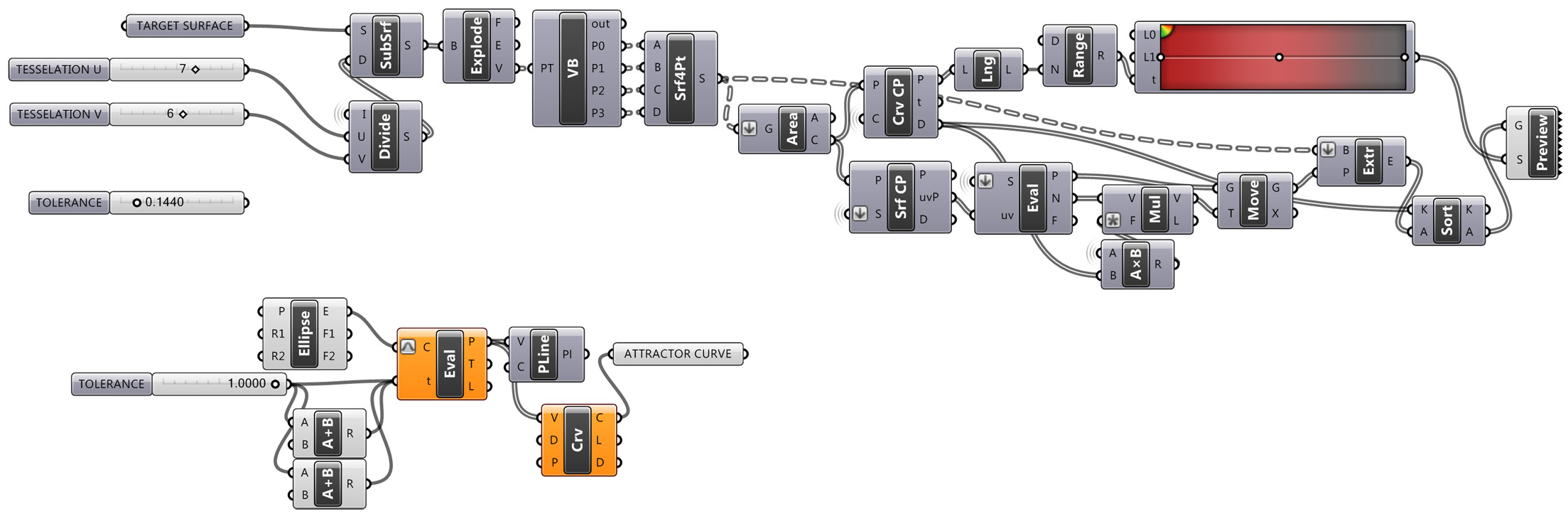
- 1) finding the area centroids of each surface panel,
- 2)finding the closest point on the attractor curve for each centroid,
- 3) calculating the distance between each centroid and it’s the closest point on the curve,
- 4) moving the centroids away from the surface using the distance value and the surface normal vector at that point,
- 5) using extrude to point component to finalize the design.
The important thing here is to find a method to compare each object (here it is the closest point and distance calculations) and assign at least one value to each of them regarding our design intentions. The third thing we learned from this exercise is the secondary parameters that are used to demonstrate the output. This might be labeling and fabrication layouts, in this case, it is the color code of the surface components. This is assigned to each component after they are modeled.
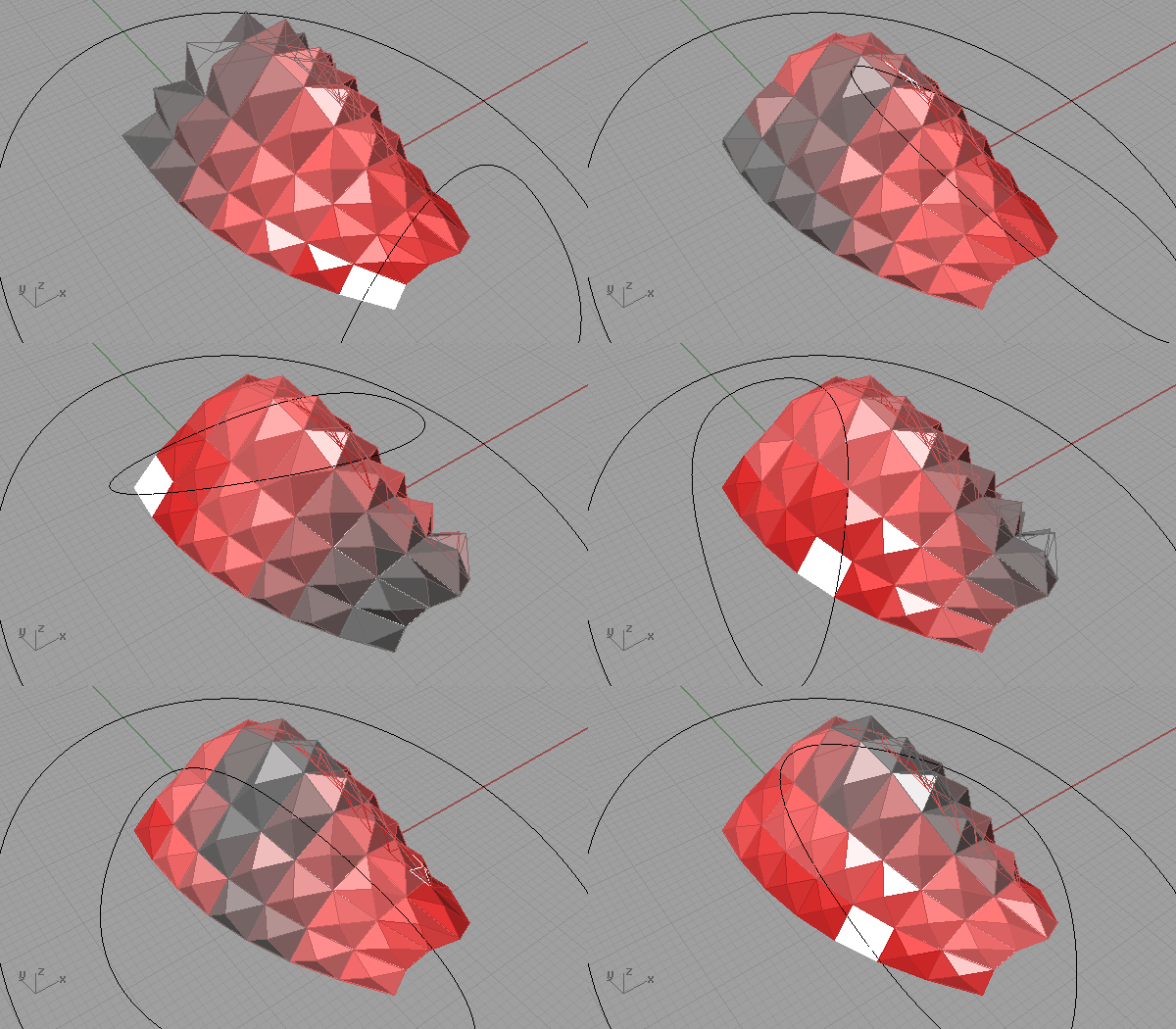
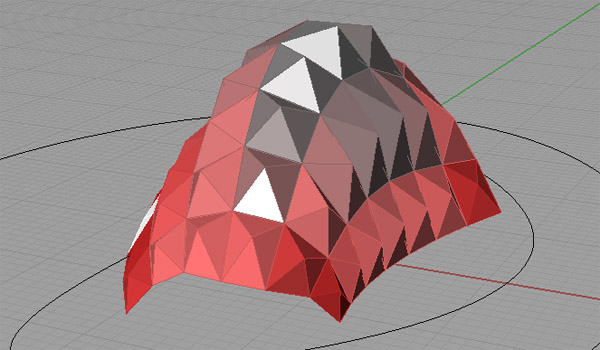
This exercise includes some methods also important for dataflow management. Sorting distance values along with their corresponding component objects; and assigning the gradient colors to them is the tricky part of the color coding here.
Cite this post
Related Posts
Point Waves
May 29, 2023
Here is another basic exercise in Grasshopper. This exercise “Point Waves” creates wave-like deformations on the grids of points. The major function of the definition is to calculate the distances from every point of a grid to an attractor point, with the help of Distance (Dist). Then it sorts them from the smallest to the largest (= closest to farthest) with the Sort List (Sort) component. This component takes and matches two lists of the same size, called key (K)…
Graph Waves with Attractor Geodesic
January 25, 2012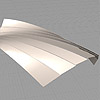
The regular component design technique can be further improved by adding several manipulations. The purpose of this study was to create a surface component that reacts to an inherent parameter (actually a geodesic curve on the surface). However, within the process of parametric modeling, diverse formal potentials emerged. Most interesting results are achieved by adding a graph parameter to control the waves of reaction while splitting the surface as stripes. It is created in the recently updated version (0.8.00066) of…
Tensile Fabric with Kangaroo
September 25, 2026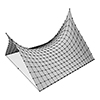
How much work we did last year for first-year architectural education! The tensile fabric study we carried out using Grasshopper Kangaroo in “Design Computing”, a first-year course I coordinated alongside my colleague Serkan Uysal, served as a baseline for the material research addressed in the Basic Design studio at that time. Such geometric optimizations in Kangaroo are no longer surprising or novel to anyone. However, experiencing these tools and possibilities in architectural education in the very first year offers a…
Voronoi Cage
June 26, 2023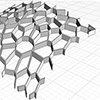
I have created a straightforward Grasshopper code that generates a Voronoi diagram on a surface. Then, it adds thickness to form a structure called a “Voronoi Cage.” In the initial step, I project a surface onto the ground plane (Z=0). The projected frame serves as the boundary for two operations: generating random points using the Populate 2D (Pop2D) function and calculating the Voronoi diagram based on these points. The resulting Voronoi cells are then slightly offset inwards. Moving on to…
Interlocking Structures Revisited
April 10, 2023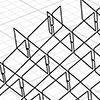
I studied the interlocking joint details in Grasshopper here and here. This time, the interlocking structures were revisited with a cleaner code and an in-depth explanation. I believe that this is a very good educational exercise for learning the potential of the native Grasshopper components. The Preparations The Region Difference (RDiff) component is used to create the interlocking detail of a surface that is contoured with bi-directional spacing. In the first part of the code, after contouring our surface in…