
Tensile Fabric with Kangaroo
How much work we did last year for first-year architectural education! The tensile fabric study we carried out using Grasshopper Kangaroo in “Design Computing”, a first-year course I coordinated alongside my colleague Serkan Uysal, served as a baseline for the material research addressed in the Basic Design studio at that time. Such geometric optimizations in Kangaroo are no longer surprising or novel to anyone. However, experiencing these tools and possibilities in architectural education in the very first year offers a profoundly different pedagogical approach.

The field of computational design is expanding and spreading rapidly. These technologies, which once allowed for specialization in a niche area, are now structured in a way that spreads, and has to spread (?) into general education. The most critical issue here seems to be instructor training. Although today it is possible to encounter a “computational design expert” architect anywhere and in any environment, the proportion of individuals who can truly cope with deep expertise and provide proper education is gradually decreasing. Even the status of whether PhD researchers in this field can step outside their niche dissertation topics to teach in mainstream architectural education has many question marks (at least within my circle).
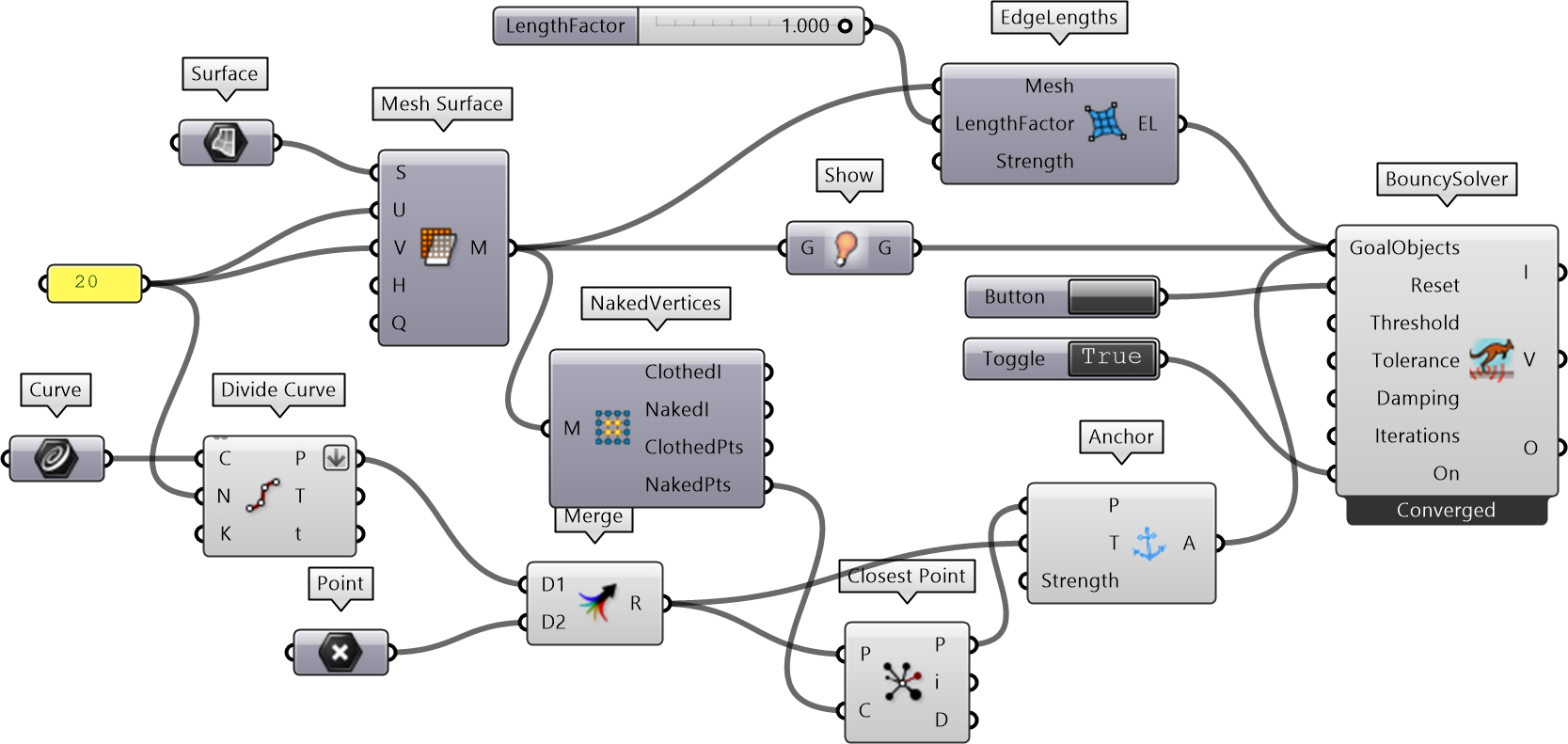
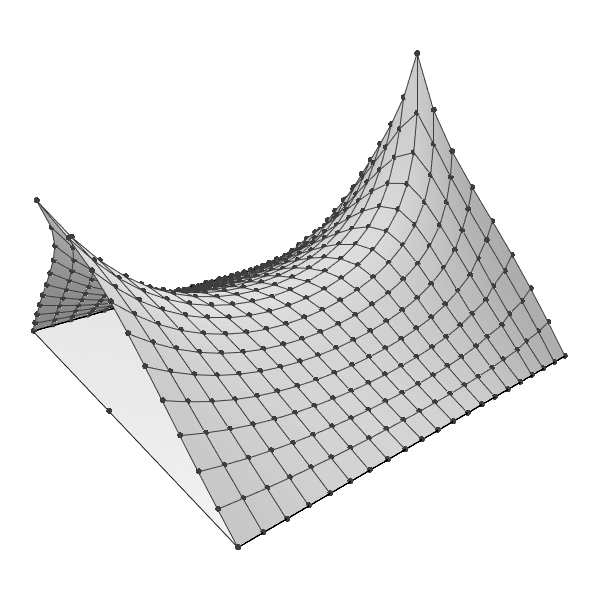
This exercise optimizes a mesh surface, anchored by two points and a curve, by stretching it for a classic tensile fabric design. You can access the files for this exercise below, which teaches Kangaroo’s goal objects structure in a nice and effective way.
Cite this post
Related Posts
Kangaroo 2 Test
April 27, 2015
After several readings, I’ve understood the way of working the new and very interesting feature of Kangaroo 2: “Grab”. Now, we can actually grab the Grasshopper objects from Rhino viewport! Also, on one hand, the new Kangaroo has a very special way of working (not common to us, native Grasshopper users) and on the other hand, it is very very easy to use and understand now. I loved that. Here is the classical truss exercise I’ve made with my students…
Folding Pattern: Folding Experiments (3)
January 21, 2023
This is the continuation of the physical prototyping project of a folding pattern from 9 years ago. I simulate the folding pattern using the Rhino Grasshopper Kangaroo. As seen in the video, this is possible thanks to the pre-set hinge positions on the Rhino model. Thus, the folding motion can be animated on the screen. You can download and try the Grasshopper code. I often use this code in my ARCH 362 Parametric Modeling course. I think it is possible…
Evolution Door: Folding Experiments (2)
December 25, 2022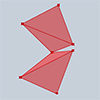
Here is the Grasshopper implementation of the famous Evolution Door design by Klemens Torggler. The code I used here is from my course on Parametric Modeling. This Grasshopper algorithm is a good exercise for the basics of Kangaroo. I attached several goal objects to a special mesh object created in Rhinoceros. Kangaroo’s goal objects work as expected to simulate the folding door behavior. I used the goal objects to fix some of the corner points and fix the edge lengths….
Folding Experiments: Basics (1)
December 6, 2022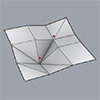
We will try to create collapsible structures in this new series called Folding Experiments. In this example, we will be using Grasshopper and Kangaroo components to understand the Folding Experiments: Basics first. Like other projects, this is a Parametric Modeling course exercise that usually includes primary Grasshopper usage. In our first example, we will try to fold a mesh object. To be able to fold a surface like origami, we need to define the folding creases and faces. The most…
Voronoi Cage
June 26, 2023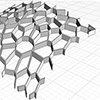
I have created a straightforward Grasshopper code that generates a Voronoi diagram on a surface. Then, it adds thickness to form a structure called a “Voronoi Cage.” In the initial step, I project a surface onto the ground plane (Z=0). The projected frame serves as the boundary for two operations: generating random points using the Populate 2D (Pop2D) function and calculating the Voronoi diagram based on these points. The resulting Voronoi cells are then slightly offset inwards. Moving on to…