
Calculating a Guitar’s Surface Area with Bézier Curves
Below is the first paper of my son, Mete Yazar. It is about a mathematical and geometric exercise of calculating the surface area of an arbitrary shape (a classical guitar’s body panel). He did a good job in utilizing Bezier/de Casteljau curves and generating the parametric equations of the piecewise curve. I helped him to validate the results by using rhinoceros CAD software. Therefore, it seems that his calculations are correct.
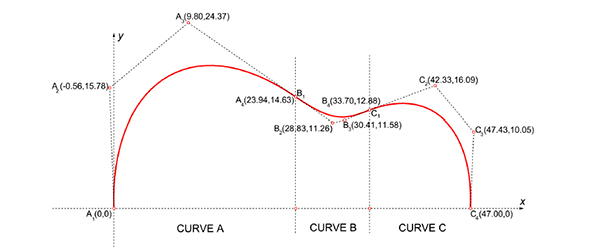
In this paper, we attempted to calculate a guitar’s surface area via Bézier curves. The construction of Bézier curves is based on a series of linear interpolations. This gives the utility to express any Bézier curve in terms of parametric polynomials. Thus, this study demonstrated that three third-degree curves are sufficient to approximate the curved shape of a guitar body. The functions derived from this approximation give us the fundamental algebraic definition. Thus one can draw the shape with the help of these functions. The inspiring part of this study is that the mathematical explanation of curve shapes is strongly related to the developments in technology and engineering. Because this eliminates the need for physical templates or blueprints.
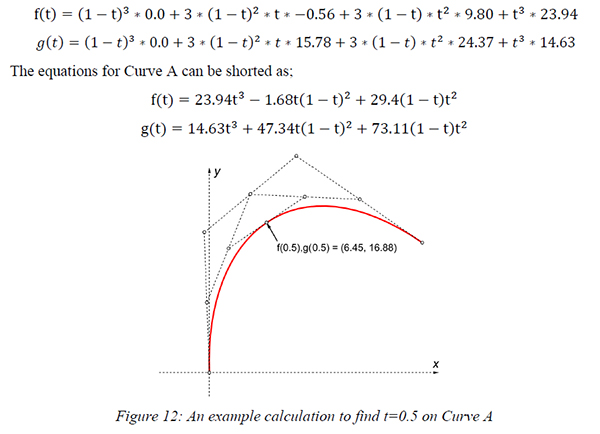
Calculating a guitar’s surface with Bézier curves was an efficient way to analyze these shapes. These curves are widely used in computer-aided design because a designer can draw and transform any curve easily and visually by placing control points. The designers don’t have to know the mathematics behind these curves focusing on their work. However, in this study, we explained these mathematical underpinnings to express this hidden relationship between mathematics and design.
Cite this post
Related Posts
Derivative and Slope
April 6, 2018
Yes, interesting topics started to reveal themselves, when I dig into the function curves, especially in the parametric representation. The first interesting application is the “derivative”. Nobody in high school told me that the derivative of a function at a given point gives the slope of the graph at that point. Moreover, it is possible to convert the slope value into an angle in degrees, showing the angle of the tangent line to the x-axis at that point. They are…
MusicXML to Grasshopper
July 20, 2012
We can model a musical composition using native Grasshopper components. After the experiments with the timer component (here and here), I managed to build a definition that allows us to produce outputs in various time intervals. I converted a small part of Bach’s Bouree in E-Minor into Grasshopper as a guitar tablature. I used Guitar Pro 5’s MusicXML export function to convert classical guitar tablature into XML data, then organized that file in Excel to suit my data tree design…
Gaussian Curvature
September 23, 2026
The development of geometry began by measuring the world as discrete objects. Moving beyond measuring nature, it evolved into reasoning, calculation, and mathematics. Platonic solids were one of the most elegant and beautiful ideas reached by geometry. Pondering why there are only five of them was a tribute to collective human intelligence. Earlier in this blog, we modeled polyhedra, like the Platonic solids, using geometric construction methods. This process was like solving a puzzle. To construct a point whose distances…
B-Spline Construction
January 25, 2024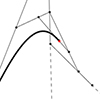
I have been studying the Bezier-De Casteljau algorithm for several years. Last week, I finally managed to understand and implement B-Spline Construction in Rhino and Grasshopper Python code, using the Cox-De Boor algorithm. This algorithm calculates the effect of control points on a B-Spline with many control points. After this, I am not limited to the degree+1 control points. This animation shows both algorithms working together. This Rhino Python code in a Grasshopper definition can handle three tasks. The first…
Bezier Function Extractor
December 26, 2023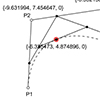
Today’s curve is the beautiful Bezier curve. A series of linear interpolations between the coordinates of control points describe a Bezier curve. So, I created a simple tool in Grasshopper called Bezier Function Extractor to experiment with this elegant construction. In the linear form (degree 1) the linear interpolation between 2 points (P1 and P2). The point at parameter t (0<= t <= 1); Q = tP1 + (1-t)P2. In the second degree, we need three points (P1, P2, and…