
Guitar Shape
Traditionally, when shaping a guitar form, a luthier relies on a combination of craftsmanship and precise geometric tools. This process involves mastering wood-bending techniques around rigid molds, guided by physical templates to achieve the desired acoustic and aesthetic curves.
Curves, once more
I love talking about this so much. Could my obsession with Bézier curves be OCD? The history of curved shape construction reflects a transformative journey from physical craftsmanship to sophisticated digital computation, primarily driven by the demands of shipbuilding, aeronautics, and automotive engineering. According to Townsend (2014), the evolution began with maritime technology, where “splines”, long strips of wood or metal, were used as flexible templates to define the morphing ribs of ship hulls, essentially treating a boat as an “inversion of the primitive hut.” This physical methodology shifted toward mathematical precision during World War II when Roy Liming (1944) introduced “Analytical Geometry with Application to Aircraft.” Liming’s breakthrough enabled aerospace engineers to replace vulnerable, space-consuming physical templates with parametric conics stored numerically in tables, ensuring security and reproducibility for contractors such as Boeing. By the mid-20th century, the automotive industry faced similar challenges in translating miniature clay mock-ups into full-scale production. This led to the pioneering work of Paul de Casteljau at Citroën in 1959 and Pierre Bézier at Renault in the early 1960s, who sought mathematical representations for mechanical parts. As Farin (2002) notes, the definitive breakthrough was de Casteljau’s use of control polygons to intuitively manipulate curves via the recursive evaluation of Bernstein polynomials. These mathematical foundations culminated in the birth of CAD/CAM systems. By 1994, Boeing used CATIA to digitally model the entire 777 aircraft, enabling assembly and performance testing in a virtual environment without physical prototypes, a methodology that has since revolutionized design and architecture (Yazar, 2021).
The guitar as a (computational) curve
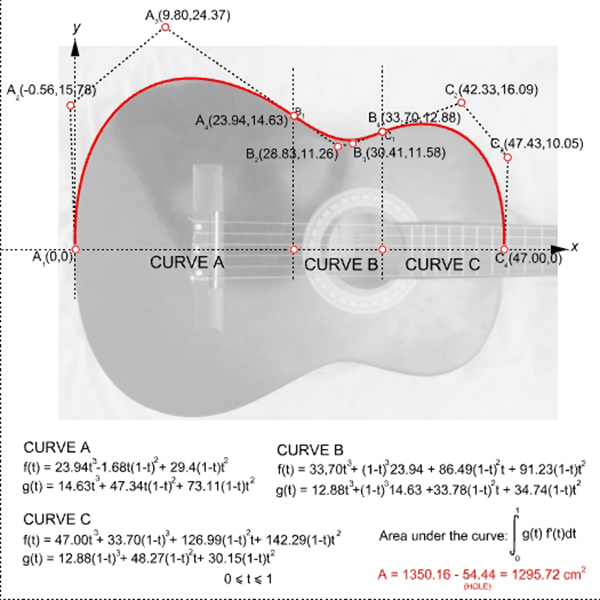
Similar to the short history explained above, the form of the classical guitar is also the result of a geometric study of physical performance, as well as of aesthetic choices and producibility. The curvature of a guitar’s body follows a mathematical flow in the hands of a luthier. The problem of defining the mathematics of luthier shapes has an old tradition in itself. For example, the master guitar maker José Ramírez Martínez (1922 – 1995), known as José Ramírez III, created a guitar model based on the golden ratio and magic numbers, endowed with a special symbology, configuring a distinctive geometry that achieved a unique sonority (Trigueros, 2023). This is one of the proofs that the “free-forms” of guitar can be rationally described.
On the other hand, there is no single standard mathematical definition in the literature. For example, French (2018) used polar coordinates in a closed-form expression to describe a family of body shapes in a compact, unambiguous, and easy-to-implement way. Kertsopoulos’ (1984) extensive research on this topic presents the foundation for the relationship between the form (shape) and the performance (sound) of the instrument.
The curvature distribution along the guitar’s body serves a distinct functional purpose that directly dictates both the instrument’s playability and its acoustic performance. For instance, the narrow waist curvature ergonomically secures the instrument on the player’s knee, enhancing playability. Conversely, the sweeping curves of the upper and lower bouts determine the internal air volume, which directly influences the resonance, projection, and overall tonal character of the sound. This article aims to bridge.
If you watch a luthier at work, you can see that the creation of that acoustic cavity is brought into being not just through geometry, but through craftsmanship (Lacan keeps coming to mind, still).
Eyes closed
And then what? After using all these techniques, we boarded ships, cars, and airplanes, and built magnificent buildings. Curves, mathematics, and the convergence of engineering and design completed everything.

Can we say that? When we look around us, has the world become a better place with curves? Faster, more efficient, more “performative”… Speaking of “performance”, it reminded me of Petrit Çeku, one of my favorite guitar virtuosos. I wonder why they turned down his volume in his duet with Hauser? Çeku, playing the guitar with his eyes closed, must be doing so to focus, to shut down visual sensations and concentrate only on hearing and touch. We reach a point where all these techniques and the analytical worldview pull us toward something else. Under such heavy visual bombardment, living with eyes closed, as if dreaming, seems like one of the doorways to rest and peace. What I actually aimed to do in this post was to talk about the numerous videos I’ve watched on guitar-making techniques, but, going around in circles, we’ve arrived at the threshold of “the doorway”, once again.
References
Courtnall, R. (2006). Making Master Guitars. Crowood Press.
Cumpiano, W., & Natelson, J. D. (1994). Guitarmaking: Tradition and Technology: A Complete Reference for the Design & Construction of the Steel-String Folk Guitar & the Classical Guitar. Chronicle Books.
Farin, G. (2002). A history of curves and surfaces in CAGD. Handbook of Computer Aided Geometric Design, 1-21. doi: 10.1016/B978-044451104-1/50002-2
French, M. (2018). An improved body shape definition for acoustic guitars. Purdue University. doi:10.48550/arXiv.1802.00439
Kertsopoulos, G. (1984). Mathematical model and geometrical progression of the guitar. Das Musikinstrument.
Liming, R. A. (1944). Practical analytical geometry with applications to aircraft. Macmillan.
Sloane, I. (1966). Classic Guitar Construction. Dutton Adult.
Townsend, A. (2014). On the spline. International Journal of Interior Architecture + Spatial Design, Applied Geometries, (2), 225-231.
Trigueros, J. A. (2023). The geometry of the Ramírez guitars.
https://guitarrasramirez.com/en/geometry-and-proportion-in-the-ramirez-guitar/ (Accessed: 30.3.2026)
Yazar, T. (2021). Compass construction of Bézier curves and B-splines. Nexus Network Journal, 23, 789–811. https://doi.org/10.1007/s00004-020-00542-9
Cite this post
Related Posts
Calculating a Guitar’s Surface Area with Bézier Curves
August 27, 2024
Below is the first paper of my son, Mete Yazar. It is about a mathematical and geometric exercise of calculating the surface area of an arbitrary shape (a classical guitar’s body panel). He did a good job in utilizing Bezier/de Casteljau curves and generating the parametric equations of the piecewise curve. I helped him to validate the results by using rhinoceros CAD software. Therefore, it seems that his calculations are correct. In this paper, we attempted to calculate a guitar’s…
B-Spline Decomposition
February 6, 2024
This is a short video tutorial on the B-Spline decomposition I studied earlier here. This tutorial demonstrates how to decompose a B-Spline curve into Bezier curves using Rhino. Despite the original Bezier-de Casteljau algorithm requiring degree+1 control points, Rhino allows drawing a degree-3 curve with any number of control points. By examining knot points and dividing segments appropriately, the B-Spline curve can be manually subdivided into Bezier curves. This involves placing control points, dividing segments, and connecting points in a…
B-Spline Construction
January 25, 2024
I have been studying the Bezier-De Casteljau algorithm for several years. Last week, I finally managed to understand and implement B-Spline Construction in Rhino and Grasshopper Python code, using the Cox-De Boor algorithm. This algorithm calculates the effect of control points on a B-Spline with many control points. After this, I am not limited to the degree+1 control points. This animation shows both algorithms working together. This Rhino Python code in a Grasshopper definition can handle three tasks. The first…
I realized this method of constructing basis splines from given control points while searching for a way to teach students about basis splines. I couldn’t find an easy and visual method to create clamped basis splines by connecting simple cubic Bézier spans. It is a tough job and requires lots of complex equations. However, I suddenly realized that there is a special way of doing that. So I decided to share this with the people searching for an easy way…
A Sartrean Criterion for AI Consciousness
August 4, 2026
In this article, I will attempt a small intervention in contemporary artificial intelligence discussions with an old philosophical example. Our hypothesis is this: ”Artificial intelligence is very powerful at defining and reproducing existing patterns. However, experiencing that which is not there, absence, negation, and nothingness, as a lived condition belongs exclusively to human consciousness.” Jean-Paul Sartre, in his famous “Cafe Example” from his 1943 work “Being and Nothingness“, describes the experience of someone entering a crowded cafe to find a…