
Aletheia
My interest in polyhedra, Bézier curves, and other computer-generated geometric and mathematical abstractions does not come from a desire to model nature. What draws me to them is their sort of “alienness.” These are not objects we encounter ready-made in the natural world; they are constructed by the human mind. Yet once we construct them, they are no longer subject solely to our minds. The moment we define a tetrahedron, a Bézier curve, or any other geometric structure, relationships, necessities, and possibilities emerge within it, waiting to be discovered. It is as if they have emerged from the human mind, yet crossed over into a world independent of it.
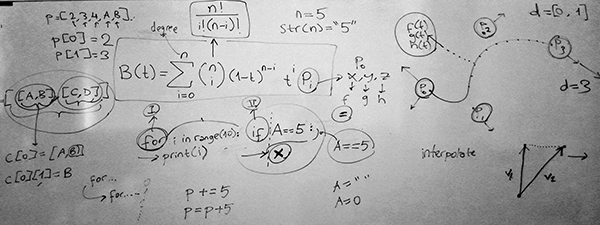
When I close my eyes, I do not see a tetrahedron, of course. That is not the point. But I feel an affinity between the experience of mental vision and these mathematical abstractions. This strange foreignness of geometric forms sometimes reminds me of a dream: something that does not yet belong to the outside world, but somehow exists within the mind. This is why I think of them as dreams translated into the digital medium (brought forth, aletheia).
Yet when the dream is transferred into the digital medium (Gestell), the process is far from over. On the contrary, that is when the most fascinating phase begins. We transform the dream into numbers, relations, and rules; then we release it into the code. The code feeds it into a machine, a computing machine so complex, with its countless turning cogs, that we cannot directly control it. And the machine brings what was originally mental back out into the open: it makes it visible on a screen, in a model, in a print, in a structure, in an object, “casting” it outward. In this state, it is not an exploitation of nature; rather, they are brought into being (physis/poiesis) in accordance with their own necessities.
Then we look at what the machine has produced, and we fall in love with it. What captivates us is not merely the beauty of the resulting form. In that form, we see the traces of the original dream. The dream itself is no longer there; it has been transformed, fragmented, digitized, and reconstructed by the machine throughout the process. But something has been carried across. And perhaps what we call “meaning” is precisely this capacity for carriage.
Here, I do not think of meaning as a form representing something else. Nor do I think a shape is meaningful because it carries a hidden message. What we call meaning is mathematics itself. Mathematics is the structure that the mental can carry without losing it as it passes into the digital medium; it is the very fabric of relations, proportions, continuities, transformations, and necessities. The part of the dream that can be preserved as it passes through the machine is the mathematical structure. Therefore, the resulting geometric form is not a picture of the original thought; it is its mathematically translated manifestation. And throughout this journey, the real question is: How much of the original dream can we bring forth (disclose)?
Reference
Heidegger, M. (1977). The Question Concerning Technology and Other Essays (W. Lovitt, Trans.). Garland Publishing. (Original work published 1954)
Cite this post
Related Posts
Techne Epistinio Poiesis
March 16, 2013
Below is a part of Heidegger’s famous text, “The Question Concerning Technology”, on Techne, Epistinio, Poiesis; Revealing “… We are questioning concerning technology, and we have arrived now at Aletheia, at revealing. What has the essence of technology to do with revealing? The answer: everything. For every bringing-forth is grounded in revealing. Bringing forth, indeed, gathers within itself the four modes of occasioning – causality – and rules them throughout. Within its domain belonging to end and means belongs to…
Principles of Onticology
December 26, 2012This started as a pragmatist search of the term “Objectile”. I was curious about the real meaning of it, while the famous 1995 works of Bernard Cache were the thing I was looking for as images. I found two things about this word. One of them is the reproductions and online marketing of those famous carved panels (I was searching for), and while the second thing was a very interesting philosophical text from Levi Bryant, this blog (then became much more important…
Guitar Shape
November 2, 2026
Traditionally, when shaping a guitar form, a luthier relies on a combination of craftsmanship and precise geometric tools. This process involves mastering wood-bending techniques around rigid molds, guided by physical templates to achieve the desired acoustic and aesthetic curves. Curves, once more I love talking about this so much. Could my obsession with Bézier curves be OCD? The history of curved shape construction reflects a transformative journey from physical craftsmanship to sophisticated digital computation, primarily driven by the demands of…
A Sartrean Criterion for AI Consciousness
August 4, 2026In this article, I will attempt a small intervention in contemporary artificial intelligence discussions with an old philosophical example. Our hypothesis is this: ”Artificial intelligence is very powerful at defining and reproducing existing patterns. However, experiencing that which is not there, absence, negation, and nothingness, as a lived condition belongs exclusively to human consciousness.” Jean-Paul Sartre, in his famous “Cafe Example” from his 1943 work “Being and Nothingness“, describes the experience of someone entering a crowded cafe to find a…
Calculating a Guitar’s Surface Area with Bézier Curves
August 27, 2024
Below is the first paper of my son, Mete Yazar. It is about a mathematical and geometric exercise of calculating the surface area of an arbitrary shape (a classical guitar’s body panel). He did a good job in utilizing Bezier/de Casteljau curves and generating the parametric equations of the piecewise curve. I helped him to validate the results by using rhinoceros CAD software. Therefore, it seems that his calculations are correct. In this paper, we attempted to calculate a guitar’s…