
Aesthetics of Rhombic Polyhedra
The more I work with and study polyhedra, the more I realize how rare and special they are. They represent both the abstract and universal rules of geometry and space. I can understand their symmetries, faces, vertices, and most importantly, their mathematical necessities. Yet, when looking at a solid, sometimes a specific form strikes me as more attractive than the others. Moreover, I cannot explain this simply by saying, “It has more symmetry” or “Its proportions are better.” For me, these are the Catalan solids that feature rhombi.
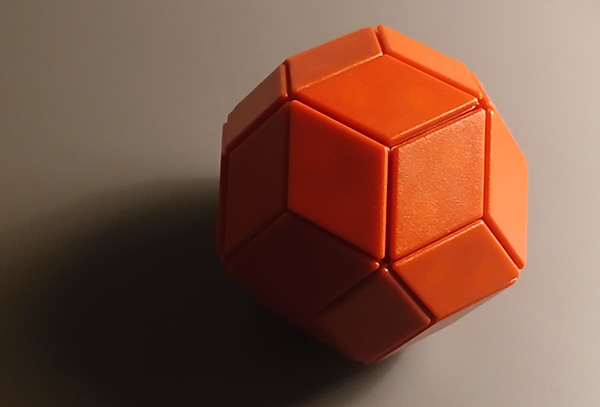
An object with mathematical symmetry can become even more beautiful when its appearance produces a local asymmetry across different perspectives. At least, that is how I can explain it to myself. Thinking about this reminded me of a talk by Žižek I watched on YouTube. I am not sure how sound the connection is, but I would love to understand why certain polyhedra are more beautiful than others.
Cindy’s mole
Žižek mentions a poll comparing Cindy Crawford (my childhood crush. I remember downloading her photos from the internet with my 28.8k dial-up modem in 1996) to Claudia Schiffer (she was fine, also, too fine). Žižek suggests that I was not the only one who preferred Crawford over the perfect Schiffer precisely because of the mole near her lip. The connection to Žižek’s example can be drawn here: A tiny detail can lift a whole from being just an example of ordinary perfection, without destroying its overall order.
The aesthetic appeal might stem not from a lack of symmetry, but from a local asymmetry emerging within a symmetrical whole. Can an order be perfect even without fully revealing itself? Perhaps these solids in particular are attractive because, despite being mathematically regular, we can never fully consume or grasp that regularity from any single perspective. This is not a universal aesthetic law, of course. Just my humble hypothesis, I am testing through certain polyhedra.
In Rhombic Catalan solids, some faces may appear to stretch in different directions from certain perspectives, or the form might seem to subtly distort within itself. The mathematical order of the object remains unbroken; yet the sense of balance in the image encountered by the eye is slightly shaken.
According to Jacques Lacan, what sets our desire in motion is not merely the obviously visible features of an object. A small, accidental detail becomes the element that makes that object unique, awakening a sense that there is “something more” within it. We tend to think that by removing flaws, we make an object perfect; yet sometimes we end up eliminating the very thing that made it desirable in the first place.
Object petit a
Why is there a gap between knowing an object and desiring it? “Object petit a” is a concept developed to think through this very gap. Lacan’s framing helps us see that desire is not reducible to an object’s attributes. The object petit a is “that elusive piece we can never quite attain, yet keeps us endlessly chasing it.” It is both the motor and the ultimate target of desire, yet by its very nature, it remains forever out of reach.
In Seminar VI, Lacan discusses a craftsman making a vase. By giving form to clay by granting it an aesthetic shape, the craftsman turns an ordinary material into an object of desire. In this process, the object is not destroyed; rather, through the form woven around it, value is created upon nothingness (the void inside the vase). Without that void, the vase would have no meaning; form exists precisely to make that void visible and meaningful. This is something we try to touch on in the solid-void exercises in Basic Design. However, we don’t touch it as deeply as Lacan.
He claims that human desire works much the same way: it always revolves around a lack (a void he physically exemplifies inside the vase). Art and creation carve that out for us by wrapping a form around that unbearable emptiness (the lack). So, there is no internal void inside my polyhedra; they are closed, complete, perfect, divine… But the void meant here is not an internal cavity. It is about a thing housing its own opposite within itself. It mirrors that beautiful, sinking feeling when you fall in love with someone. It pulls you toward an unreachable, inexpressible depth. Words fail here. This is what I felt like “Object petit a”…
I am trying to make sense of this relationship with the vase, with Žižek, with Cindy, or with the Catalan solids not as an expert in psychoanalysis or art theory, in any way, but as an amateur human geometer. Perhaps Lacan never intended any of this, but I just wanted to explore and discuss the question of desire objects, and why we call things beautiful, and why we need love.
Cite this post
Related Posts
Why is the Hilbert Curve Beautiful?
April 8, 2025
The Hilbert Curve is one of the results of David Hilbert’s vision of mathematics as a network of symbolic systems. Defined in 1891, this curve is a fractal that fills a two-dimensional plane with a one-dimensional line in the limit. It exhibits self-similarity. It emerged from representing higher-dimensional spaces through continuous, lower-dimensional entities. A curve that grows within a bounded area remains continuous but non-differentiable. Yet it possesses infinite length. Perhaps no one will ever truly see or fully grasp…
Albrecht Dürer
July 22, 2013
In the 14th century, Albrecht Dürer basically seems to capture some of the fundamentals of contemporary parametric design. Apart from other thinkers of his age, he refused to accept one single definition of beauty, based on proportions. His famous physiognomical studies reflected very early examples of referential systems that generate diverse design outputs, even a half-century before Descartes published the coordinate system and four centuries before D’Arcy draw the formal studies on species. I don’t know if he is mentioned…
Parametric IQlight
August 23, 2024
Holger Strøm designed the famous IQlight system in 1973. After more than 50 years, it is still a popular, innovative, and smart design. The IQlight is a self-assembly lamp composed of interlocking quadrilaterals. By utilizing polyhedral geometry, you can generate various shapes and sizes. I created a model of one of the most common IQlight designs, fitting it onto the Catalan solid known as the rhombic triacontahedron. This solid is a convex polyhedron with 30 rhombic faces, making it an…
Catalan Lamps
January 11, 2024
Catalan Solids are the duals of Archimedean Solids. They were first described by mathematician Eugène Charles Catalan in the 19th century. There are 13 Catalan solids, and they exhibit interesting symmetries and unique characteristics. While coding the vertex coordinates of these solids in Grasshopper, I made a simple lamp design to exercise the programming language. The code generates the 13 Catalan Lamps with flaps. Since the polyhedra have planar faces, they can be cut out by hand or a laser…