
Albrecht Dürer
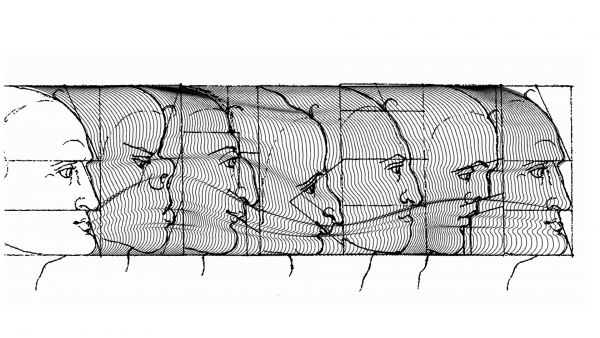
In the 14th century, Albrecht Dürer basically seems to capture some of the fundamentals of contemporary parametric design. Apart from other thinkers of his age, he refused to accept one single definition of beauty, based on proportions. His famous physiognomical studies reflected very early examples of referential systems that generate diverse design outputs, even a half-century before Descartes published the coordinate system and four centuries before D’Arcy draw the formal studies on species. I don’t know if he is mentioned in historical studies of computational design today but he seems to me as very underestimated in this field. Below are some of the phrases from Erwin Panofsky’s book about him, explaining Dürer’s background, his ideas about representation, and his understanding of the beauty within variation itself, but not in any single body.
…Dürer was the first artist who, brought up in late-medieval workshops of the North, fell under the spell of art theory as it had evolved in Italy. It is in his development as a theorist of art that we can study in vitro, as it were, the transition from a convenient code of instructions to a systematic and formulated body of knowledge. And it is in his contributions to this body of knowledge, written and printed, that we can witness the birth of German scientific prose…
…He emphasized the basic difference between a geometrical figure in the abstract and its concrete realization in pen and ink (the mathematical point, he says, is not a “dot”, however small, but can be “mentally located so high or so low that we cannot even reach there physically,” and what applies to the point applies a fortiori to lines); he never confused exact awith approximate constructions (the former ones being correct “demonstrative”, the latter ones merely “mechanice”); and he presented his material in perfect methodical order…
…He didn’t share Alberti’s belief that one objective norm of beauty could be laid down in one canon. He had come to realize that perfect or absolute beauty transcends the human mind, that is does not reside in any individual body and reveals itself in many shapes. Like Leonardo’s “varieta”, representation of beauty, not by way of a decree valid under all circumstances but many diverse shapes…
Erwin Panofsky, 1955, “The Life and Art of Albrecht Dürer”
Below are his own words, explaining the relativist notion of beauty, after his parametric explanation of human figures;
…when we now ask how to produce a beautiful figure…
…I believe that there is no man alive who might think out the maximum of beauty in the lowliest living creature, let alone in man who is a special creation of God and master of the other creatures. This I admit that one man may contemplate and produce a figure more beautiful than can another, and may demonstrate it with good natural reasons plausible to our understanding; but not to that extent that it could not be still beautiful. For this does not enter the mind of man …
…Nobody knows what makes a good shape unless he knows before what makes a bad one…
Bernard Cache is giving lectures about the parametric reading of Dürer and is about to publish a book on this.
There is also a very interesting artwork called Profilograph by Pablo Garcia.
Cite this post
Related Posts
Aesthetics of Rhombic Polyhedra
October 12, 2026
The more I work with and study polyhedra, the more I realize how rare and special they are. They represent both the abstract and universal rules of geometry and space. I can understand their symmetries, faces, vertices, and most importantly, their mathematical necessities. Yet, when looking at a solid, sometimes a specific form strikes me as more attractive than the others. Moreover, I cannot explain this simply by saying, “It has more symmetry” or “Its proportions are better.” For me,…
Why is the Hilbert Curve Beautiful?
April 8, 2025
The Hilbert Curve is one of the results of David Hilbert’s vision of mathematics as a network of symbolic systems. Defined in 1891, this curve is a fractal that fills a two-dimensional plane with a one-dimensional line in the limit. It exhibits self-similarity. It emerged from representing higher-dimensional spaces through continuous, lower-dimensional entities. A curve that grows within a bounded area remains continuous but non-differentiable. Yet it possesses infinite length. Perhaps no one will ever truly see or fully grasp…
Dürer Rhombii
November 19, 2013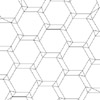
I’ve come across this nice website about the short history of tilings and tessellations. In this post, I am regenerating a tiling of Dürer rhombii. Albrecht Dürer sounds like one of the pioneers of some of the concepts of today’s emerging field of architectural geometry. Here is a phrase from that website about Dürer; “…Like Kepler, regular polygons and polyhedra fascinated Dürer… A large section of the Painter’s Manual is dedicated to practical ways to construct various curves and regular polygons with…
Designing with Grasshopper
May 2, 2012
Today, there are pedagogical and practical challenges on the use of algorithms in architectural design, as computer puts not only a physical but also a cognitive layer between designer and the subject. Formulation of this cognitive layer is becoming important, regarding which model of computing is used to connect designer with the subject. Is it a “designerly” search, or design exploration in a visual programming environment? As most of the researchers admit that visual programming environments are very effective in generating variations,…
Catenary Dome without Kangaroo
August 13, 2026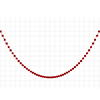
When thinking about serious and specific topics, I suddenly find myself looking back at the basics again. Catenary curves, are not the most beautiful one among those mathematical forms found in nature. However, it still tells us a lot about structures. The name apparently comes from catenaria, the Latin word for “chain”. This Grasshopper code was actually an example from our book 10 years ago (link here). It seems catenary curves could potentially be used in a type of dome…