
Designing with Grasshopper
Today, there are pedagogical and practical challenges on the use of algorithms in architectural design, as computer puts not only a physical but also a cognitive layer between designer and the subject. Formulation of this cognitive layer is becoming important, regarding which model of computing is used to connect designer with the subject. Is it a “designerly” search, or design exploration in a visual programming environment? As most of the researchers admit that visual programming environments are very effective in generating variations, but on the other hand, it dramatically changes the way of sketching.
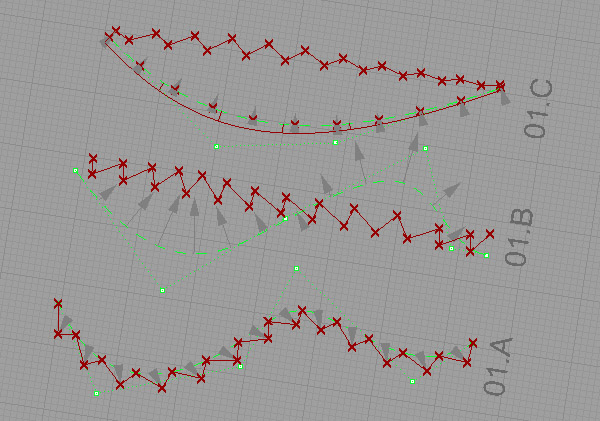
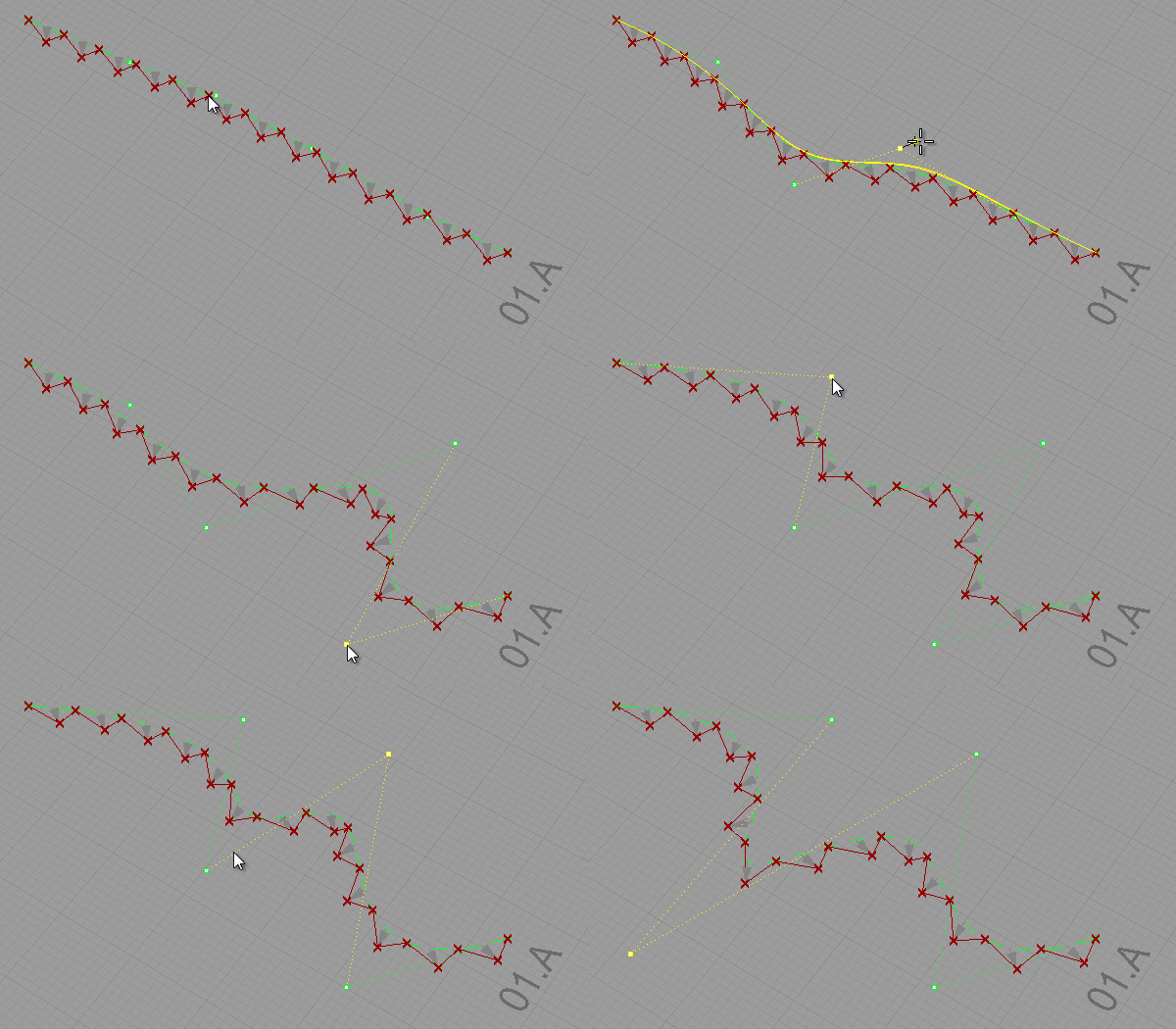
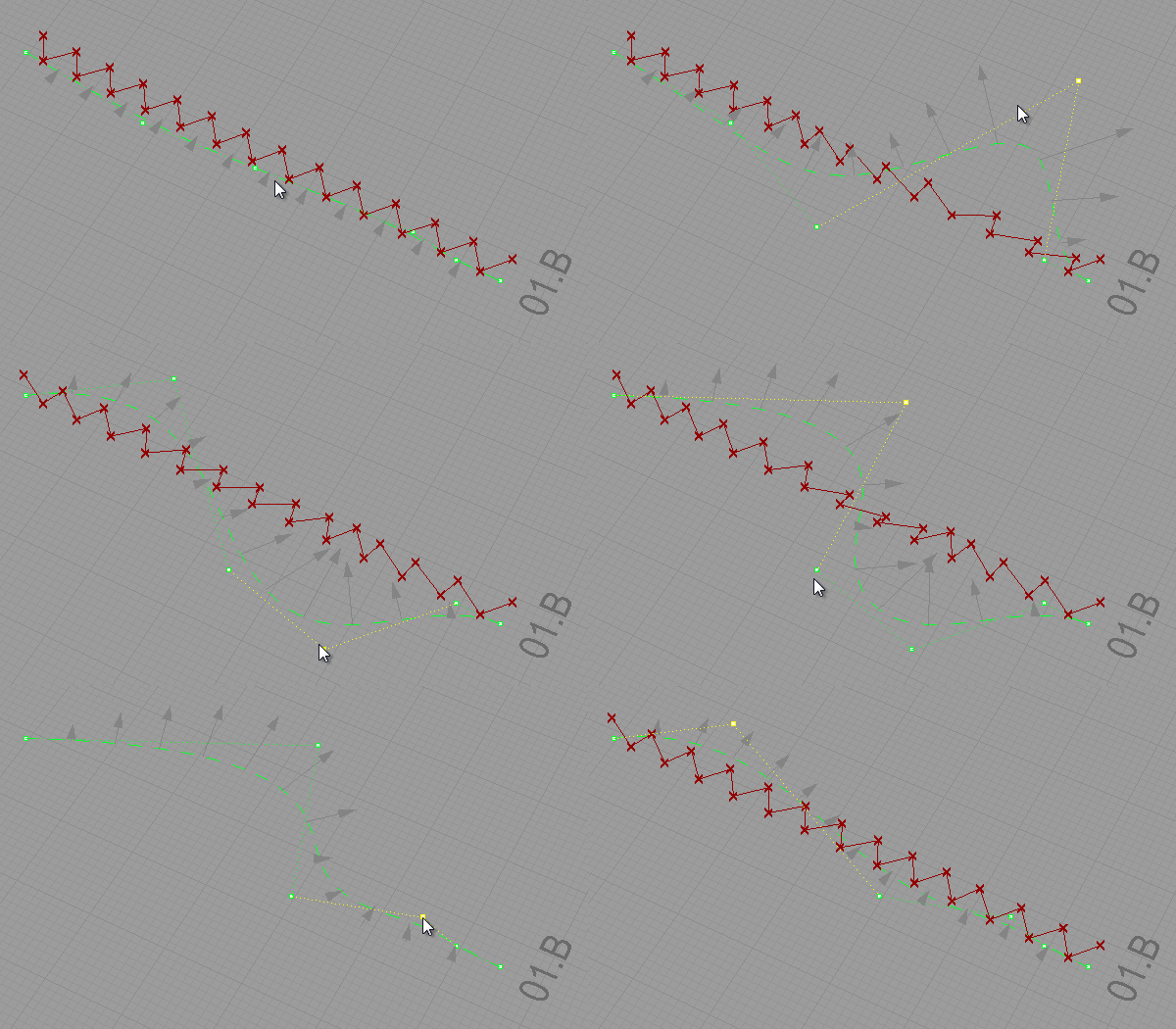
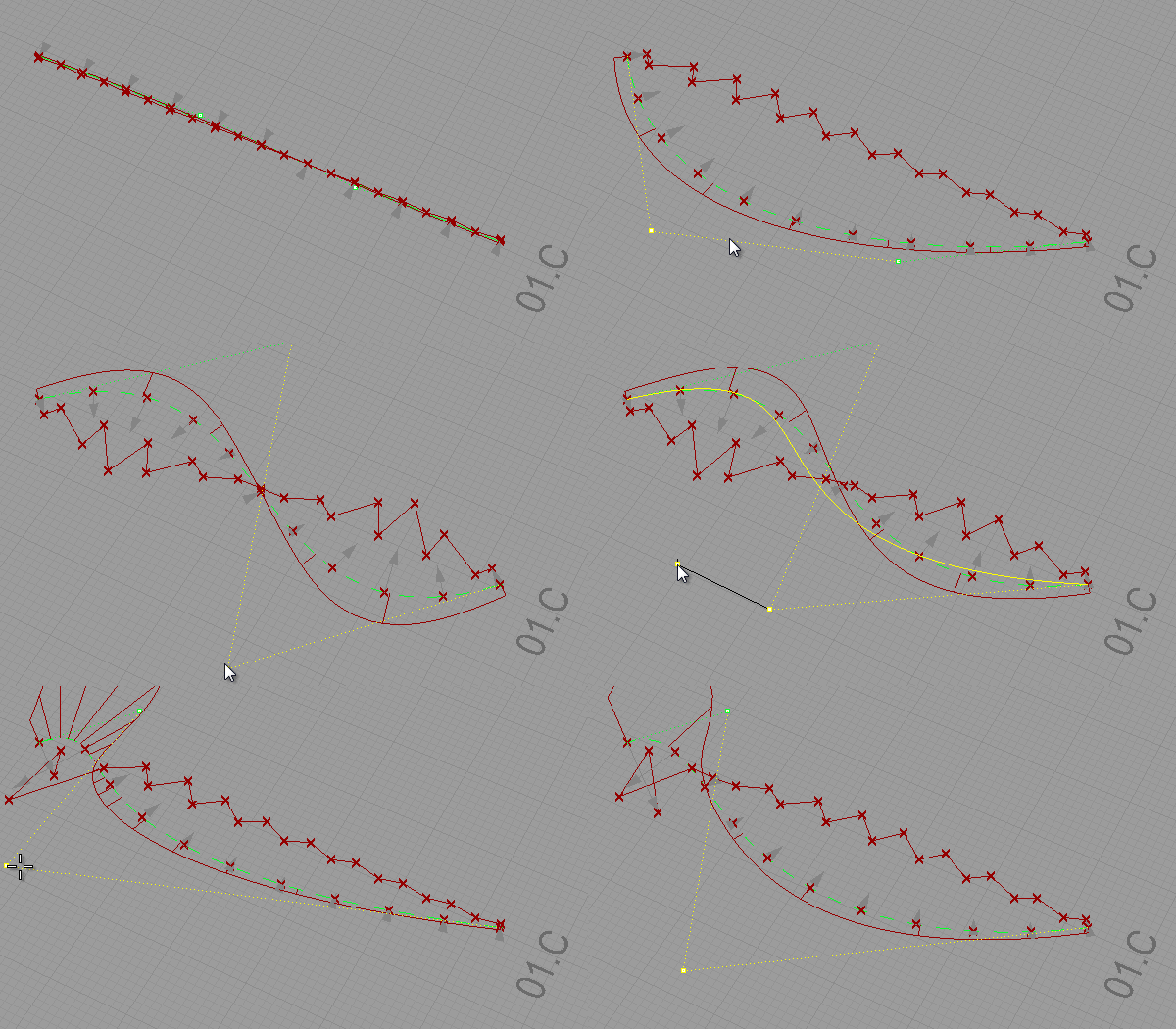
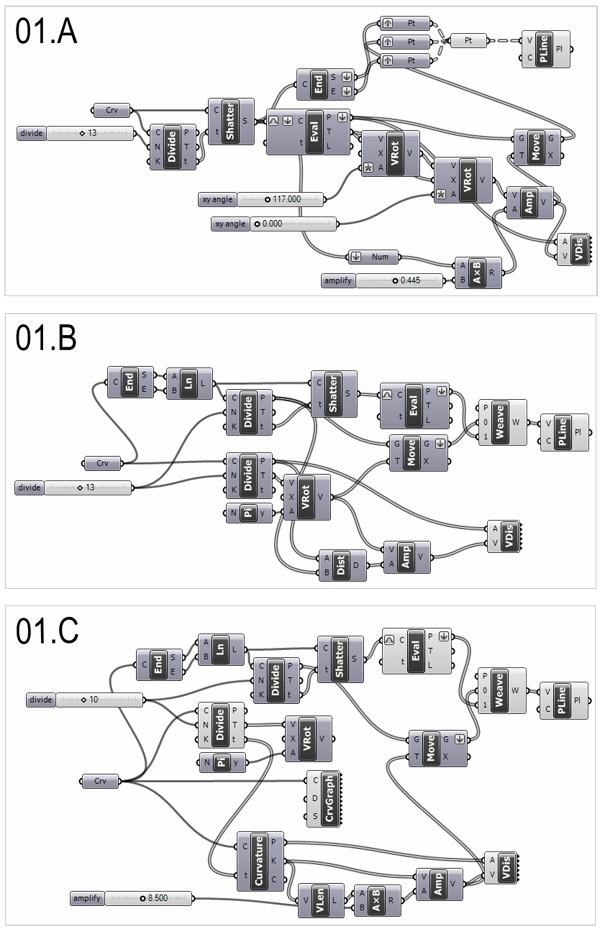
The basic experiment shown below denotes design of a single relationship with from multiple perspectives. Each perspective has it’s own construction paths and each path is somehow both different and the same. I’m working on these perspectives in education as far as I see a risk of tutorial-based design education in parametric modeling, sometimes I found myself within.
Cite this post
Related Posts
Gaussian Curvature
September 23, 2026
The development of geometry began by measuring the world as discrete objects. Moving beyond measuring nature, it evolved into reasoning, calculation, and mathematics. Platonic solids were one of the most elegant and beautiful ideas reached by geometry. Pondering why there are only five of them was a tribute to collective human intelligence. Earlier in this blog, we modeled polyhedra, like the Platonic solids, using geometric construction methods. This process was like solving a puzzle. To construct a point whose distances…
Leveling in Dataflow
March 26, 2015
This is a great book, explaining very familiar concepts of dataflow diagrams for designers firsthand. Leveling is an interesting chapter there, I’m not sure if it completely fits with the use of “Clusters” in Grasshopper but it is obvious that the complex systems should be well organized not only to be perceptually “better” ones but also to develop a way to use parts of definitions again and again in different situations. …How do you actually DO the leveling of DFDs? The…
30 years old Grasshopper
October 22, 2012Nowadays I plan to enter Rhinoscript, Python, and DesignScript back again. However, I can’t leave Grasshopper3D without mentioning the “cognitive shift” it pioneered in the design computing community. Here is a phrase from a famous special issue of “Computer” Journal, published in 1982 with Tilak Agerwala and Arvind’s editorials; Data flow languages form a subclass of the languages which are based primarily upon function application (i.e., applicative languages). By data flow language we mean any applicative language based entirely upon…
The DataFlow Approach
October 18, 2012In 1982, it has been more than 15 years since the dataflow approach to algorithm designing are discussed in computer science. Computer journal publishes a special issue with the foreword of Tilak Agerwala; he says; …We have discussed two characteristics of the von Neumann model of computation: global updatable memory and a single program counter. It will become clear shortly that the data flow model has neither of these. First, the data flow model deals only with values and not with names of value containers…
Curvature Map on Terrains
September 17, 2026
This is the last of the site analysis tools we previously used in the midterm project of first-year architecture education. As you may recall, we previously introduced a tool that generates topographies based on specific parameters. Afterward, we examined two tools that perform slope and flow analyses on these topographies. Today, we are presenting a tool that analyzes curvature. This topic actually constitutes one of the interesting intersection points between architectural design and differential geometry. Curvature is not something architects…