designcoding
Search
About Table of Contents Keywords Support designcoding!

data-flow

23 posts

Data Domains in Grasshopper

March 24, 2024
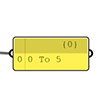
In this short tutorial, I am showing the essentials of data domains in Grasshopper. A domain is a data type in Grasshopper that represents a portion of the 1d or 2d number space. This requires a starting and ending point in those spaces. In 1d,…

Data Structures in Grasshopper

June 8, 2023

Data structures and data matching principles are important to be able to design with Grasshopper. In this tutorial, I show data matching procedures with arithmetic operations. Then I repeat them in the production of geometric objects. I think it should be easier to use this…

Rhino+Gh: Grasshopper for Beginners (7)

February 2, 2023

We continue with the Grasshopper for Beginners series by explaining Rhino+Gh workflow principles. What does GH add to Rhino‘s standard drawing and modeling functions? To put the question differently, what does GH do that conventional modeling programs, such as Rhino, can’t? What is the difference…

Hello World! Grasshopper for Beginners (6)

January 17, 2023

Let’s continue the Grasshopper for Beginners series. We start with the traditional “Hello World!” displayed on the Rhino screen: Placing the Components In most CAD programs, the text creation function, which is the equivalent of the Text command, is performed by a component called Text…

History: Grasshopper for Beginners (2)

November 23, 2022

We continue the Grasshopper for Beginners (2) series with the data flow programming concept. Control flow diagrams we use in traditional programming languages control the sequence of executed commands. In data flow diagrams, the focus is not on the order of commands but on how…

Design Exercise of Dataflow Diagrams

January 24, 2019

Here is a design exercise I’ve been giving to students. It aims to familiarize students with the concept of dataflow diagrams used in Grasshopper. Dataflow is a different concept than conventional computer programming. Here is a good comparison between control flow and dataflow languages. In…

Circular Relationship Diagram

May 31, 2015

This is done because I needed to represent relationships between different factors and layers of a design process. Although this method of “Chord Diagrams” is a very common technique in information design, it became very hard to find an effective tool for generating those diagrams quickly….

ARCH362 Midterm

March 27, 2015

About to finish the well-defined section of this year’s Parametric Modeling course, here are the mid-term questions I’ve asked; First question checks if the curve < > point conversions are well understood in Grasshopper. Evaluating a parametric curve and generating the closest point from another…

Leveling in Dataflow

March 26, 2015

This is a great site, explaining very familiar concepts of dataflow diagrams for designers firsthand. Leveling is an interesting chapter there, I’m not sure if it completely fits with the use of “Clusters” in Grasshopper but it is obvious that the complex systems should be well…

Clustering

January 2, 2013

The famous “Deutsch limit” says, “you cannot have more than -say a hundred- components in a visual programming environment, that is why you cannot write an operating system with it.”; so it says, the perceptual and pedagogical advantages of visual programming are limited according to…

A Diagram (Sometimes) Worth Ten Thousand Words

December 12, 2012

Here is an interesting phrase from Jill Larkin and Herbert Simon’s famous article. It is “Why A Diagram (Sometimes) Worth Ten Thousand Words”; The phrase from the article We consider external problem representations of two kinds. Both of which use a set of symbolic expressions…

30 years old Grasshopper

October 22, 2012

Nowadays I plan to enter Rhinoscript, Python, and DesignScript back again. However, I can’t leave Grasshopper3D without mentioning the “cognitive shift” it pioneered in the design computing community. Here is a phrase from a famous special issue of “Computer” Journal, published in 1982 with Tilak…

The DataFlow Approach

October 18, 2012

In 1982, it has been more than 15 years since the dataflow approach to algorithm designing are discussed in computer science. Computer journal publishes a special issue with the foreword of Tilak Agerwala; he says; …We have discussed two characteristics of the von Neumann model of…

Excel Outputs in Grasshopper

May 22, 2012

Basic Design Studio at Bilgi University is coming to semester’s big final. Nowadays, students are trying to build their final projects. Oğuz and Gupse’s group has a truss structure with nearly 800 segments. They attempt to build it by taking length values from their own…

Designing with Grasshopper

May 2, 2012

Today, there are pedagogical and practical challenges on the use of algorithms in architectural design, as computer puts not only a physical but also a cognitive layer between designer and the subject. Formulation of this cognitive layer is becoming important, regarding which model of computing is…

Paramod 2011 Subdivided Entities

March 14, 2012

Today, we’ve studied fundamentals of component-based design methods. Using curves and surfaces as starting points, we’ve experienced ways of translating those entities via design criteria based on our purposes. First, a curve is used to construct a leaf structure. We’ve experienced dispatching data lists and…

Attractors: Paramod 2011 / W04

March 7, 2012

Today’s subject was closely related to the one last week; the data list and data tree management. Creating suitable data structures for our purposes is one of the tricky parts of whole Grasshopper experiments. We’ve developed a grid of objects, somehow associated with another one…

Smooth Sketch Data Recorder

February 29, 2012

Here is a funny sketching system for the “SPEC” homework. [GHX: 0.8.0066] Four (or more) points are created using 2d sliders (MD slider) and decomposed these points into x,y and z numbers. Then, they are re-populated in 3d points by changing their plane. X coordinates are connected…

Paramod 2011 Data Lists and Trees

February 29, 2012

Today, we’ve studied ways of representing multiple data structures in Grasshopper. As of our last week’s experience, sometimes (most of the time actually) we’ll need to work with vast amount of data. We’ll have to control them in order to open door for further explorations….

Data Recorder and Surfaces

February 7, 2012

In this experiment, I’m trying to use data recorder to change components on a surface. The component part is a standart triangular construction, but the attractor points are defined by a 2D slider that is connected to a data recorder. Data recorder remembers last 15…

1 2 »
  • Chapters

    • Algorithms
    • Discourses
    • Fabrications
    • Studios
  • Explore

    • #rhombicosidodecahedron
    • #parametric-wall
    • #lissajous
    • #stellated-solid
    • #workshop
    • #wave
    • #phenomenology
    • #circle
    • #hyperbolic
    • #random
    • #firefly
    • #rubber
    • #design-competition
    • #simulation
    • #arduino
    • #minimal-surface
    • #puzzle
    • #archimedean-solid
    • #golden-ratio
    • #solar-analysis
  • Search

  • Support designcoding!

    Enjoying designcoding? Support its future with a small donation on Patreon. Thank you!

    Patreon


    copyright 2026 designcoding.net
    about | table of contents | keywords | monthly archive | privacy policy | end user license agreement