
Design Exercise of Dataflow Diagrams
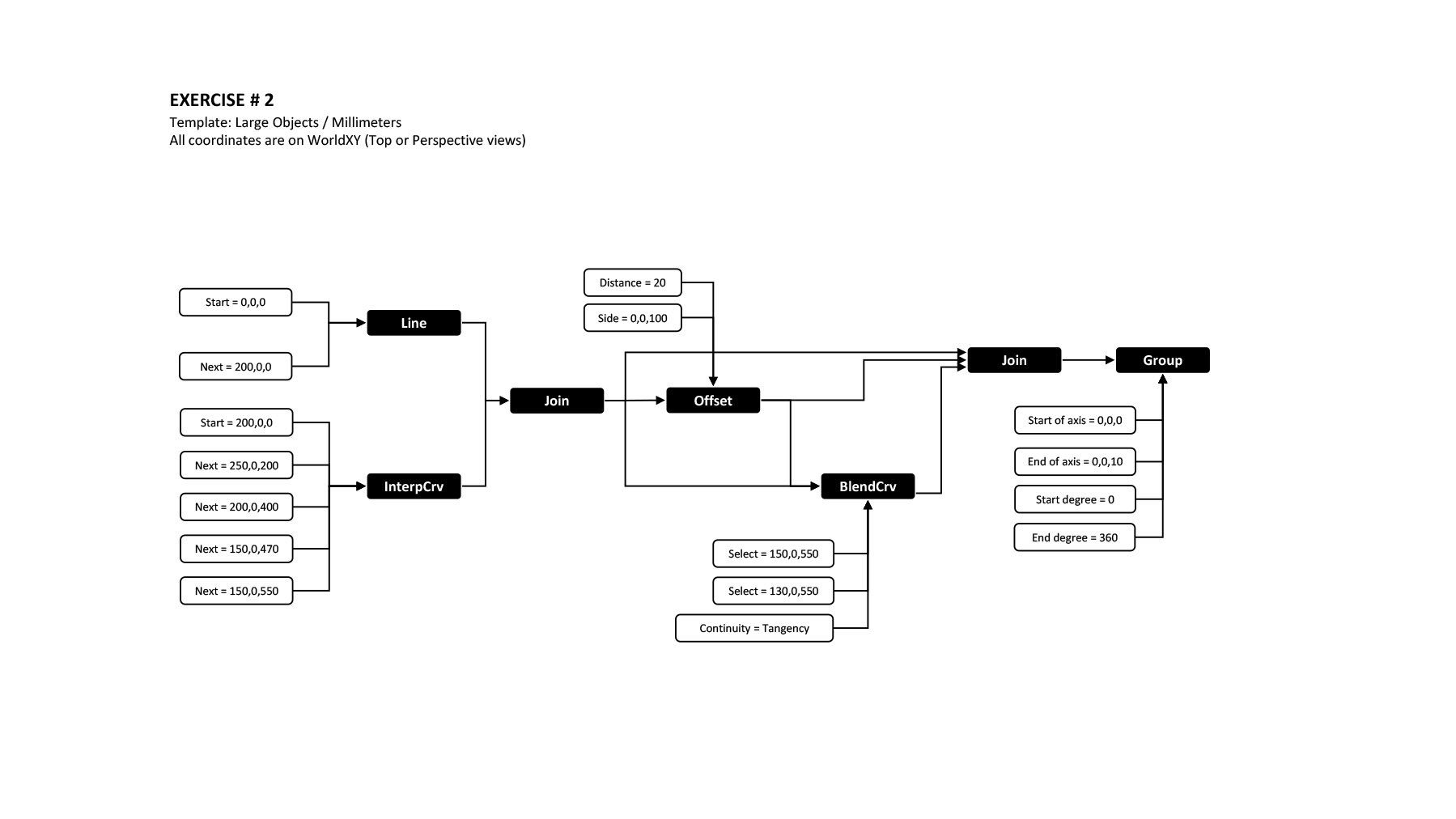
Here is a design exercise I’ve been giving to students. It aims to familiarize students with the concept of dataflow diagrams used in Grasshopper. Dataflow is a different concept than conventional computer programming. Here is a good comparison between control flow and dataflow languages. In most educational settings (such as courses and workshops) we concentrate on the fundamental issue of dataflow management via design projects. This requires us to think about a design exercise of dataflow diagrams. In the most basic form of this conception; we can focus on the geometric modeling process. Therefore, we think about the “command history”. In Grasshopper, we use diagrams to represent the flow of data. Even without Grasshopper, we can create these abstract diagrams easily. Thus, these diagrams can be a new way of representing design processes.
The Exercise of Dataflow Diagrams
In the below exercise, first, the students are given a diagram of Rhino commands. Then, they are asked to follow the diagram’s inputs and outputs in Rhino. This would lead to modeling a simple object in Rhino. Then, we ask the students to design and model a simple chair. While doing this, they take notes of their modeling actions. These notes include the names of the commands and their geometric and numeric inputs. After that, they repeat their own designs by using these notes. When finished, they submit both the Rhino file and its dataflow diagram. Below are some of the exercises:
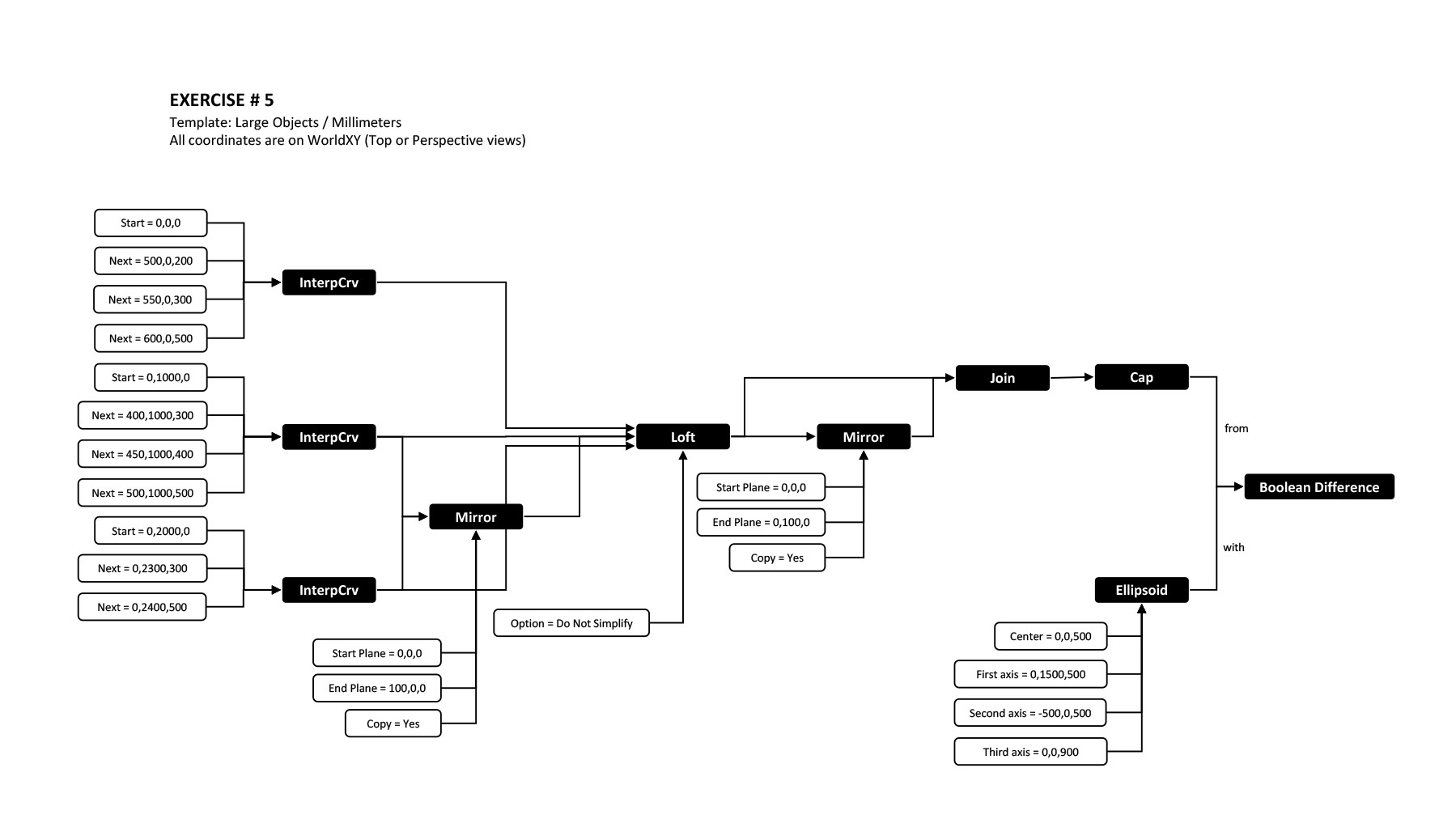
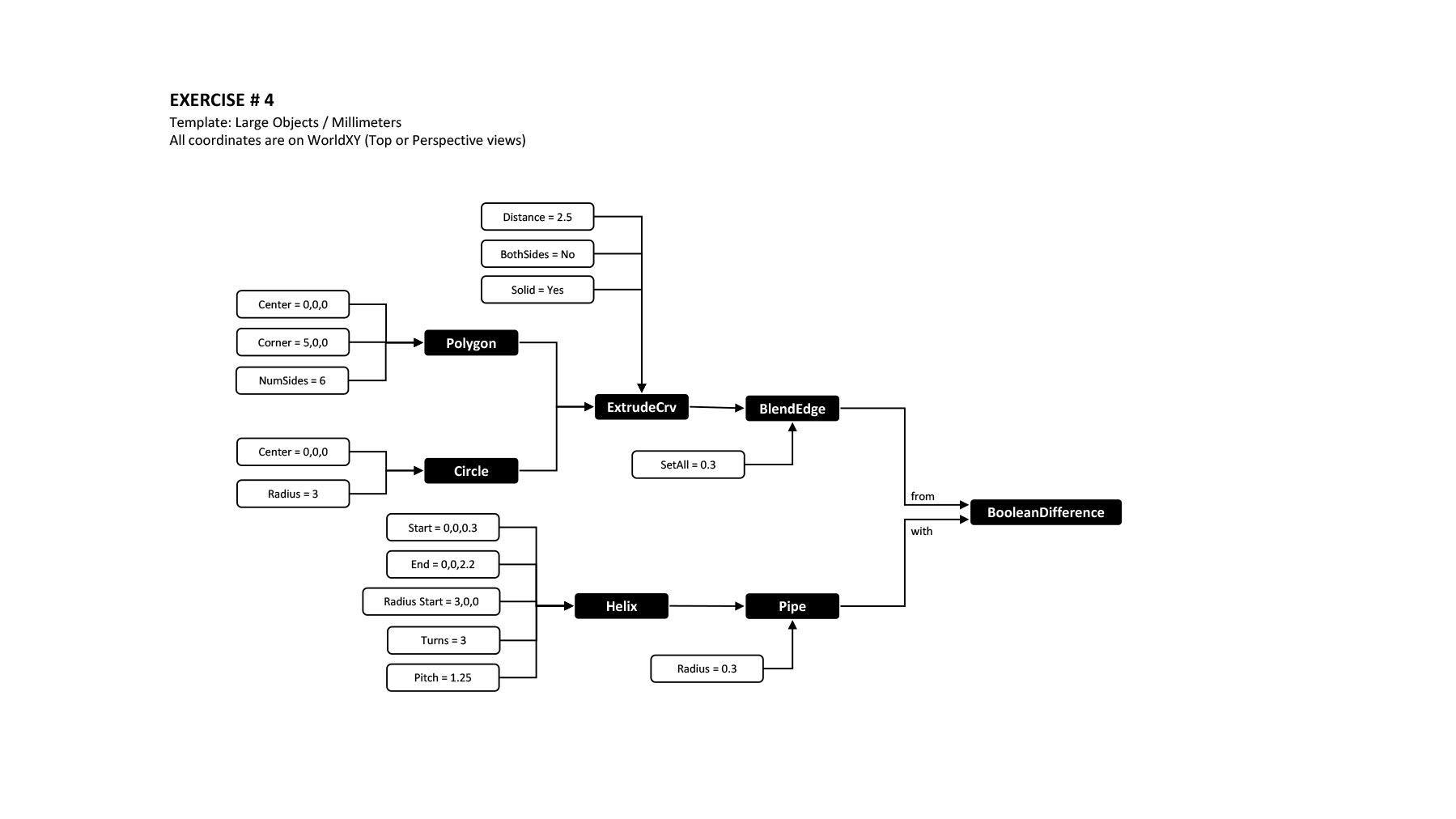
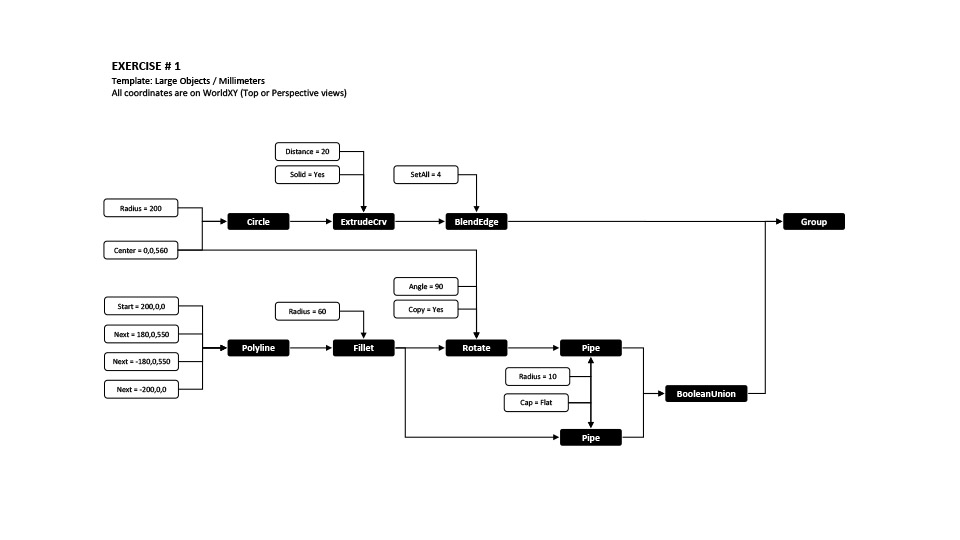
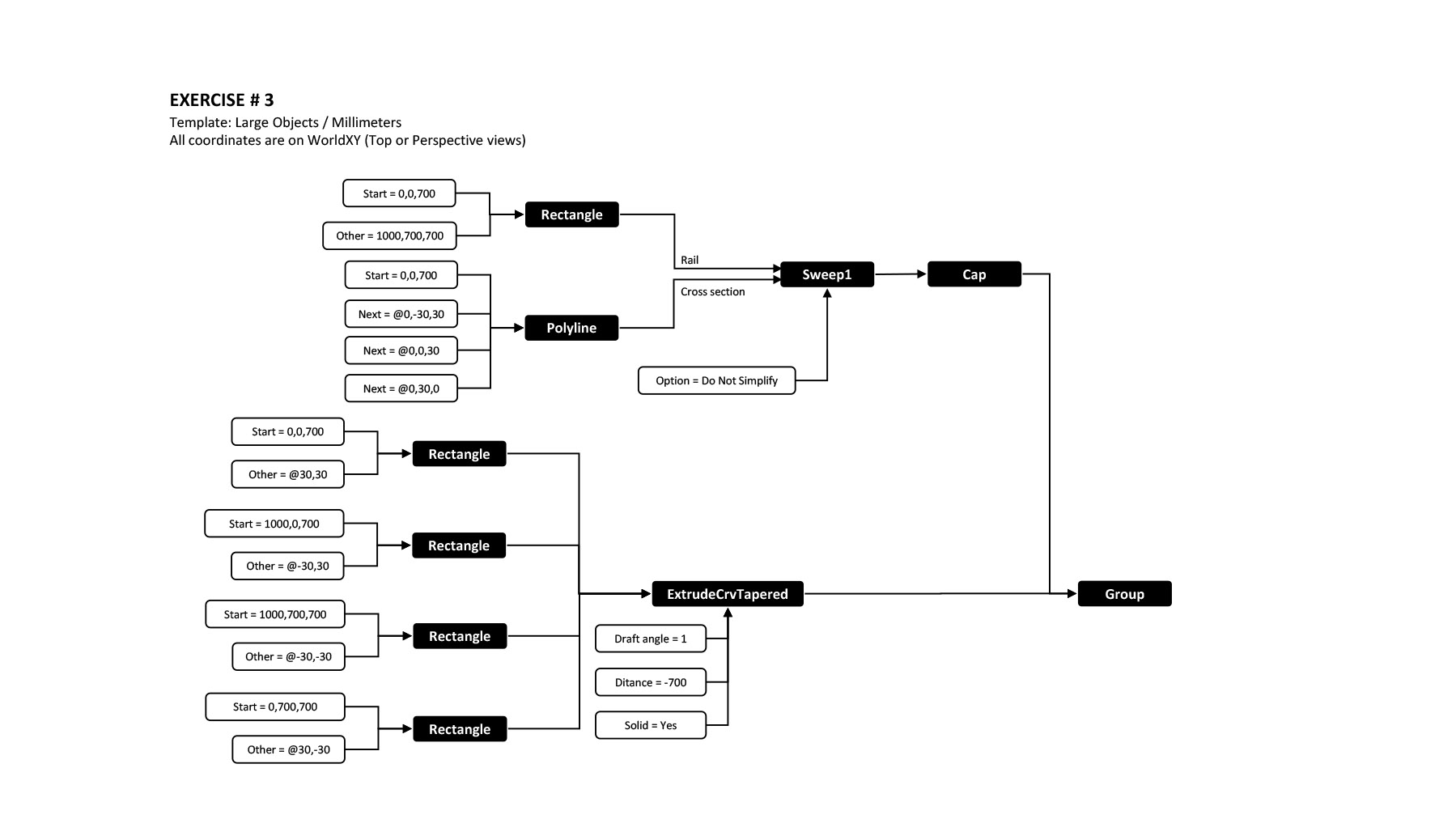
Conclusion
This is a simple introduction to dataflow management via a design exercise of dataflow diagrams. Of course, it only includes the basic idea. Therefore, it is not possible to teach the complex procedures of Grasshopper. For instance, the data matching process of Grasshopper should require an additional effort. In the future, I am planning to submit more content on the issue of data matching in Grasshopper.
Cite this post
Related Posts
Data Structures in Grasshopper
June 8, 2023
Data structures and data matching principles are important to be able to design with Grasshopper. In this tutorial, I show data matching procedures with arithmetic operations. Then I repeat them in the production of geometric objects. I think it should be easier to use this programming language once the students understand the basic principles. Therefore it would be easier to design with it. Sometimes the design process of these diagrams proceeds from left to right (by induction) but sometimes it…
Rhino+Gh: Grasshopper for Beginners (7)
February 2, 2023
We continue with the Grasshopper for Beginners series by explaining Rhino+Gh workflow principles. What does GH add to Rhino‘s standard drawing and modeling functions? To put the question differently, what does GH do that conventional modeling programs, such as Rhino, can’t? What is the difference and relationship between Rhino+Gh? Let’s take an example to answer these questions. Our example is about parametrically describing a surface model and deriving its alternatives. First, we will try to create a surface using only…
Hello World! Grasshopper for Beginners (6)
January 17, 2023Let’s continue the Grasshopper for Beginners series. We start with the traditional “Hello World!” displayed on the Rhino screen: Placing the Components In most CAD programs, the text creation function, which is the equivalent of the Text command, is performed by a component called Text Tag (Tag) in GH. The Text Tag (Tag) component is in the Dimension panel under the Display tab. If you’re not comfortable with tabs and panels yet, you can revisit this section from the beginning….
ARCH362 Midterm
March 27, 2015
About to finish the well-defined section of this year’s Parametric Modeling course, here are the mid-term questions I’ve asked; First question checks if the curve < > point conversions are well understood in Grasshopper. Evaluating a parametric curve and generating the closest point from another curve. This also requires a basic understanding of the use of the Grasshopper interface. The second question was testing a basic and classical use of attractors on grids of objects. Students generated their own grids…
Parametric Modeling Class: Subdivided Entities
March 14, 2012
Today, we’ve studied fundamentals of component-based design methods. Using curves and surfaces as starting points, we’ve experienced ways of translating those entities via design criteria based on our purposes. First, a curve is used to construct a leaf structure. We’ve experienced dispatching data lists and combining them back together. Subdividing curves into points created further entities such as vectors and planes. We used those entities as inputs of regular drawing and modeling commands such as rectangles, or planar surfaces. This…