
Design of Dataflow
Design scripting is initially based on secondary syntactic mechanisms that control sequential executions of code. We call this model of computation control flow programming. On the other hand, dataflow represents a widespread alternative to control flow by utilizing concurrent streams of data. Dataflow programming languages are also considered as pedagogical tools in fields where the coders are not expert computer programmers. In the last decade, new parametric modeling tools introduced this conception to design scripting, shifting its practical and educational foundations. Dataflow programming represents a promising platform to study contemporary parametric modeling techniques in design while architects and designers increasingly use it as their algorithmic sketchbooks. This paper describes a purpose to reflect this shift in design education, pursuing four pedagogical patterns derived from in-class experiences; named “explication”, “kit of components”, “objectification”, and “re-generation”.
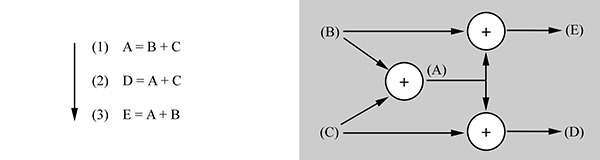
This paper describes an experiment on the design of dataflow. It suits well with some aspects of designing as a “curiosity-driven production of new knowledge” [after Nowotny 2011]. We might predict that future tools (such as programming languages) will continue to re-orient design; while design will continue to re-create tools.
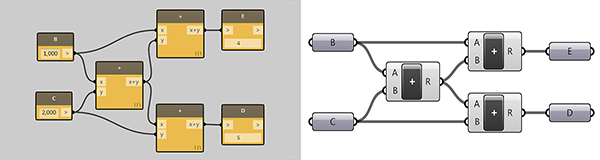
This is why design education should remain experimented, discussed, and kept updated by academia. We should consider these chaotic in the sense that they are likely occurrences of infinite possibilities. Therefore, all individual feedbacks presented here are not subject to generalization. One pedagogical pattern could produce multiple design exercises, while one exercise could match multiple patterns. One of the most significant consequences (or risks, or potentials) of a data-driven design idea is the reduction (or redefinition) of design into data, and the design process into a “flow of data”.
Cite this post
Related Posts
Data Structures in Grasshopper
June 8, 2023
Data structures and data matching principles are important to be able to design with Grasshopper. In this tutorial, I show data matching procedures with arithmetic operations. Then I repeat them in the production of geometric objects. I think it should be easier to use this programming language once the students understand the basic principles. Therefore it would be easier to design with it. Sometimes the design process of these diagrams proceeds from left to right (by induction) but sometimes it…
Rhino+Gh: Grasshopper for Beginners (7)
February 2, 2023
We continue with the Grasshopper for Beginners series by explaining Rhino+Gh workflow principles. What does GH add to Rhino‘s standard drawing and modeling functions? To put the question differently, what does GH do that conventional modeling programs, such as Rhino, can’t? What is the difference and relationship between Rhino+Gh? Let’s take an example to answer these questions. Our example is about parametrically describing a surface model and deriving its alternatives. First, we will try to create a surface using only…
Hello World! Grasshopper for Beginners (6)
January 17, 2023Let’s continue the Grasshopper for Beginners series. We start with the traditional “Hello World!” displayed on the Rhino screen: Placing the Components In most CAD programs, the text creation function, which is the equivalent of the Text command, is performed by a component called Text Tag (Tag) in GH. The Text Tag (Tag) component is in the Dimension panel under the Display tab. If you’re not comfortable with tabs and panels yet, you can revisit this section from the beginning….
Design Exercise of Dataflow Diagrams
January 24, 2019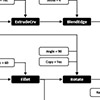
Here is a design exercise I’ve been giving to students. It aims to familiarize students with the concept of dataflow diagrams used in Grasshopper. Dataflow is a different concept than conventional computer programming. Here is a good comparison between control flow and dataflow languages. In most educational settings (such as courses and workshops) we concentrate on the fundamental issue of dataflow management via design projects. This requires us to think about a design exercise of dataflow diagrams. In the most…
ARCH362 Midterm
March 27, 2015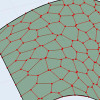
About to finish the well-defined section of this year’s Parametric Modeling course, here are the mid-term questions I’ve asked; First question checks if the curve < > point conversions are well understood in Grasshopper. Evaluating a parametric curve and generating the closest point from another curve. This also requires a basic understanding of the use of the Grasshopper interface. The second question was testing a basic and classical use of attractors on grids of objects. Students generated their own grids…