
Why is the Hilbert Curve Beautiful?
The Hilbert Curve is one of the results of David Hilbert’s vision of mathematics as a network of symbolic systems. Defined in 1891, this curve is a fractal that fills a two-dimensional plane with a one-dimensional line in the limit. It exhibits self-similarity. It emerged from representing higher-dimensional spaces through continuous, lower-dimensional entities. A curve that grows within a bounded area remains continuous but non-differentiable. Yet it possesses infinite length. Perhaps no one will ever truly see or fully grasp it. Yet it carries the potential to fill a higher-dimensional space through infinite iteration. It is one of the most elegant way of Hilbert’s belief in the power of axiomatic structures.
Using Grasshopper Python, I created a script that generates L-systems with letters and symbols, one that represents the Hilbert Curve here in this post. But is this code the Hilbert Curve?
The script outputs coordinates that Rhino can process. But is that geometric data the Hilbert Curve?
To Hilbert, mathematics was a symbolic construction of human thought. His contemporary, Gottlob Frege, held a different view. Frege, one of the founding figures of the analytic tradition in philosophy, regarded the world and mathematics as within the realm of logic. For him, mathematics was a branch of logic. He searched for the foundations behind everything that could be deemed true. This is the mode of thought I always feel close to Frege. Searching for a deeper truth. Just one year after Hilbert introduced his curve, in 1892, Frege published the famous On Sense and Reference. This text offered a powerful tool for understanding meaning and language as part of his project to reconstruct mathematics through logic. It also planted the early seeds of the “linguistic turn”. This turn would probably reach one of its peaks with Wittgenstein, who is another very intuitive person for me.
The fractal drawing appears on the screen through computed data. So, does that count as the Hilbert Curve?
In the next step, I tried to 3D print an infill with a robot-controller extruder. I developed a Grasshopper script that generated a KRL file to be read by a robot within a predefined setup. Are these codes and robot instructions the Hilbert Curve?
According to Frege, a word’s meaning has two layers. The sense is how the word appears within a particular context. The various things we might refer to when we say “Hilbert Curve”: the code, the image on screen, the CAD file, the KRL file.
Finally, the KRL code moved the robot and printed the curve onto a platform. Is that printed object the Hilbert Curve?
According to Frege, reference is the entity to which we anchor senses. In this case, what underlies all these representations is the mathematical idea in Hilbert’s mind. I think this is why Frege is thought to be a pseudo-Platonic. There is a conceptual essence of infinity through formalism that appears in many different senses. For me, it was interesting to see Hilbert’s mind through the lens of Frege’s method.
Cite this post
Related Posts
Syntax, Meaning, and Wasp
August 24, 2026
The question of how form emerges in architecture has always been one of the most fundamental debate topics of computational design. When I was a graduate student, we used to examine how abstract language structures made of words and rules turned into spatial and geometric systems. In this post, starting from the reflection of linguistic theories on architecture, we will talk about the logic of discrete aggregation that we study in the first year Design Computing courses. At the same…
A Programmable World
October 1, 2026
The mandatory course Readings on Digital Culture in the Graduate Program in Architectural Design at Istanbul Bilgi University began with the introductory chapter of Charlie Gere’s Digital Culture. We will write a response paper every week. I have completed my response to the first reading. The reading begins with the parallel development of the Industrial Revolution and capitalism. It then follows this history up to the emergence of today’s computers. It looks at how money gradually became a more abstract…
Geography of the Unsayable
August 30, 2026
Everything starts with an image in the mind, with a cinematic dream: the great white cliffs at the end of the movie, “Atonement”. While the waves are hitting the shore, that reunion that can never happen. But the moment we take our first step, that abstract feeling of Ludwig’s hard reality smacks us: “The world is everything that is the case; it is the totality of facts, not of things.” The exact departure times on the station boards, the numbers…
Hilbert Curve
January 16, 2024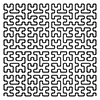
The Hilbert Curve, also referred to as the Hilbert space-filling curve, was initially introduced by the German mathematician David Hilbert in 1891. It is a continuous fractal curve, presenting a variation of the space-filling Peano curves uncovered by Giuseppe Peano in 1890. After a study on the mathematical background of this curve, I implemented a Python code into Grasshopper Python. However, I wanted to explore more variations by playing with the algorithm. This is why, the resulting Grasshopper definition can…
Aesthetics of Rhombic Polyhedra
October 12, 2026
The more I work with and study polyhedra, the more I realize how rare and special they are. They represent both the abstract and universal rules of geometry and space. I can understand their symmetries, faces, vertices, and most importantly, their mathematical necessities. Yet, when looking at a solid, sometimes a specific form strikes me as more attractive than the others. Moreover, I cannot explain this simply by saying, “It has more symmetry” or “Its proportions are better.” For me,…