
Butterfly Curve
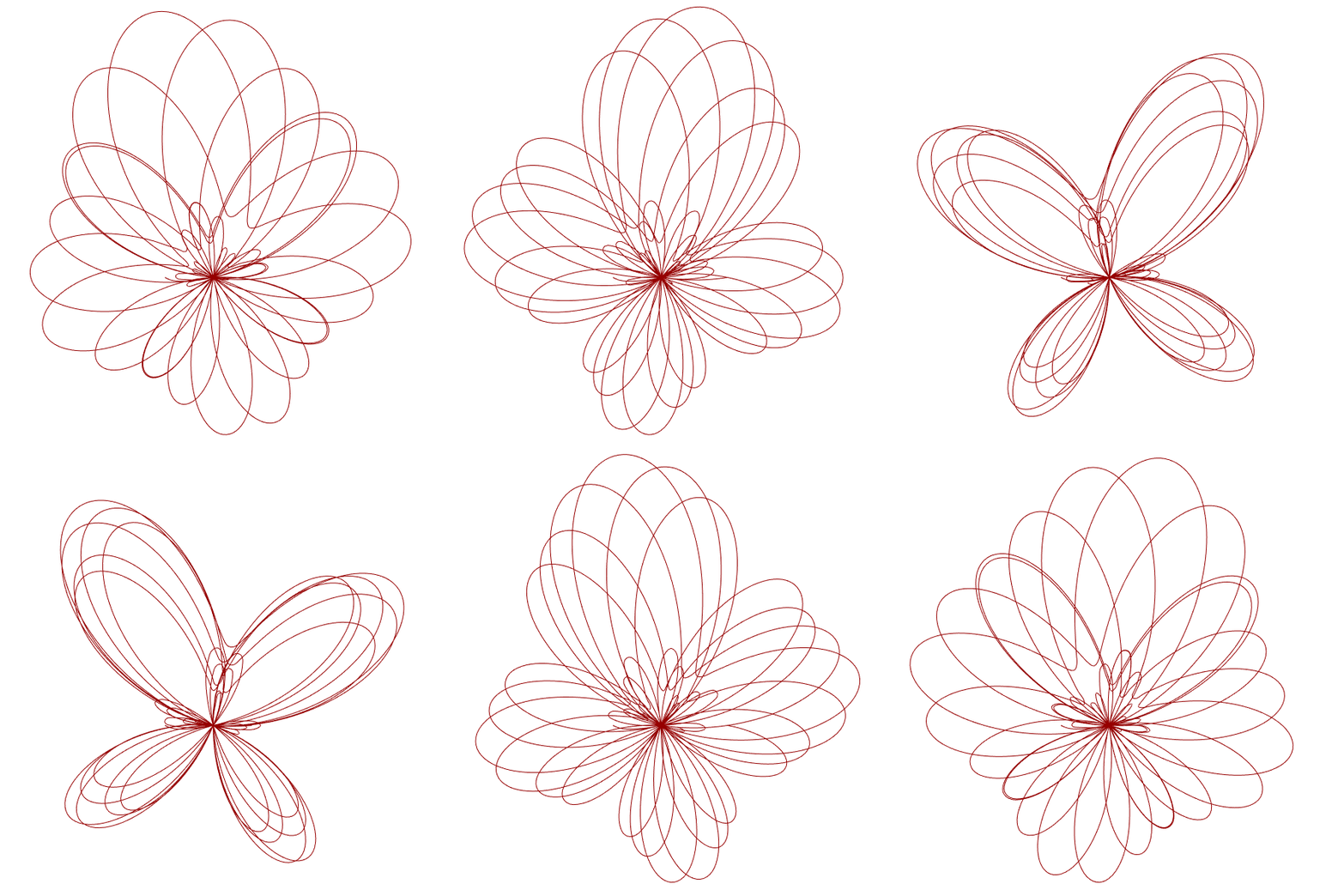
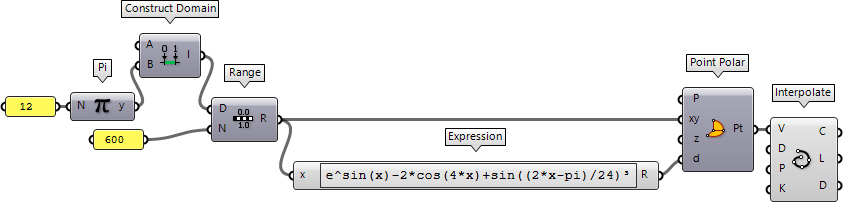
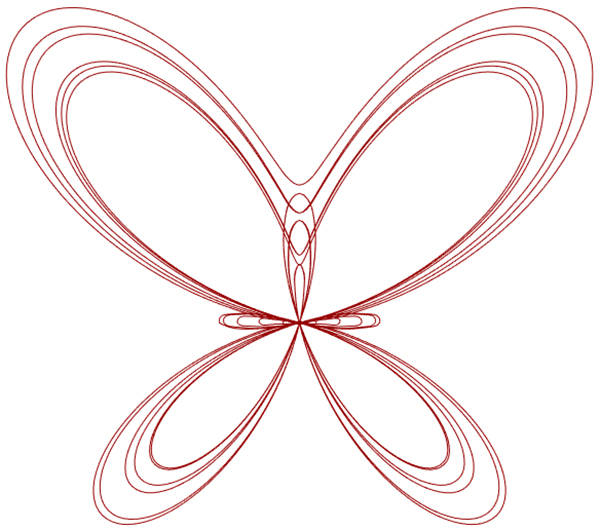
The Butterfly Curve is a special planar curve consisting of elegant functions, first described in 1989 by the American mathematician Temple H. Fay in Mathematics Magazine. Its polar-coordinate form is commonly used, though it can also be defined by two parametric functions in Cartesian coordinates.

In Praise of Useless Things
The Butterfly Curve has no functional role or practical application in modern technology or theory (it is frequently confused with the Lorenz Attractor, to which it is totally unrelated). It serves as an example used when explaining polar coordinate systems and demonstrating how they work in tandem with trigonometric functions. A resemblance created entirely by the human mind. What use is this to us? Honestly, I do not think it looks much like a butterfly (anyway). The mathematician who drew it is also the designer of the Chrysanthemum Curve. Paul Bourke’s codes over here constitute a typical example of them. Fay’s butterfly article begins with some expressions regarding aesthetics. What caught my attention while examining this curve was encountering the term “transcendental” curve.
Transcendental functions
Wikipedia says:
In mathematics, a transcendental function is an analytic function that does not satisfy a polynomial equation whose coefficients are functions of the independent variable that can be written using only the basic operations of addition, subtraction, multiplication, and division (without the need of taking limits). This is in contrast to an algebraic function.
What is meant here is a type of function different from polynomials, which can be written using the operations of classical ordinary algebra (the four basic operations, finite powers, root extraction, etc.). Transcendental functions cannot be expressed solely through algebraic operations and involve limits, infinite series, exponential growth, etc. The literal meaning of “transcend” is to “go beyond or surpass”. Our butterfly features Euler’s number, and its trigonometric functions oscillate infinitely. While algebraic functions generally draw basic and static curves, transcendental curves tend to produce more lively, harder-to-predict, organic forms.
What the Kant?
The word transcendental goes, of course, beyond curves and polynomials. From here, we transition to the transcendental concept in philosophy, which shares a common root meaning. (I have even started wondering if I have ADHD, given how I jump from topic to topic.) It stems from the Latin verb transcendere (to go beyond). It is used to mean going beyond ordinary or simple rules. Further, allowing my ADHD to run free, I would like to touch on the lessons from Immanuel Kant that I am still trying to grasp. According to Kant, our mind has templates such as space, time, and causality. We perceive the external world through these. Kant named the mental domain that outlines the limits of knowledge, stating that “Objects conform to the rules of our mind (time and space) as transcendental. It is the foundational structure “behind/beyond” simple perception and the empirical world. In his (reverse) Copernican revolution, he places human beings at the center and positions objects and phenomena around them.
Therefore, this meaningless function is self-evident and serves no practical purpose whatsoever. Yet, when plotted on paper, what appears in our mind resembles a butterfly figure. In reality, no such butterfly exists there. A butterfly costume is draped by our mind over the path (phenomenon) traversed by a parametric function over time.
References
Temple H. Fay, “The Butterfly Curve” American Mathematical Monthly 96, No. 5, May 1989.
Temple H. Fay, “A Study in Step Size” Mathematics Magazine 70, No 2, April 1997
Cite this post
Related Posts
Catenary Dome without Kangaroo
August 13, 2026
When thinking about serious and specific topics, I suddenly find myself looking back at the basics again. Catenary curves, are not the most beautiful one among those mathematical forms found in nature. However, it still tells us a lot about structures. The name apparently comes from catenaria, the Latin word for “chain”. This Grasshopper code was actually an example from our book 10 years ago (link here). It seems catenary curves could potentially be used in a type of dome…
Discrete Fourier Transform
May 8, 2025
The Fourier Transform is a powerful mathematical technique that allows us to analyze the different frequency components within a signal or shape. Its discrete version, the Discrete Fourier Transform (DFT), is used when working with numerical data. I studied the Fourier Series here before. One of the most fascinating aspects of the DFT is that it can represent a signal or shape using rotating circles (or vectors). Each circle corresponds to a specific frequency, amplitude, and phase. When connected in…
Lissajous Pendants
February 9, 2024
Lissajous curves, named after the French physicist Jules Antoine Lissajous are a family of curves that emerge from the interaction between two harmonic oscillations. They have applications in various fields including physics, engineering, and signal processing. They are commonly used in electronic devices such as oscilloscopes to visualize the phase relationship between two oscillating signals. Similarly, they are also useful in mechanical engineering for analyzing and designing mechanisms that involve harmonic motion. Lissajous curve functions can help in understanding the…
B-Spline Construction
January 25, 2024
I have been studying the Bezier-De Casteljau algorithm for several years. Last week, I finally managed to understand and implement B-Spline Construction in Rhino and Grasshopper Python code, using the Cox-De Boor algorithm. This algorithm calculates the effect of control points on a B-Spline with many control points. After this, I am not limited to the degree+1 control points. This animation shows both algorithms working together. This Rhino Python code in a Grasshopper definition can handle three tasks. The first…
Cycloid Experiment
May 9, 2014
This is a Cycloid-like family of curves, generated by its classical description: a rolling circle. I had several other studies on similar topics before. In this cycloid experiment, I used Grasshopper in which, we don’t need to roll the circle. Instead, we can divide a parametric curve, utilizing data lists to simply rotate a circle around it. Finally, evaluating the circle repeatedly creates a Cycloid-like result. I found this as the most simplistic way of showing and studying these special…