
Lissajous Pendants
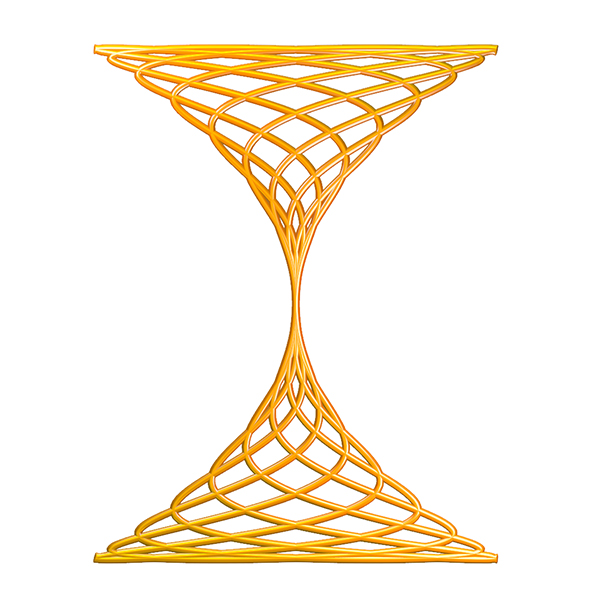
Lissajous curves, named after the French physicist Jules Antoine Lissajous are a family of curves that emerge from the interaction between two harmonic oscillations. They have applications in various fields including physics, engineering, and signal processing. They are commonly used in electronic devices such as oscilloscopes to visualize the phase relationship between two oscillating signals. Similarly, they are also useful in mechanical engineering for analyzing and designing mechanisms that involve harmonic motion. Lissajous curve functions can help in understanding the behavior of vibrating systems, such as pendulums, springs, and rotating machinery. Beyond their technical applications, Lissajous curves are easy to code and incorporate into various art forms and designs. I tried to implement a Lissajous Pendants design by utilizing and deforming the original curve function. This code can generate many different and interesting variations. You can see one of them in this animation.

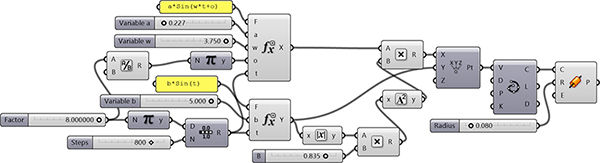
This Grasshopper definition generates Lissajous curves and their improvizations with several input parameters. The f(t) and g(t) functions, density, parameter, and all variables of a standard Lissajous curve are the user-controlled inputs. You can generate original Lissajous curves and several deformed variations of them by playing with the inputs. The outputs are polysurfaces (pipe objects) and the NURBS curve. Therefore, it is possible to 3d print the output. I made the definition with the help of the native Grasshopper components in Rhinoceros 7. So, you don’t need to install any add-on to be able to use the definition.
Cite this post
Related Posts
Graph of Parametric Functions
April 6, 2018
This RhinoPython script handles the simple graphs of two-dimensional parametric functions. Therefore, it approximates these functions by drawing parametric curves. It generates many points by solving the functions. The graph of parametric functions is a major topic in most Design Mathematics courses. Because it looks like the building block of many concepts of CAD. However, there is much more to learn before saying that the third degree NURBS is a degree-3 polynomial function. I am curious about learning the underlying…
Catenary Dome without Kangaroo
August 13, 2026
When thinking about serious and specific topics, I suddenly find myself looking back at the basics again. Catenary curves, are not the most beautiful one among those mathematical forms found in nature. However, it still tells us a lot about structures. The name apparently comes from catenaria, the Latin word for “chain”. This Grasshopper code was actually an example from our book 10 years ago (link here). It seems catenary curves could potentially be used in a type of dome…
Discrete Fourier Transform
May 8, 2025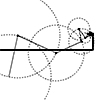
The Fourier Transform is a powerful mathematical technique that allows us to analyze the different frequency components within a signal or shape. Its discrete version, the Discrete Fourier Transform (DFT), is used when working with numerical data. I studied the Fourier Series here before. One of the most fascinating aspects of the DFT is that it can represent a signal or shape using rotating circles (or vectors). Each circle corresponds to a specific frequency, amplitude, and phase. When connected in…
B-Spline Construction
January 25, 2024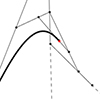
I have been studying the Bezier-De Casteljau algorithm for several years. Last week, I finally managed to understand and implement B-Spline Construction in Rhino and Grasshopper Python code, using the Cox-De Boor algorithm. This algorithm calculates the effect of control points on a B-Spline with many control points. After this, I am not limited to the degree+1 control points. This animation shows both algorithms working together. This Rhino Python code in a Grasshopper definition can handle three tasks. The first…
Cycloid Experiment
May 9, 2014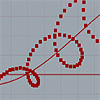
This is a Cycloid-like family of curves, generated by its classical description: a rolling circle. I had several other studies on similar topics before. In this cycloid experiment, I used Grasshopper in which, we don’t need to roll the circle. Instead, we can divide a parametric curve, utilizing data lists to simply rotate a circle around it. Finally, evaluating the circle repeatedly creates a Cycloid-like result. I found this as the most simplistic way of showing and studying these special…