
Circle Crossing
I am learning Grasshopper. In this Circle Crossing definition, I tried to create the above pattern (also described in Sunflower Spiral) as simply as possible, this definition creates not only spirals but is also capable of more tessellations I guess. Maybe a three-dimensional equivalent might be studied in the future. As you can see from the definition, I started with a large circle. Then, I divided it into segments and placed new circles centered on them. Finally, I divide the secondary circles and connect them with a Polyline. It is a good starting exercise to produce something and learn some of the basic components of Grasshopper.
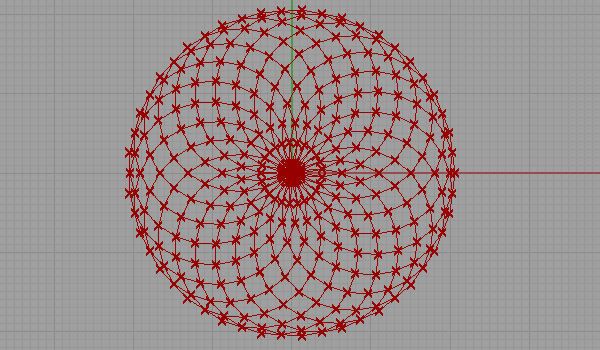

The aspects of things that are most important for us are hidden because of their simplicity and familiarity. (One is unable to notice something because it is always before one’s eyes.) The real foundations of his inquiry do not strike a man at all.
Ludwig Wittgenstein (1958, PI.)
What I have been learning so far, and in the Circle Crossing, is so basic and simple. I will continue to combine the components of Grasshopper to develop new working machines. It is probably not about design and architecture in a broader sense. I guess it is about the comprehension of life, by thinking and producing. I hope that I will produce more for myself and for everyone else around me. Probably this is the reason I chose to be a teacher. What I want is to leave something after I pass away.
Cite this post
Related Posts
Attractor Basics
June 29, 2023
In this short tutorial, I want to give Grasshopper beginners the basics of how we create attractor systems. The Grasshopper definition you see in the below figure is the equivalent of array-type copying operations in CAD. However, unlike in CAD programs, here we are dealing with multiple generations of objects rather than transformations. Attractor Basics: Data Matching In the application you see in the figure below, each row of the hexagonal grid created with HexGrid has a different radius value….
Discrete Fourier Transform
May 8, 2025
The Fourier Transform is a powerful mathematical technique that allows us to analyze the different frequency components within a signal or shape. Its discrete version, the Discrete Fourier Transform (DFT), is used when working with numerical data. I studied the Fourier Series here before. One of the most fascinating aspects of the DFT is that it can represent a signal or shape using rotating circles (or vectors). Each circle corresponds to a specific frequency, amplitude, and phase. When connected in…
Conformal Circle Packing
September 19, 2012
After a couple of days of studying the mysterious Doyle spiral, I’ve decided to test an approach of circle packing from conformal mapping. First, I tried to understand the Poincare disk (earlier at here, here, and here and here). I used it as the hyperbolic representation of space on a two-dimensional plane. Then, I linked a regular hexagonal grid and rebuilt it after the hyperbolic distortion. This led me to find the below hexagonal grid. Therefore, it looks like a suitable…
Circle Packing Experiments
October 3, 2012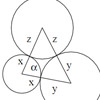
Since last week, I’m very curious about circle packing. There are a couple of complete solutions on the internet. I’m still in the early steps of such a solution yet. A full circle packing means that it does not include any gaps and each circle is tangent to all possible neighbors. Sounds easy in Grasshopper but I couldn’t see any solution yet. There are some circle-packing attempts but they have gaps. Also, I don’t want to use an evolutionary solver…
Fermat’s Nightmare
October 14, 2026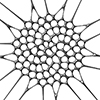
Revisiting a specific mathematical phenomenon that I previously explored twice, here (in 2017) and here (in 2011), from a different angle in 2026 now. This was the final video (from 2023) that I found in my junk folder during the blog’s resurrection. Today, designers mostly know Fermat through the famous 137.5-degree angle of rotation, which is the mathematical formula used to describe the arrangement of sunflower seeds. However, today I will speculate on a nightmare of Fermat’s. Because Fermat, in…