
Sunflower Spiral
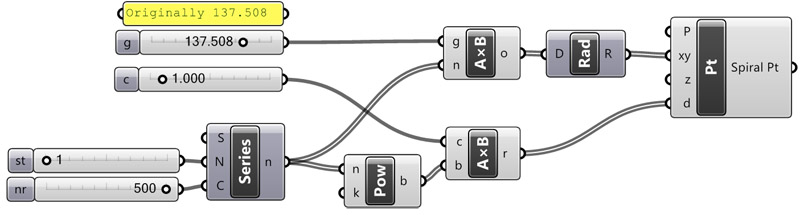
Sunflower Spiral (or Phyllotaxis) can be constructed in Grasshopper according to Vogel’s model of parametric relationships. This model uses polar coordinates. The Grasshopper file is still working after more than 11 years -15.12.2022. This is such a powerful quality of Grasshopper, I think.
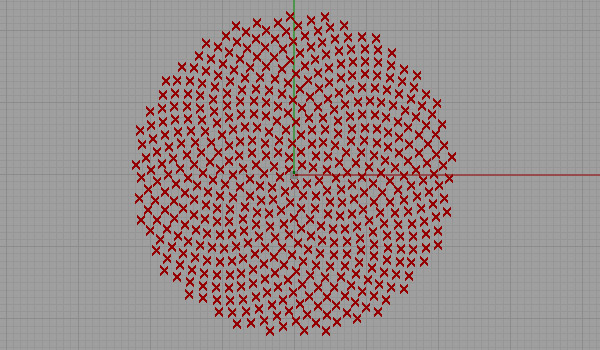
It’s a good example of utilizing polar coordinates. It’s also fun to play with the parameters and constraints of the Sunflower Spiral. Also, there are very interesting results if you also connect the polar angle value to the “z” of the point component.
According to Science.org:
Mathematical biologists love sunflowers. The giant flowers are one of the most obvious—as well as the prettiest—demonstrations of a hidden mathematical rule shaping the patterns of life: the Fibonacci sequence, a set in which each number is the sum of the previous two (1, 1, 2, 3, 5, 8, 13, 21, 34, 55, 89, 144, 233, 377, 610, …), found in everything from pineapples to pine cones. In this case, the telltale sign is the number of different seed spirals on the sunflower’s face.
Count the clockwise and counterclockwise spirals that reach the outer edge, and you’ll usually find a pair of numbers from the sequence: 34 and 55, or 55 and 89, or—with very large sunflowers—89 and 144. Although the math may be beautiful, plant biologists have not worked out a mechanistic model. Thus, this fully explains how the sunflower seed patterns arise. The problem is that plants don’t always show perfect Fibonacci numbers.
Cite this post
Related Posts
Fermat’s Spiral with Rhino Python
July 30, 2017
As studied earlier in Grasshopper here, the sunflower spiral, or Phyllotaxis, or Fermat‘s spiral, could be drawn as an exercise in looping in Rhino Python. Phyllotaxis is the arrangement or patterning of leaves, flowers, or other plant parts around a stem or axis. Thus, it refers to the specific geometric arrangement of these structures in plants. The term “phyllotaxis” comes from the Greek words “phyllon” (meaning “leaf”) and “taxis” (meaning “arrangement” or “order”). Phyllotaxis can vary widely among plant species…
Fermat’s Nightmare
October 14, 2026
Revisiting a specific mathematical phenomenon that I previously explored twice, here (in 2017) and here (in 2011), from a different angle in 2026 now. This was the final video (from 2023) that I found in my junk folder during the blog’s resurrection. Today, designers mostly know Fermat through the famous 137.5-degree angle of rotation, which is the mathematical formula used to describe the arrangement of sunflower seeds. However, today I will speculate on a nightmare of Fermat’s. Because Fermat, in…
Fibonacci Portraits
December 27, 2023
“In the heart of a sunflower’s embrace, its seeds weave a poetic tale—a dance of two spirals, parastichies they’re called. One unfurls gracefully from the center in the hush of clockwise whispers, while its counterpart whispers secrets in the tender breaths of counterclockwise motion. A subtle ballet unfolds, where the number of these spirals gracefully mirrors the whispers of adjacent Fibonacci numbers, composing a delicate symphony in the sun-kissed fields.” says ChatGPT if I force it to be a little…
Fibonacci Dome
March 1, 2024
This is the continuation of my previous study on the Fibonacci lattice on a spherical surface, creating a Fibonacci Dome structure. The panelization of curved forms with flat surfaces has been a favorite topic in architectural geometry. The trigonometric layout of the Fibonacci sequence generates a spherical formation, while the Faceted Dome component handles planarity. Here, I further enhanced the previous code into a pavilion design. The essential part of the code is about the placement of points on the half…
Fibonacci Sphere
April 12, 2023
This website explains the problem and several solutions. I managed to implement the formulas to convert a 2D square grid into spherical coordinates. The Fibonacci Sphere is one of the solutions to the equal distribution of points on a sphere. It is not the best solution to this problem. But it is regarded as a quick and efficient one. Suitable for me. I developed this Grasshopper code by studying the above website and some other sources. The code starts with…