
Fibonacci Portraits
“In the heart of a sunflower’s embrace, its seeds weave a poetic tale—a dance of two spirals, parastichies they’re called. One unfurls gracefully from the center in the hush of clockwise whispers, while its counterpart whispers secrets in the tender breaths of counterclockwise motion. A subtle ballet unfolds, where the number of these spirals gracefully mirrors the whispers of adjacent Fibonacci numbers, composing a delicate symphony in the sun-kissed fields.” says ChatGPT if I force it to be a little poetic. I made a simple tool, Fibonacci Portraits to generate Sunflower Spirals with an output that gets data from any image. You can use it to create artwork if you choose the image carefully. It is a basic programming exercise for Grasshopper.
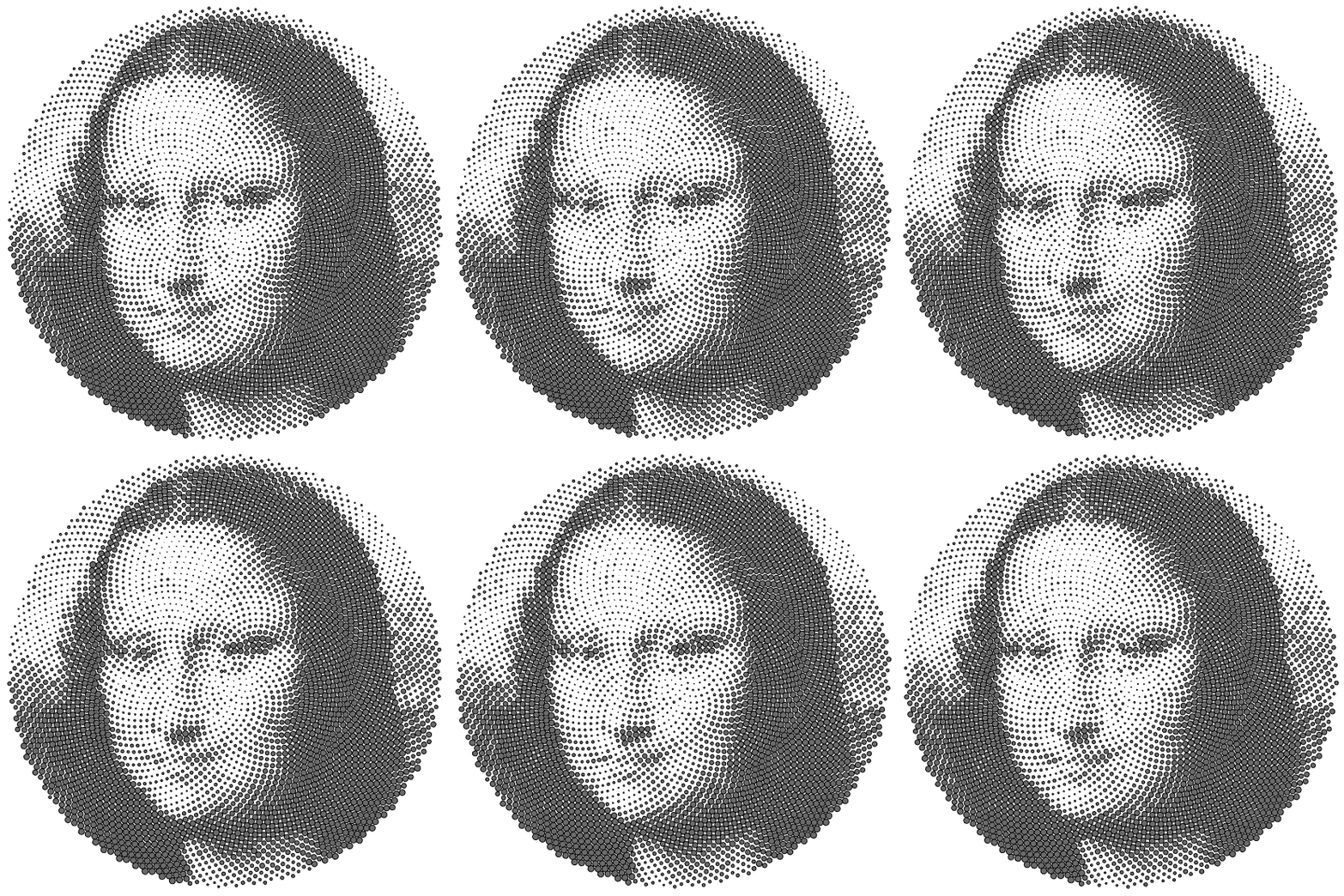
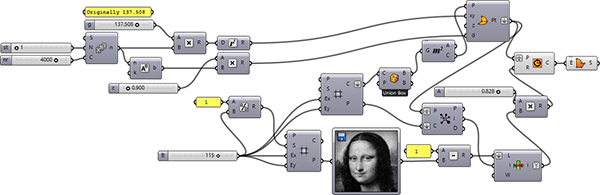
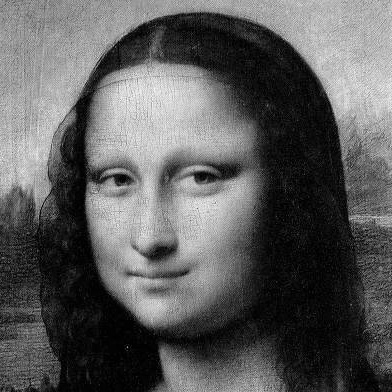
This Grasshopper definition generates Fibonacci Spirals with variable radii circles, resembling an input photo. The input parameters are the size of the spiral and the photo. Thus, it is possible to re-generate the classical spiral (the Sunflower Spiral) and explore new designs (with the help of the Image Sampler component). The result is a set of circles. Therefore, it is ready for laser cutting or CNC milling. I made the definition with the help of the native Grasshopper components in Rhinoceros 7. So, no external add-on is necessary.
Cite this post
Related Posts
Fermat’s Nightmare
October 14, 2026
Revisiting a specific mathematical phenomenon that I previously explored twice, here (in 2017) and here (in 2011), from a different angle in 2026 now. This was the final video (from 2023) that I found in my junk folder during the blog’s resurrection. Today, designers mostly know Fermat through the famous 137.5-degree angle of rotation, which is the mathematical formula used to describe the arrangement of sunflower seeds. However, today I will speculate on a nightmare of Fermat’s. Because Fermat, in…
Fermat’s Spiral with Rhino Python
July 30, 2017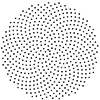
As studied earlier in Grasshopper here, the sunflower spiral, or Phyllotaxis, or Fermat‘s spiral, could be drawn as an exercise in looping in Rhino Python. Phyllotaxis is the arrangement or patterning of leaves, flowers, or other plant parts around a stem or axis. Thus, it refers to the specific geometric arrangement of these structures in plants. The term “phyllotaxis” comes from the Greek words “phyllon” (meaning “leaf”) and “taxis” (meaning “arrangement” or “order”). Phyllotaxis can vary widely among plant species…
Sunflower Spiral
December 22, 2011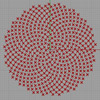
Sunflower Spiral (or Phyllotaxis) can be constructed in Grasshopper according to Vogel’s model of parametric relationships. This model uses polar coordinates. The Grasshopper file is still working after more than 11 years -15.12.2022. This is such a powerful quality of Grasshopper, I think. It’s a good example of utilizing polar coordinates. It’s also fun to play with the parameters and constraints of the Sunflower Spiral. Also, there are very interesting results if you also connect the polar angle value to…
Subdivide by Image Contrast
October 17, 2012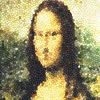
This was my old plan to work with images in Grasshopper. Certainly, that was not the result I expected, but this could be counted as a starting point. After seeing beautiful circle packing compositions here, I decided to program Grasshopper, so that it’ll create a subdivision, based on image data. This was the initial version, just subdividing a plane with Voronoi points and visualizing it according to the image’s color values of proper UV coordinates. There is no interpretation on…
String Art in Rhino Python
June 19, 2025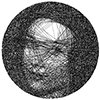
String art is a cool art technique that combines geometry and aesthetics to recreate images using lines between pins. Here is a good reference to start studying it. In this post, I explored a custom Rhino Python script designed for Rhinoceros 7 and 8. It transforms a grayscale image into a dense web of threads. The algorithm analyzes the darkest areas of the image and connects pins in a circular layout to form compositions. The script begins by converting a…