
Fermat’s Nightmare
Revisiting a specific mathematical phenomenon that I previously explored twice, here (in 2017) and here (in 2011), from a different angle in 2026 now. This was the final video (from 2023) that I found in my junk folder during the blog’s resurrection.
Today, designers mostly know Fermat through the famous 137.5-degree angle of rotation, which is the mathematical formula used to describe the arrangement of sunflower seeds. However, today I will speculate on a nightmare of Fermat’s. Because Fermat, in truth, never cared about sunflowers at all.
The Prince of Amateur Mathematicians
Pierre de Fermat was a French amateur mathematician who studied number theory. While geometry deals with shapes and algebra with unknowns, number theory deals directly with “numbers themselves” (notably prime numbers, divisibility, squares, and the like). Though it often seems to have no practical purpose, its traces can be found in many of today’s technologies. Aside from number theory, Fermat was also deeply interested in analytic geometry. Around the same time as Descartes (actually even slightly before him), he independently realized that equations could be expressed visually by applying a coordinate system to geometry.
In 1636, during his studies of analytic geometry, Fermat examined a special curve defined by an equation he had developed. Although this curve resembles an Archimedean spiral, it grows at a parabolic rate outward from the center. For this reason, mathematicians named this class of curves the “Fermat Spiral” in his honor. Back then, just like Descartes, he was busy translating geometric shapes into algebraic equations and studying their tangents, areas, and properties. The algebraic curve that Fermat examined on paper was found to coincide with phyllotaxis (leaf arrangement) systems in nature, much later. Particularly in the 1970s, mathematician Helmut Vogel studied plant growth models.
In summary, Fermat’s work had nothing to do with sunflowers or any other natural phenomena. After all his deep dedication to the world of numbers, what do you think he would have thought if he had seen someone stamping his name onto a sunflower centuries later?
The Speculation
If we were to tell Fermat today that flowers, organic forms, or digital design codes have his name and are shaped by his equation, he likely would have been surprised a lot. Fermat’s approach to mathematics was theoretical and abstract. He was concerned with the structures of numbers and abstract geometric spaces. To him, mathematics did not have to be a copy of the physical world or a botanical catalog; it was the pure product of the mind. In the field of physics, Fermat is best known for the “Principle of Least Time” (Fermat’s Principle). He argued that nature does not possess a teleological (goal-oriented) and esoteric consciousness or knowledge, and that everything operates according to a mechanical order. Therefore, he would have kept his distance from approaches that treat plant growth or natural patterns with a mystical “golden ratio / secret of life” esotericism; instead, he would have looked at the phenomenon through rational determinism.
All of this is speculation. The only thing we know for certain, historically, is this: The man had zero interest in sunflowers and wrote the equation in question entirely for abstract geometry. So, how could this be a coincidence?
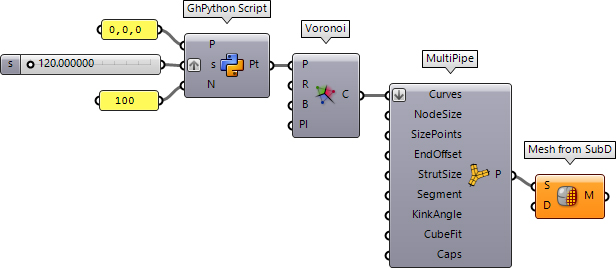
ghenv.Component.Params.Input[0].Description = "Center point"
ghenv.Component.Params.Input[1].Description = "Generation parameter"
ghenv.Component.Params.Input[2].Description = "Number of points"
ghenv.Component.Params.Output[0].Description = "Calculated points"
import rhinoscriptsyntax as rs
import math
Pt = []
for n in range(0,N):
	t = math.sqrt(n)
	g = n * s**0.8
	z = rs.Polar(P,g/1.2,t)
	Pt.append(z)
Pt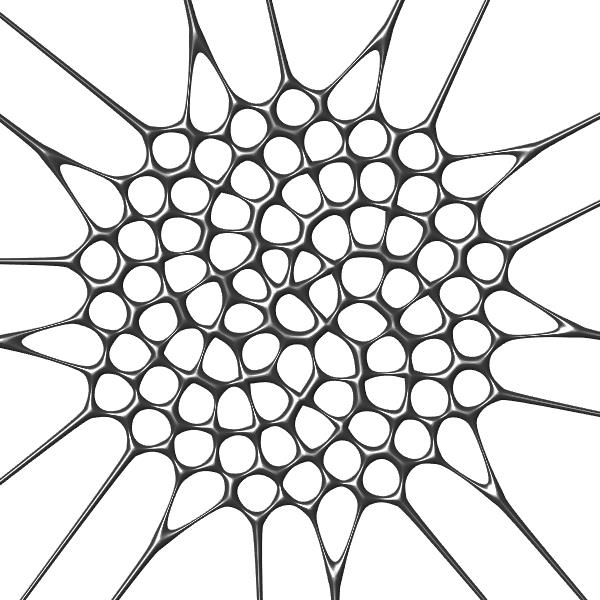
Cite this post
Related Posts
Fermat’s Spiral with Rhino Python
July 30, 2017
As studied earlier in Grasshopper here, the sunflower spiral, or Phyllotaxis, or Fermat‘s spiral, could be drawn as an exercise in looping in Rhino Python. Phyllotaxis is the arrangement or patterning of leaves, flowers, or other plant parts around a stem or axis. Thus, it refers to the specific geometric arrangement of these structures in plants. The term “phyllotaxis” comes from the Greek words “phyllon” (meaning “leaf”) and “taxis” (meaning “arrangement” or “order”). Phyllotaxis can vary widely among plant species…
Sunflower Spiral
December 22, 2011
Sunflower Spiral (or Phyllotaxis) can be constructed in Grasshopper according to Vogel’s model of parametric relationships. This model uses polar coordinates. The Grasshopper file is still working after more than 11 years -15.12.2022. This is such a powerful quality of Grasshopper, I think. It’s a good example of utilizing polar coordinates. It’s also fun to play with the parameters and constraints of the Sunflower Spiral. Also, there are very interesting results if you also connect the polar angle value to…
Fibonacci Portraits
December 27, 2023
“In the heart of a sunflower’s embrace, its seeds weave a poetic tale—a dance of two spirals, parastichies they’re called. One unfurls gracefully from the center in the hush of clockwise whispers, while its counterpart whispers secrets in the tender breaths of counterclockwise motion. A subtle ballet unfolds, where the number of these spirals gracefully mirrors the whispers of adjacent Fibonacci numbers, composing a delicate symphony in the sun-kissed fields.” says ChatGPT if I force it to be a little…
Spiral of Random
October 21, 2013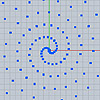
Grasshopper still surprises me. This definition draws a spiral by using a random component. It is obvious that the seed value of the random component has a relationship with an archimedean or a similar spiral. My intention was to create a definition to put a number of random points inside a circular area, not a rectangular one. While I grow the radius of a circle and get a t parameter evaluation from a random component using the same seed value…
Karyokinesis
November 2, 2013
While searching for a way to work with random points and growing populations, this idea appeared accidentally. I wasn’t trying to mimic the behavior of Karyokinesis of biological cells (in fact I’m in serious doubt about biomimicry in general). The trick is to use a timer + data recorder + a knob for the arbitrary user input. It starts to breed when you start the timer, but to change the evolution speed, just roll the knob! Of course, the knob…