
Spiral of Random
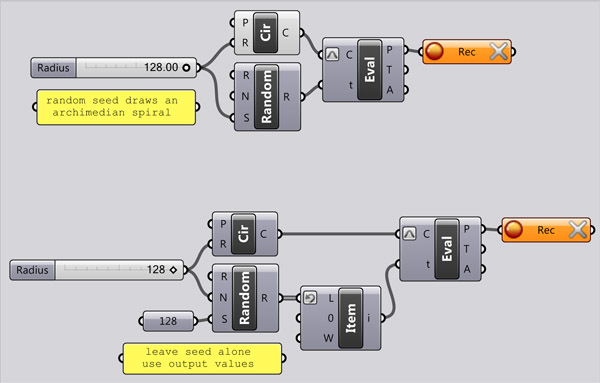
Grasshopper still surprises me. This definition draws a spiral by using a random component. It is obvious that the seed value of the random component has a relationship with an archimedean or a similar spiral. My intention was to create a definition to put a number of random points inside a circular area, not a rectangular one. While I grow the radius of a circle and get a t parameter evaluation from a random component using the same seed value with the radius, the resulting points started to create this spiral. It was interesting to see the (pseudo)random behavior of the component. Below you see the animation with seeds changing from 0 to 128 and getting the first random output.
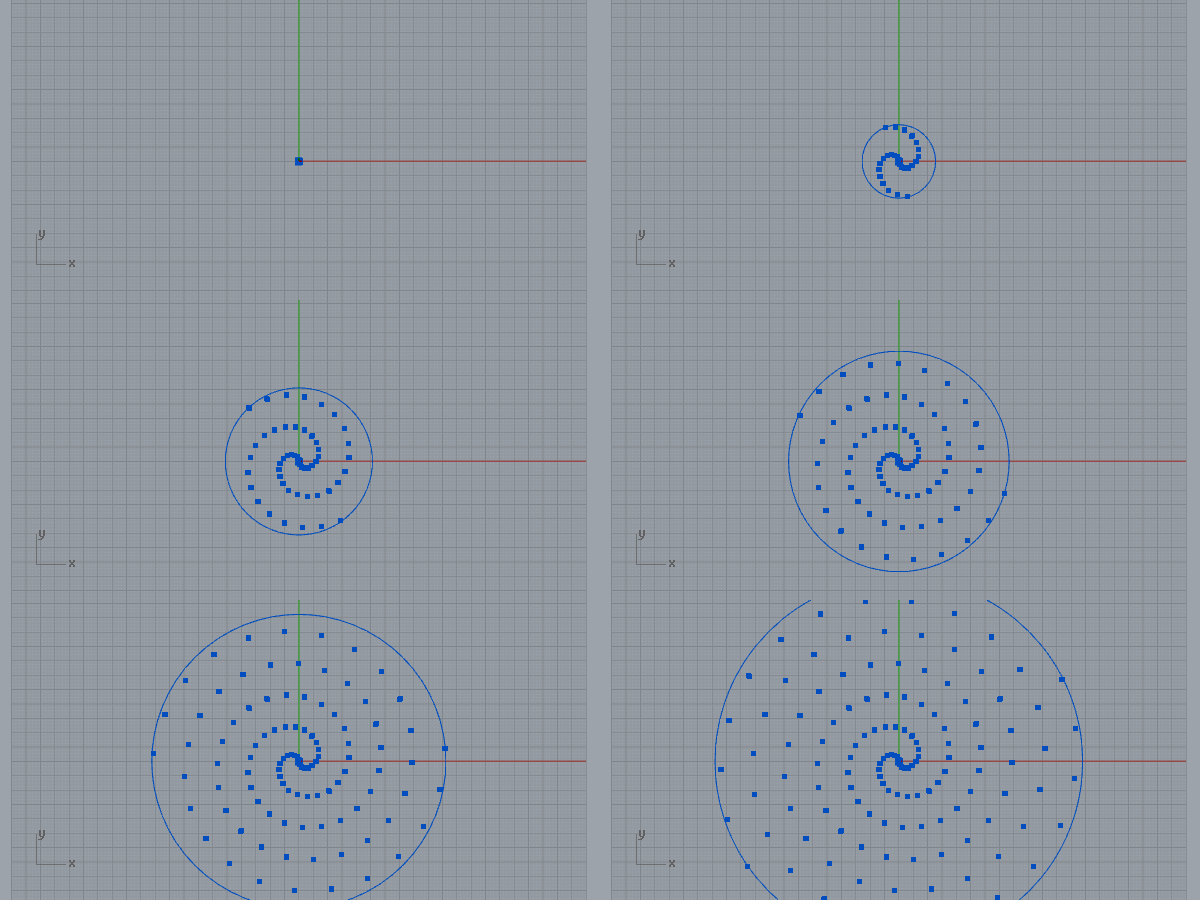
Within the same domain, below takes the second random value, and again another beautiful pattern emerges;
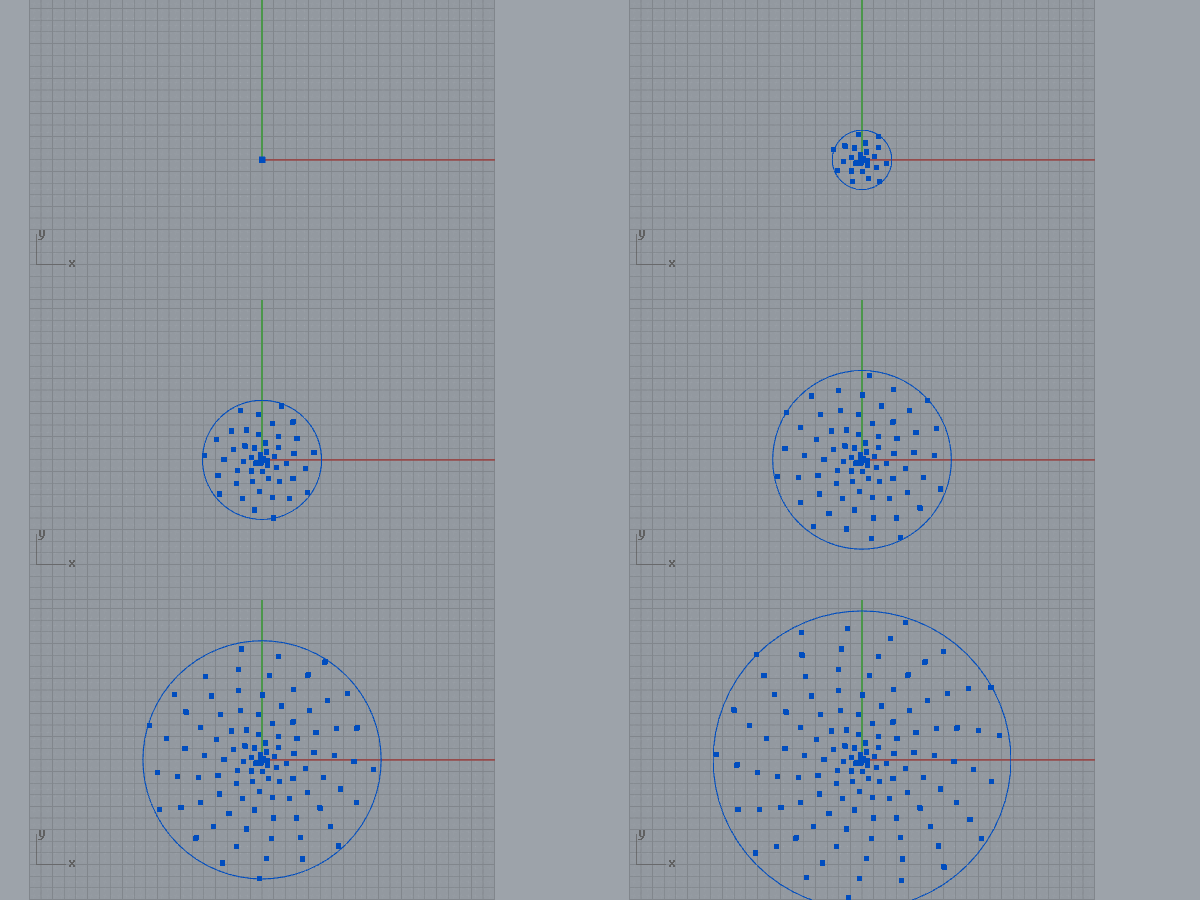
However, I solved my real problem by fixing the seed value. Again, the mistake became more significant than the problem.
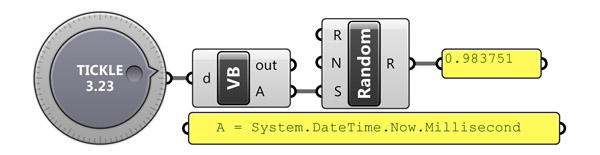
If you want a more “random-like” result, you may use the good old random methods of getting seed values from a physical input such as time. The calculation of milliseconds might be a good choice. Below is a definition that gets the seed value of a random component from the actual milliseconds of any action. This would cause better randomness if you like.Don’t worry about the algorithm tickler, its output value is useless, all I want is a manual timer execution so that the random values are always fired by the actual millisecond value exactly when you tickle the Grasshopper.
Cite this post
Related Posts
Regenerating Random Numbers
January 2, 2013
Just a quick tip as I thought might be useful in some cases. Generating random numbers in architectural scripting is not a too catchy thing for designers. It is for sure, we want every parameter to be under our control (as if it were possible!). I was thinking about that in Grasshopper. A dataflow graph such as in Grasshopper regenerates whenever necessary (a change on an input value “fires” every connected component), therefore random number component requires your action (for…
Fermat’s Nightmare
October 14, 2026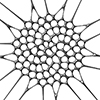
Revisiting a specific mathematical phenomenon that I previously explored twice, here (in 2017) and here (in 2011), from a different angle in 2026 now. This was the final video (from 2023) that I found in my junk folder during the blog’s resurrection. Today, designers mostly know Fermat through the famous 137.5-degree angle of rotation, which is the mathematical formula used to describe the arrangement of sunflower seeds. However, today I will speculate on a nightmare of Fermat’s. Because Fermat, in…
Fibonacci Portraits
December 27, 2023
“In the heart of a sunflower’s embrace, its seeds weave a poetic tale—a dance of two spirals, parastichies they’re called. One unfurls gracefully from the center in the hush of clockwise whispers, while its counterpart whispers secrets in the tender breaths of counterclockwise motion. A subtle ballet unfolds, where the number of these spirals gracefully mirrors the whispers of adjacent Fibonacci numbers, composing a delicate symphony in the sun-kissed fields.” says ChatGPT if I force it to be a little…
Spiral Staircase
April 17, 2023
This is a basic Grasshopper exercise, covering many fundamental topics. The aim is to create the parametric model of a spiral staircase. This is more educational than functional, I guess. Below is the explanation of the Grasshopper definition in three parts. Helix Points for the Spiral Staircase In the first part of the definition, I am defining the points ordered on a helix. First, I calculate the number of steps by dividing the total height value by the height of…
Tetrahedral Helix and Snake Game
January 2, 2015
This is the Grasshopper definition that generates a tetrahedral helix (also called as Boerdijk-Coxeter helix) but in a funny way. This geometry is also a solution for tangent spheres. I generated the helix using Anemone components for recursion and gave it a little bit of responsiveness. I don’t know if it depends on the speed of your CPU but if it is slow enough, you’ll see the snake game of tetrahedral helix as it is driven by your input from a…